
Liquor liability rules differ sharply from state to state. In New York, New Jersey, Vermont and Massachusetts, a bar or restaurant that over-serves a guest can be sued by the people that guest later injures. In Kansas, Virginia, Delaware and Maryland, courts have refused to create that kind of liability. Massachusetts, Michigan, South Carolina and Vermont go further and require licensees to prove they carry liquor liability coverage or equivalent financial responsibility.
This table summarizes the dram shop standard, any state insurance mandate, server-training rules and the main statute or court decision for every state where Provident Financial Group is licensed. It is written for restaurant, bar, brewery and caterer owners comparing coverage, and for anyone who needs a quick, sourced reference. Each state name links to our full guide for that state, which cites the underlying statutes and agency pages.
Liquor liability and dram shop laws by state (2026)
| State | Dram shop liability for licensees | Liquor liability insurance required by state law? | Server training | Key statute or case |
|---|---|---|---|---|
| Arizona | Yes, limited: licensees liable for serving an obviously intoxicated person or a minor without checking ID | None found in state law | Title 4 training required for owners and managers | A.R.S. §4-311, §4-312 |
| California | Very limited: sellers generally not liable; narrow exception for selling to an obviously intoxicated minor | None found statewide | Mandatory Responsible Beverage Service certification for servers and managers | Bus. & Prof. Code §25602; Civil Code §1714 |
| Connecticut | Yes: sale to an intoxicated person who then injures someone; damages capped by statute | None found in statute | Voluntary; DCP-approved programs | Conn. Gen. Stat. §30-102 |
| Delaware | No: courts recognize no cause of action against a tavern for off-premises injuries | None found | Mandatory server training, renewed every 2 years | McCall v. Villa Pizza (1994); 4 Del. C. ch. 12 |
| Florida | Very limited: only willful sales to minors or knowing service to a habitual drunkard | None found | Voluntary Responsible Vendor Program with license protections | Fla. Stat. §768.125; §561.701–.706 |
| Georgia | Limited: knowingly serving someone under 21, or someone noticeably intoxicated who will soon drive | None found statewide | No statewide mandate; set locally | O.C.G.A. §51-1-40 |
| Indiana | Limited: actual knowledge the person was visibly intoxicated | None found | Mandatory server training within 120 days, refresher every 3 years | IC 7.1-5-10-15.5 |
| Kansas | No dram shop statute; courts have declined to create vendor liability | Not required (a liquor drink tax bond applies to on-premise licensees) | Voluntary | Ling v. Jan’s Liquors (1985); Bland v. Scott (2005) |
| Kentucky | Limited: drinking, not serving, is the proximate cause for patrons of legal age | None found | State STAR training offered; statewide mandate unverified | KRS 413.241 |
| Maryland | No: courts do not recognize tavern liability for off-premises harm absent a special relationship | None found statewide; local boards set conditions | Mandatory alcohol awareness training, renewed every 4 years | Warr v. JMGM Group (2013); Alc. Bev. §4-505 |
| Massachusetts | Yes: licensee that knew or should have known a patron was intoxicated (common law recognized by statute) | Yes: proof of liquor legal liability coverage of at least $250,000 per person and $500,000 per accident before a license issues or renews | No statewide mandate identified; set locally | G.L. c. 138, §12 |
| Michigan | Yes: unlawful sale to a minor or visibly intoxicated person; strict notice and “name and retain” rules | Yes: proof of financial responsibility of at least $50,000 for dram shop liability | Mandatory server-trained supervisors for many on-premises licensees | MCL 436.1801, 436.1803, 436.1906 |
| Nevada | Very limited: no liability for serving adults 21+; liability for knowingly serving under-21s | None found in state law | Mandatory alcohol awareness training for certain employees | NRS 41.1305; NRS 369.600–.635 |
| New Jersey | Yes: serving a visibly intoxicated person or a minor the server knew or should have known was underage | None in statute (commonly required by leases and lenders) | Voluntary | N.J.S.A. 2A:22A-1 et seq. |
| New York | Yes: anyone injured by an intoxicated person can sue whoever unlawfully sold to that person | None in statute | Voluntary SLA-certified ATAP training | Gen. Obligations Law §11-101 |
| North Carolina | Yes, for sales to underage persons whose impairment causes a driving injury; total damages capped by statute | None found | Proof of seller/server training required before an ABC permit issues | G.S. 18B-120 to 18B-129 |
| Ohio | Yes, limited: negligence standard on premises; knowing sale to a noticeably intoxicated person or minor off premises | None in statute | Voluntary ASK program | Ohio Rev. Code §4399.18 |
| Pennsylvania | Yes, limited: off-premises harm only if the customer was served while visibly intoxicated | None found in statute | Mandatory RAMP server/seller training for newer alcohol service staff | 47 P.S. §4-497 |
| South Carolina | No standalone dram shop act; since 2026, a licensee found liable alongside a DUI defendant is jointly liable for part of the damages | Yes: on-premises licensees selling after 5 p.m. must carry liquor liability with an annual aggregate of at least $1,000,000 | Mandatory SCDOR-approved server training since 2026 | S.C. Code §61-2-145, §61-2-147 (Act 42 of 2025) |
| Texas | Yes: provider liable only if the person was obviously intoxicated and a clear danger | None found statewide | Voluntary; TABC certification can protect the permit from TABC action (not from lawsuits) | Tex. Alco. Bev. Code §2.02, §106.14 |
| Vermont | Yes, broad: serving minors, after hours, or negligently serving an apparently intoxicated person | Yes: licensees must carry liquor liability insurance meeting state minimums (new requirement) | Mandatory training before working, renewed every 2 years | 7 V.S.A. §501 |
| Virginia | No: drinking, not furnishing, is the proximate cause under Virginia case law | None found | Voluntary ABC MART and RSVP programs | Williamson v. The Old Brogue (1986) |
| Washington, DC | No statute, but courts impose common-law liability for serving minors or intoxicated patrons | None in statute | Mandatory certification for ABC managers, every 3 years | D.C. Code §25-781, §25-120 |
“None found” means we found no statewide statute requiring licensees to carry liquor liability insurance in the official sources we reviewed. Local licensing boards, landlords, lenders, event venues and franchisors frequently require it by contract even where state law does not.
How to read the dram shop column
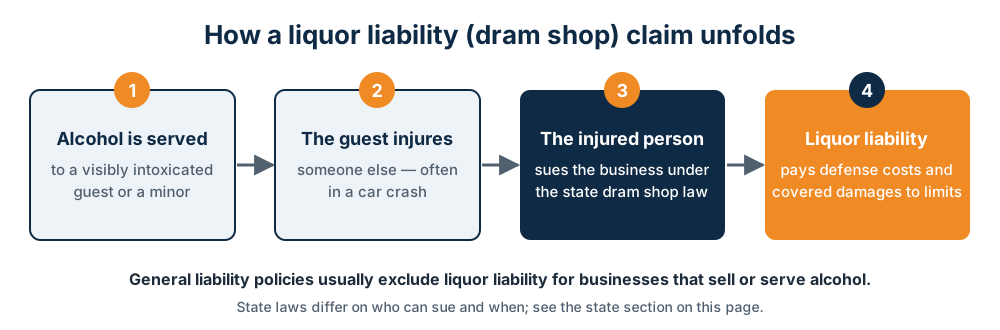
A dram shop law lets a person injured by an intoxicated customer sue the business that served the alcohol. States fall into roughly three groups. Broad liability states such as New York (General Obligations Law §11-101) and Vermont (7 V.S.A. §501) let almost anyone injured by an unlawfully served patron bring a claim. Limited liability states such as Texas, Pennsylvania, Indiana and Ohio require a specific showing, for example that the patron was obviously or visibly intoxicated when served, or that the server actually knew it. No-liability states such as Kansas, Virginia, Delaware and Maryland treat drinking, not serving, as the legal cause of the harm, so claims against the business usually fail unless another theory applies.
Even in a no-liability state, a bar can still be sued for what happens on its own premises: a fight the staff failed to stop, a fall on a wet floor, or a security guard’s use of force. Those claims run through general liability and assault and battery coverage rather than a dram shop statute, which is why owners in every state should read the assault and battery terms on their policy.
Where the state requires proof of insurance
- Massachusetts: G.L. c. 138, §12 bars issuing or renewing an on-premises license until the applicant proves liquor legal liability coverage of at least $250,000 per person and $500,000 per accident. See Massachusetts liquor liability.
- Michigan: MCL 436.1803 requires retail licensees to show financial responsibility of at least $50,000 for dram shop claims, usually met with liquor liability insurance. See Michigan liquor liability.
- South Carolina: on-premises licensees that sell after 5 p.m. must carry liquor liability, or general liability with a liquor endorsement, with an annual aggregate of at least $1,000,000. See South Carolina liquor liability.
- Vermont: 7 V.S.A. §501(i) now requires first-, third- and fourth-class licensees to carry liquor liability insurance that meets state minimums. See Vermont liquor liability.
A statutory minimum is a floor, not a recommendation. Most landlords and many event venues ask for limits well above these amounts, and a single serious crash claim can exceed any minimum. An umbrella or excess policy that sits over liquor liability is the usual way to add limits.
Why server training matters for insurance
Mandatory training states, including California, Indiana, Delaware, Maryland, Pennsylvania, South Carolina and Vermont, can suspend or fine a licensee whose staff are not certified. In states where training is voluntary, it still matters: underwriters routinely ask whether every server is certified, and a documented program helps defend a claim. Texas is a useful example of the limits of training, since TABC certification can protect the permit from TABC enforcement but does not stop a civil dram shop suit.
What liquor liability insurance does, in any state
Liquor liability insurance pays for defense costs and covered damages when a business is sued because of alcohol it sold or served. Standard commercial general liability policies exclude this exposure for businesses that sell or serve alcohol, so a restaurant with a bar program needs either a liquor liability policy or a liquor liability coverage part. Pricing is driven by the share of sales that comes from alcohol, hours, entertainment, security practices, claim history and the limits you choose. For a deeper explanation see liquor liability vs. host liquor liability and per-occurrence vs. aggregate limits.
Frequently asked questions
Which states have the strictest dram shop laws?
Among the states in this table, New York and Vermont have the broadest statutes, letting almost anyone injured by an unlawfully served patron sue the licensee. Massachusetts, Michigan and New Jersey also impose meaningful liability, and Massachusetts and Michigan add proof-of-coverage requirements.
Do I need liquor liability insurance if my state has no dram shop law?
Usually yes. Leases, lenders, franchisors and event venues require it by contract, on-premises fights and injuries still produce claims, and your general liability policy likely excludes alcohol-related claims for a licensed business.
Does BYOB change the answer?
Allowing guests to bring their own alcohol can still create exposure, and several states regulate BYOB directly. See do BYOB restaurants need liquor liability for how carriers treat it.
How often do these laws change?
Often enough to check every year. South Carolina and Vermont both changed their insurance rules recently. Each state guide lists the official statute and agency pages so you can confirm the current rule.
Serving alcohol in more than one state, or opening a new bar program? We compare liquor liability from multiple carriers on one application. Get Multiple Quotes within minutes. Or call (866) 964-6660.