
South Carolina bars and restaurants licensed for on-premises consumption that sell alcohol after 5 p.m. must carry liquor liability insurance under S.C. Code 61-2-145, with an annual aggregate of at least $1,000,000 and SCDOR listed as certificate holder. Since Jan. 1, 2026, a risk mitigation program can lower that minimum for qualifying operations, and server training is now mandatory.
This page is for South Carolina licensees working under the 2025 reforms, from a Charleston cocktail bar to a Myrtle Beach oceanfront grill or a Columbia sports bar on game days. Act 42 of 2025 (H.3430) changed insurance minimums, training and fault allocation, and many older policies have not caught up. For the wider picture, see restaurant insurance in South Carolina.
The statutory mandate under S.C. Code 61-2-145
South Carolina is one of the few states where this coverage is a condition of the license. Businesses licensed for on-premises consumption that sell after 5 p.m. must carry liquor liability insurance, or general liability with a liquor liability endorsement, with an annual aggregate of at least $1,000,000. The per-occurrence limit must be at least 50% of the total coverage, and the South Carolina Department of Revenue (SCDOR) must be named as certificate holder. A lapse is grounds for suspension or revocation, so a missed renewal payment is a licensing problem, not just an insurance one.
Since Jan. 1, 2026, a risk mitigation program lets qualifying businesses reduce the required minimum, down to a floor of $300,000. Qualifying measures include closing by midnight, having all servers trained, keeping alcohol under 40% of sales, using forensic ID scanning, and 501(c)(3) status. A smaller statutory minimum does not shrink what a jury can award, so weigh that trade-off before you drop limits.
| Item | What 61-2-145 requires |
|---|---|
| Who must carry it | On-premises licensees that sell alcohol after 5 p.m. |
| Acceptable policy | Liquor liability, or general liability with a liquor liability endorsement |
| Annual aggregate | At least the statutory minimum, reducible through risk mitigation |
| Per-occurrence limit | At least 50% of total coverage |
| Certificate holder | SCDOR |
| If coverage lapses | Grounds for suspension or revocation |
No standalone dram shop act, but Act 42 changed the math
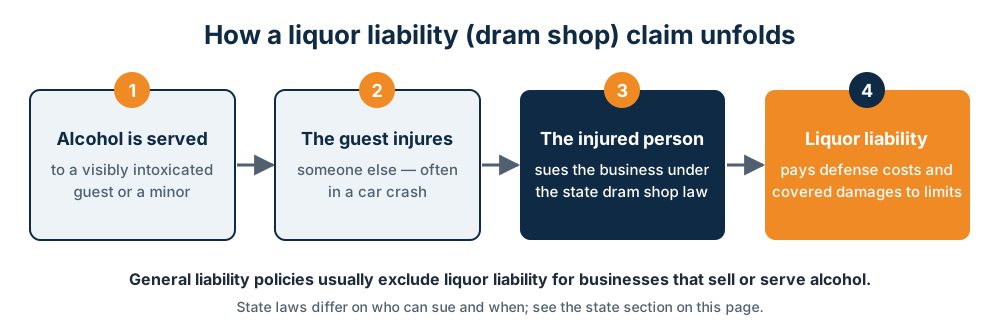
South Carolina does not have a standalone dram shop statute. Licensees may not knowingly sell to intoxicated persons (S.C. Code 61-6-2220), and violations carry escalating penalties under 61-4-580: a $2,500 fine, then a suspension of up to 14 days, then revocation. SCDOR’s Alcohol Beverage Licensing (ABL) handles licensing, and SLED investigates violations.
Act 42 of 2025, effective Jan. 1, 2026, lets fault be apportioned among tortfeasors in alcohol cases (15-38-15). Where a DUI defendant is also found liable, the licensee is jointly and severally liable for 50% of actual damages (61-2-147). We have not verified the case-law basis for civil suits against licensees, so have counsel review any specific claim; the statute now spells out how much of a judgment can land on the bar.
Social host liability and BYOB: points we could not confirm
Social host liability and BYOB rules in South Carolina are points we could not verify from official sources, so we won’t state a rule here. If you host private events or let guests bring their own bottles, check with SCDOR Alcohol Beverage Licensing and your local government first, and ask whether host liquor coverage fits; see liquor liability vs. host liquor liability.
Mandatory alcohol server training since 2026
Under S.C. Code 61-3-110 through 61-3-140, added by the H.3430 reforms, employees who serve alcohol for on-premises consumption at least 10 hours a week, and their managers and supervisors, must complete an SCDOR-approved alcohol server training program. Existing staff had until Mar. 2, 2026; new hires have 30 days; certificates must be kept on premises. Full server training also counts toward risk mitigation, so the same certificates can support a reduced minimum. Beach-town operators who staff up each spring need a tracking system so seasonal hires don’t miss the 30-day window.
Claim scenarios South Carolina venues should plan for
- A Myrtle Beach bar keeps serving a visibly drunk vacationer, who hits a pedestrian on Ocean Boulevard; 61-2-147 now defines the bar’s share if the driver is also liable.
- A Charleston patron falls on an upstairs deck stairway after heavy pours, and the suit alleges both over-service and a premises defect.
- A sports bar near Clemson on a home-game Saturday sees a patio fight, and the injured fan sues for negligent security.
- A Columbia restaurant’s liquor policy is cancelled for non-payment; no one is hurt, but the lapse alone puts the license at risk.
Assault and battery and liquor exclusions to read before you sign
If you use the GL-plus-endorsement route, confirm the endorsement actually overrides the standard GL liquor exclusion and meets both limit rules. Then look for assault and battery exclusions or low A&B sublimits: a policy that satisfies the statute can still leave a bar fight largely uninsured. Check whether defense costs sit inside the limit, too. More: does liquor liability cover assault claims. A South Carolina program typically includes:
- Liquor liability meeting 61-2-145 — keeps the license valid.
- Assault and battery — patio fights and bouncer claims in peak season.
- General liability — premises and food claims.
- Umbrella — protection above the statutory minimum.
- Property with wind and hail — coastal sites may need the South Carolina Wind and Hail Underwriting Association.
- Workers’ comp — required once you regularly employ four or more (South Carolina restaurant workers’ comp).
Per-occurrence vs. aggregate: the 50% rule in practice
The statute fixes the relationship between the two numbers: per-occurrence must be at least half of the total, so a large aggregate with a small per-occurrence limit won’t pass. The aggregate is shared by every claim in the policy year, so a fight in June and a crash in August draw on the same pool. See per-occurrence vs. aggregate limits.
What drives liquor liability pricing in South Carolina?
Liquor receipts come first: the larger alcohol’s share of sales, the higher the rate. Underwriters then weigh closing time, live entertainment, tourist-season volume, security, prior claims and SCDOR violations. The statute’s risk mitigation measures are also what underwriters like to see, so they can help both your required minimum and your pricing. Capacity for late-night bars can be tight, which makes comparing multiple carriers worth the effort.
Bars, breweries, caterers and fine dining: different pressure points
- Bars — late closing, A&B exposure and the full statutory minimum.
- Breweries and taprooms — earlier closing can line up with risk mitigation criteria.
- Caterers — confirm whether 61-2-145 applies to your license type; venues want certificates regardless.
- Fine dining — alcohol under 40% of sales may qualify for a reduced minimum.
How the quote process works
Provident Financial Group is an independent agency: one application, multiple carriers compared side by side, each checked against the 61-2-145 aggregate, per-occurrence and certificate rules. Once bound, you get live certificates of insurance, with SCDOR as certificate holder, that you can also share with landlords and venues. Call (866) 964-6660.
Frequently asked questions
What happens if my liquor liability policy lapses in South Carolina?
A lapse is grounds for suspension or revocation of your license under 61-2-145, even if no claim ever occurs.
Can I carry less than the statutory aggregate?
Only through the risk mitigation program in effect since Jan. 1, 2026, which allows reductions down to a $300,000 floor.
Does a restaurant that stops serving before 5 p.m. need liquor liability?
The 61-2-145 mandate applies to on-premises licensees that sell after 5 p.m. A daytime-only operation may fall outside it but still faces lawsuit exposure and lease requirements.
Does Act 42 make my bar pay the whole judgment?
Not necessarily. Fault can be apportioned, and where a DUI defendant is also liable the licensee is jointly and severally liable for 50% of actual damages (61-2-147).
Ready to line up a compliant policy? Get Multiple Quotes within minutes.
Official South Carolina sources
- S.C. Code Title 61, Chapter 2 (alcohol general provisions; liquor liability insurance)
- S.C. H.3430 (2025): liquor liability and tort reform
- SC Department of Revenue ABL: how H.3430 impacts your business
- SC Department of Revenue ABL: alcohol server training compliance
State facts on this page are drawn from the statutes and agency pages above. Laws and agency rules change, so confirm current requirements with the agency before relying on them. This page is general information, not legal advice or a coverage opinion.
Related pages
- Bar insurance in South Carolina
- Brewery insurance in South Carolina
- Catering insurance in South Carolina
- Fine dining insurance in South Carolina
- South Carolina restaurant insurance
- Restaurant insurance in Charleston
- Restaurant insurance in Myrtle Beach