
Fast casual insurance covers the segment that runs restaurant volume at retail speed — counter service, high throughput, lean labor models, and often multiple locations sharing one brand. QSR classifications rate below full-service in both liability and workers’ comp, so the biggest pricing mistake in this segment is being written as a full-service restaurant. The second biggest is outgrowing a single-location policy without anyone noticing.
Coverage fast casual and quick-service restaurants actually need
General liability (counter-service classified)
Customer slips, hot-food incidents, and foodborne-illness claims — at counter-service rates, which run below full-service classes. Verify the classification; it’s worth real money.
Property & business interruption
Kitchen lines, digital ordering hardware, and build-outs — with interruption coverage sized to real revenue, because high-volume locations lose more per closed day than their square footage suggests.
Workers’ compensation
Fast-casual crews rate in favorable food-service classes with correct QSR coding — and high-turnover, part-time-heavy rosters fit pay-as-you-go billing perfectly. Details at our sister agency’s restaurant comp program.
Multi-location structure
Growing brands need policies that add locations cleanly mid-term, blanket property limits across sites, and per-location aggregates that don’t let one location’s claim exhaust the brand’s coverage.
Franchise compliance (if franchised)
Franchisors specify limits, additional-insured wording, and sometimes carriers — we build to franchise addenda and keep compliance certificates current automatically.
What fast casual insurance costs
Every restaurant is priced individually — alcohol share, payroll, square footage, location, claims history and the limits you choose all move the number. The fastest way to see yours is a side-by-side quote: Get Multiple Quotes within minutes.
Market ranges for planning, not quotes — every operation prices individually on location, revenue, payroll, and history. Compare policy terms, limits, deductibles, and premiums when reviewing quotes.
What goes wrong: the claims that hit fast casual and quick-service restaurants
- Slip-and-falls at volume — throughput is the exposure; more customers per hour, more floor incidents per year
- Hot food and beverage claims — the segment’s signature customer injury
- Repetitive-motion injuries — line speed drives wrist and shoulder comp claims
- Equipment-line failures — one down fryer bank in a two-item concept is an interruption event
- Multi-location aggregation — one brand-wide policy structured wrong lets one bad claim year hit every location’s renewal
Scaling from one location to five
Fast casual is the growth segment, and insurance either scales with you or trips you. The single-location BOP that fit store one becomes wrong at store three: locations in different states, blanket vs. scheduled property decisions, payroll flowing through one comp policy or several, and franchise agreements layering requirements on top. We build programs with the growth path designed in — adding a location becomes an endorsement, not a re-shop — and we benchmark at every renewal because carriers’ QSR appetite shifts with the segment’s claims trends.
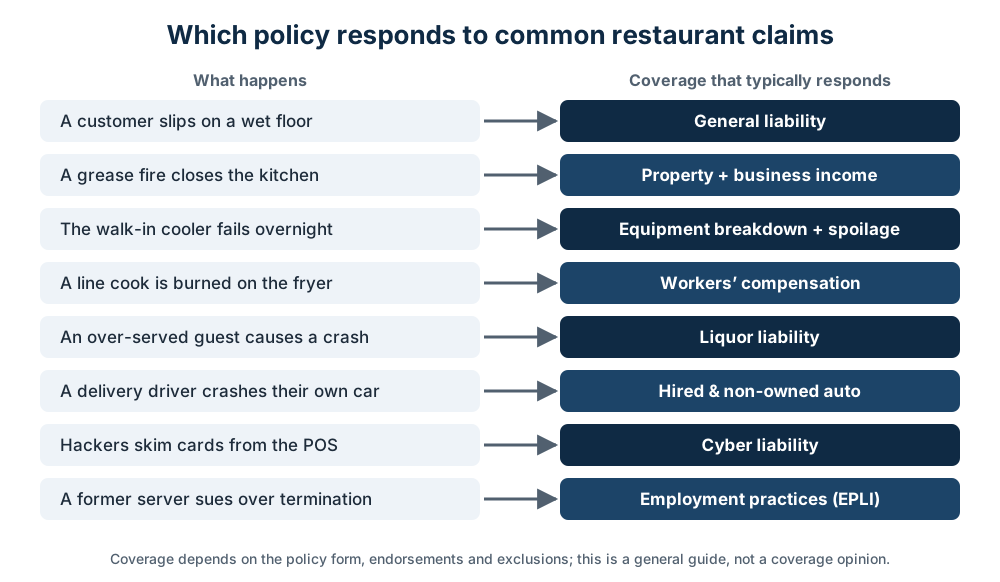
Fast Casual insurance FAQs
Is fast casual insurance cheaper than full-service restaurant insurance?
Generally yes — counter-service GL classes and QSR comp codes rate below full-service equivalents, and no alcohol usually means no liquor liability. Correct classification is the single biggest savings lever in the segment.
How does insurance work for multiple locations?
One program with all locations scheduled (or blanket limits) usually beats separate policies — cleaner certificates, package pricing, and one renewal. Structure matters: per-location aggregates protect the brand from one location’s bad year.
What do franchisors require for insurance?
Franchise agreements specify limits, additional-insured wording for the franchisor, and sometimes approved carriers — compliance certificates are a condition of operating. We build to the addendum and keep certificates current.
Do part-time crew members need workers’ comp coverage?
Yes — part-timers count in nearly every state, and QSR’s high-turnover rosters are exactly why pay-as-you-go billing (premium from actual payroll each period) fits the segment.
What’s the most common coverage gap in fast casual?
Interruption limits sized to square footage instead of revenue — high-volume small-footprint locations lose far more per closed day than their size suggests. We size interruption to your actual sales.
Get covered right: one application, multiple A-rated carriers that actually want fast casual and quick-service restaurants — start your quote. Related: Pizzeria insurance · Ghost kitchen insurance · Coffee shop insurance · all coverages · what restaurant insurance costs.
US Restaurant Insure connects food service business owners with Provident Financial Group. Insurance products are offered through Provident Financial Group, a licensed independent insurance agency, and are subject to underwriting approval, policy terms, conditions, and exclusions. Cost figures on this page are illustrative market ranges for planning purposes only — they are not quotes, offers of coverage, or guarantees of premium or savings. Coverage availability varies by state and carrier. Contact us at 1-866-964-6660 for a quote specific to your business.
Fast Casual & QSR Insurance by state
- Fast Casual Restaurant Insurance in New Jersey
- Fast Casual Restaurant Insurance in New York
- Fast Casual Restaurant Insurance in Connecticut
- Fast Casual Restaurant Insurance in Vermont
- Fast Casual Restaurant Insurance in Ohio
- Fast Casual Restaurant Insurance in Michigan
- Fast Casual Restaurant Insurance in Virginia
- Fast Casual Restaurant Insurance in Pennsylvania
- Fast Casual Restaurant Insurance in Delaware
- Fast Casual Restaurant Insurance in Maryland
- Fast Casual Restaurant Insurance in North Carolina
- Fast Casual Restaurant Insurance in South Carolina
- Fast Casual Restaurant Insurance in Georgia
- Fast Casual Restaurant Insurance in Florida
- Fast Casual Restaurant Insurance in Texas
- Fast Casual Restaurant Insurance in Kentucky
- Fast Casual Restaurant Insurance in Kansas
- Fast Casual Restaurant Insurance in California
- Fast Casual Restaurant Insurance in Indiana
- Fast Casual Restaurant Insurance in Arizona
- Fast Casual Restaurant Insurance in Washington, DC
- Fast Casual Restaurant Insurance in Massachusetts
- Fast Casual Restaurant Insurance in Nevada