
Fine dining insurance protects restaurants where the values run higher across the board — wine cellars worth more than most kitchens, chef-driven reputations that are literally the business, tasting-menu revenue concentrated in fewer covers, and build-outs that took years to create. A generic restaurant policy underinsures nearly every line of this business. The program has to be written for what’s actually on the premises and what a closure actually costs.
Coverage fine dining restaurants actually need
Property with wine & spirits valuation
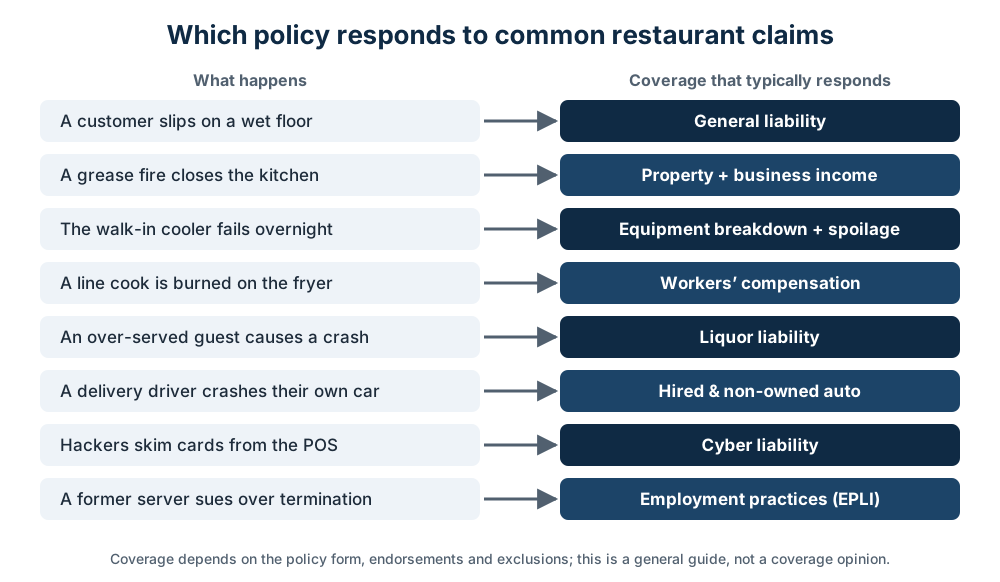
Cellars and rare-spirits collections need scheduled or blanket valuation that reflects replacement reality — market-value wine coverage, temperature-control failure protection, and breakage. The walk-in full of Burgundy is not “contents.”
General & liquor liability
White-tablecloth service doesn’t reduce liability — wine pairings are alcohol service with dram-shop exposure, and high-check guests bring high-value claims. $1M/$2M with umbrella layering is the fine-dining standard.
Business interruption (revenue-real)
A month closed costs a tasting-menu room far more than its seat count suggests — interruption limits must be built from actual revenue and fixed costs, including the payroll of a team you cannot afford to lose to a temporary closure.
Workers’ compensation
Brigade kitchens carry real comp exposure — burns, cuts, repetitive strain — and skilled-team retention makes return-to-work programs matter more here than anywhere. Our sister agency’s restaurant comp program covers the details.
Equipment breakdown & spoilage
Combi ovens, immersion circulators, dry-agers, and cellar climate systems — specialized equipment with specialized failure costs, plus spoilage limits that reflect what’s actually in your walk-ins.
What fine dining insurance costs
Every restaurant is priced individually — alcohol share, payroll, square footage, location, claims history and the limits you choose all move the number. The fastest way to see yours is a side-by-side quote: Get Multiple Quotes within minutes.
Market ranges for planning, not quotes — every operation prices individually on location, revenue, payroll, and history. Compare policy terms, limits, deductibles, and premiums when reviewing quotes.
What goes wrong: the claims that hit fine dining restaurants
- Cellar losses — temperature failure, power loss, and breakage against collections built over decades
- Kitchen fires — high-BTU lines and duty cycles that never relent
- Liquor liability at the high end — pairings and pours are dram-shop exposure in formalwear
- Interruption severity — concentrated revenue makes every closed night expensive
- Key-person dependency — chef-driven rooms carry business risk insurance can only partly address; we’ll tell you honestly which parts
Valuation is everything
Fine dining claims go wrong at valuation: the cellar insured as generic contents, the interruption limit set by a formula that never met a tasting menu, the custom millwork covered at builder-grade rates. We inventory what’s actually there — cellar schedules, equipment values, real revenue — and write limits to match, with carriers whose fine-dining appetite means they’ve paid these claims before and price them knowledgeably. Underinsurance discovered at claim time is the one mistake this segment can’t afford.
Fine Dining insurance FAQs
How is fine dining insurance different from regular restaurant insurance?
Higher values everywhere — wine cellars needing scheduled valuation, interruption limits built from concentrated revenue, specialized equipment, and umbrella layering as standard. The structure matters more than the premium.
Does restaurant insurance cover my wine cellar?
Generic contents coverage usually undervalues it badly. Cellars need explicit valuation — schedules or blanket limits reflecting replacement/market value, plus temperature-failure and breakage coverage.
What does fine dining insurance cost?
Your real number depends on payroll, operations, and carrier appetite — comparing several quotes side by side is the only way to see it. The right question is whether the limits would actually rebuild the room and the list — premium follows from there.
Do wine pairings create liquor liability?
Yes — any alcohol service carries dram-shop exposure in most states, regardless of price point or formality. Liquor liability with limits matching your clientele’s claim potential is standard.
How should a tasting-menu restaurant size business interruption?
From actual revenue and committed costs — including retaining key kitchen staff through a closure — not from square footage or seat counts. Underinsured interruption is the classic fine-dining claim regret.
Get covered right: one application, multiple A-rated carriers that actually want fine dining restaurants — start your quote. Related: Bar insurance · Catering insurance · Brewery insurance · all coverages · what restaurant insurance costs.
US Restaurant Insure connects food service business owners with Provident Financial Group. Insurance products are offered through Provident Financial Group, a licensed independent insurance agency, and are subject to underwriting approval, policy terms, conditions, and exclusions. Cost figures on this page are illustrative market ranges for planning purposes only — they are not quotes, offers of coverage, or guarantees of premium or savings. Coverage availability varies by state and carrier. Contact us at 1-866-964-6660 for a quote specific to your business.
Fine Dining Restaurant Insurance by state
- Fine Dining Restaurant Insurance in New Jersey
- Fine Dining Restaurant Insurance in New York
- Fine Dining Restaurant Insurance in Connecticut
- Fine Dining Restaurant Insurance in Vermont
- Fine Dining Restaurant Insurance in Ohio
- Fine Dining Restaurant Insurance in Michigan
- Fine Dining Restaurant Insurance in Virginia
- Fine Dining Restaurant Insurance in Pennsylvania
- Fine Dining Restaurant Insurance in Delaware
- Fine Dining Restaurant Insurance in Maryland
- Fine Dining Restaurant Insurance in North Carolina
- Fine Dining Restaurant Insurance in South Carolina
- Fine Dining Restaurant Insurance in Georgia
- Fine Dining Restaurant Insurance in Florida
- Fine Dining Restaurant Insurance in Texas
- Fine Dining Restaurant Insurance in Kentucky
- Fine Dining Restaurant Insurance in Kansas
- Fine Dining Restaurant Insurance in California
- Fine Dining Restaurant Insurance in Indiana
- Fine Dining Restaurant Insurance in Arizona
- Fine Dining Restaurant Insurance in Washington, DC
- Fine Dining Restaurant Insurance in Massachusetts
- Fine Dining Restaurant Insurance in Nevada