
Food vendor insurance covers the smallest and most certificate-dependent corner of food service: farmers-market stalls, festival booths, fair concessions, pop-ups, and cottage-food sellers. Markets and events won’t assign a space without proof of liability naming them as additional insured — making insurance literally the ticket to sell. The good news: correctly structured vendor coverage is usually modest compared with other food-service risks.
Coverage food vendors and market sellers actually need
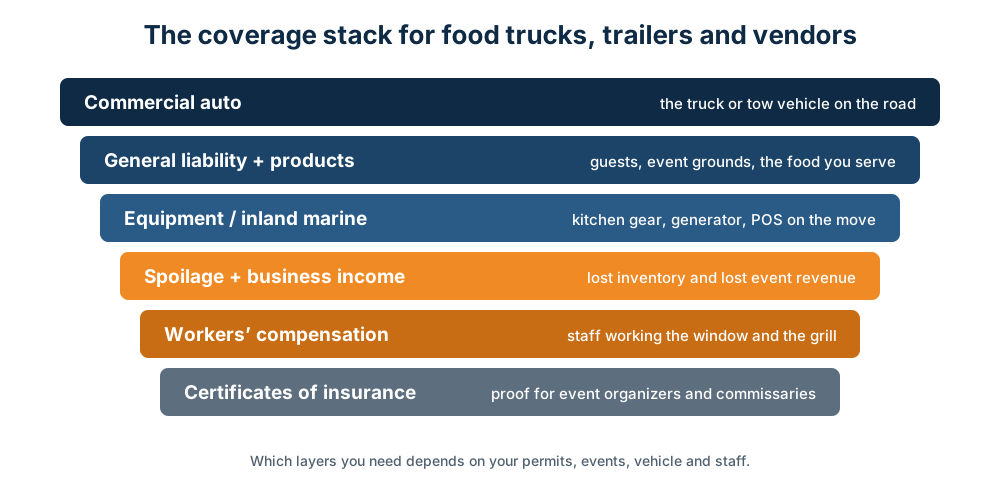
General liability with additional-insured capability
The market-entry requirement: $1M limits with the market, festival, or municipality named — often several at once across your season. Unlimited additional insureds without per-certificate fees is the structural feature to demand.
Product liability
Foodborne-illness and allergen claims follow your product home from the market — the exposure that outlasts the event day. Cottage-food sellers need it most and think about it least.
Equipment & stall property
Tents, tables, coolers, grills, and displays — including transit to and from events and theft from vehicles, where most vendor property actually disappears.
Workers’ compensation (with helpers)
Family helpers and paid assistants can count as employees under state law — a two-minute analysis that prevents an uninsured-injury disaster. Our sister agency’s comp program handles the smallest-payroll cases.
Annual vs. per-event structure
Vendors working more than a handful of dates almost always win with annual policies — per-event coverage stacks up expensively and leaves gaps between the days that matter.
What food vendor insurance costs
Every restaurant is priced individually — alcohol share, payroll, square footage, location, claims history and the limits you choose all move the number. The fastest way to see yours is a side-by-side quote: Get Multiple Quotes within minutes.
Market ranges for planning, not quotes — every operation prices individually on location, revenue, payroll, and history. Compare policy terms, limits, deductibles, and premiums when reviewing quotes.
What goes wrong: the claims that hit food vendors and market sellers
- Customer illness claims — the product exposure that follows your goods home
- Booth injuries — tent stakes, cords, hot equipment, and crowds in close quarters
- Weather and wind — canopies become kites; some policies exclude exactly that
- Theft in transit and storage — where vendor equipment actually disappears
- Helper injuries — the uninsured-employee surprise at the smallest business size
The certificate is the business license
Vendor life runs on certificates: every market manager, festival organizer, and municipal permit office wants current proof with their name on it, and the request always precedes the season’s first good weekend. We issue unlimited certificates same-day at no per-certificate charge, and we keep a standing list of your venues so renewals regenerate the whole stack automatically. FLIP-style direct programs sell this market hard — our difference is comparison: multiple carriers’ vendor programs quoted against each other, plus an agency that answers the phone when a market manager questions your wording.
Food Vendor insurance FAQs
What insurance do farmers markets require from vendors?
Nearly all require general liability (typically $1M) naming the market as additional insured, delivered before your first market day. Municipal markets often add the city as well — we issue all of it same-day.
How much does food vendor insurance cost?
Premiums are priced individually by each carrier; compare quotes side by side to see yours.
Do cottage food sellers need insurance?
Legally it varies; practically yes — markets require certificates regardless of where you cook, homeowner’s policies exclude business claims, and product liability is the coverage that follows your goods home.
Is my tent and equipment covered if it’s stolen from my van?
With inland marine/equipment coverage including transit and vehicle theft, yes — the actual way vendor property disappears, and a common exclusion in generic policies.
Does my helper at the market need workers’ comp?
If they’re an employee under your state’s law — and paid helpers usually are — yes, even part-time and family in many states. It’s a two-minute analysis that prevents the worst small-business insurance story there is.
Get covered right: one application, multiple A-rated carriers that actually want food vendors and market sellers — start your quote. Related: Food trailer insurance · Food truck insurance · Bakery insurance · all coverages · what restaurant insurance costs.
US Restaurant Insure connects food service business owners with Provident Financial Group. Insurance products are offered through Provident Financial Group, a licensed independent insurance agency, and are subject to underwriting approval, policy terms, conditions, and exclusions. Cost figures on this page are illustrative market ranges for planning purposes only — they are not quotes, offers of coverage, or guarantees of premium or savings. Coverage availability varies by state and carrier. Contact us at 1-866-964-6660 for a quote specific to your business.
Food Vendor & Farmers Market Insurance by state
- Food Vendor & Farmers Market Insurance in New Jersey
- Food Vendor & Farmers Market Insurance in New York
- Food Vendor & Farmers Market Insurance in Connecticut
- Food Vendor & Farmers Market Insurance in Vermont
- Food Vendor & Farmers Market Insurance in Ohio
- Food Vendor & Farmers Market Insurance in Michigan
- Food Vendor & Farmers Market Insurance in Virginia
- Food Vendor & Farmers Market Insurance in Pennsylvania
- Food Vendor & Farmers Market Insurance in Delaware
- Food Vendor & Farmers Market Insurance in Maryland
- Food Vendor & Farmers Market Insurance in North Carolina
- Food Vendor & Farmers Market Insurance in South Carolina
- Food Vendor & Farmers Market Insurance in Georgia
- Food Vendor & Farmers Market Insurance in Florida
- Food Vendor & Farmers Market Insurance in Texas
- Food Vendor & Farmers Market Insurance in Kentucky
- Food Vendor & Farmers Market Insurance in Kansas
- Food Vendor & Farmers Market Insurance in California
- Food Vendor & Farmers Market Insurance in Indiana
- Food Vendor & Farmers Market Insurance in Arizona
- Food Vendor & Farmers Market Insurance in Washington, DC
- Food Vendor & Farmers Market Insurance in Massachusetts
- Food Vendor & Farmers Market Insurance in Nevada