
“What insurance is a restaurant actually required to carry?” The honest answer has four layers — state law, your lease, your liquor license, and your lender — and confusing them is how owners end up either under-covered or over-sold. Here’s each layer, clearly. Get multiple quotes within minutes.
US Restaurant Insure connects food service business owners with Provident Financial Group for restaurant insurance guidance. Find answers in our restaurant insurance FAQs.
Layer 1: What state law requires
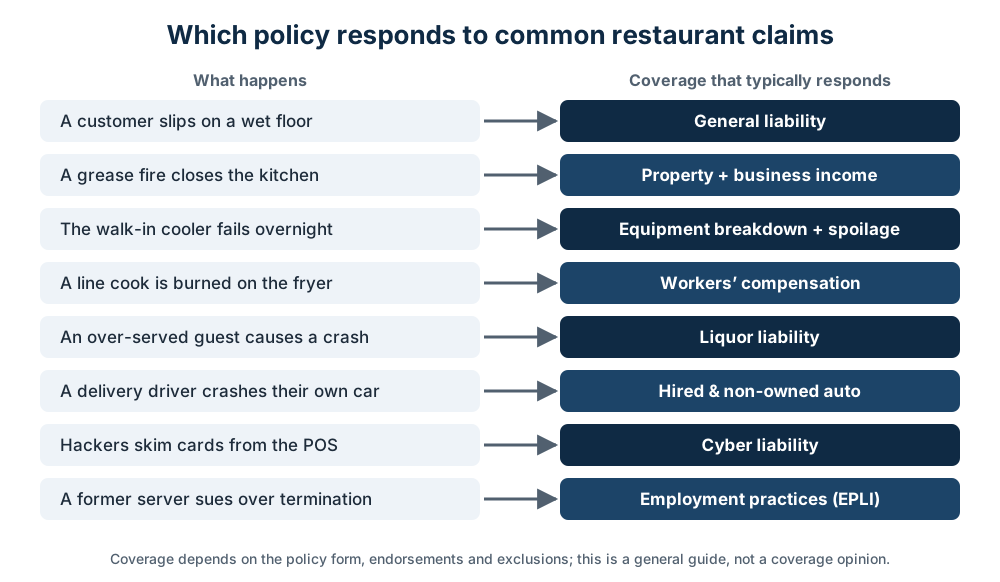
Workers’ compensation is the true legal mandate — required in every state we serve once you cross that state’s employee threshold (from the first employee in states like New Jersey and California, at higher headcounts in states like Florida and Georgia). Beyond comp, most states require unemployment insurance and, if you run vehicles, commercial auto at state minimums. Your state’s specifics: see our state pages, e.g. New Jersey, Florida, Texas.
Layer 2: What your lease requires
Nearly every commercial lease mandates general liability — the near-universal ask is $1M per occurrence with the landlord as additional insured — plus property coverage for your improvements. Not law, but you can’t occupy without it: the certificate of insurance is the enforcement mechanism.
Layer 3: What your liquor license expects
If you serve alcohol, liquor liability enters — by statute in a few states (South Carolina mandates $1M for many late-serving establishments), by dram shop reality everywhere else. Our liability guide links every state’s dram shop rules.
Layer 4: What lenders and contracts add
SBA and equipment lenders require property coverage protecting collateral; franchise agreements impose the FDD’s full insurance section (checklist here); delivery platforms and event organizers require liability proof. Each contract you sign is an insurance requirement in disguise — read them together and the “required” package practically writes itself.
Frequently asked questions
Is general liability legally required for restaurants?
Not by state statute — but virtually every commercial lease, franchise agreement, and vendor contract requires it, making it mandatory in practice for any restaurant that rents space or signs contracts.
What’s the only insurance restaurants are required by law to carry?
Workers’ compensation, once you cross your state’s employee threshold — plus commercial auto minimums if the business owns vehicles. Everything else is contractual: leases, licenses, lenders, and franchisors supply the rest of the “requirements.”
Ready for your number? Get multiple quotes within minutes from an independent agency that shops top carriers for your restaurant.
Restaurant insurance requirements by state at a glance (2026)
The table below summarizes the legal requirements that most often shape a restaurant’s insurance program in each state where Provident Financial Group is licensed: when workers’ compensation becomes mandatory, where it can be bought, the minimum auto liability limits for any vehicle the business owns (bodily injury per person / per accident / property damage, in thousands of dollars), and whether state law requires licensees to carry liquor liability. Each state name links to our full state guide, which cites the statutes and agency pages behind these entries. For alcohol rules in more detail, see liquor liability and dram shop laws by state.
| State | Workers’ comp required for | Where comp is bought | Auto liability minimums (thousands of dollars) | Liquor liability required by state law? |
|---|---|---|---|---|
| Arizona | Employers with regularly employed workers | Private carriers or self-insurance | 25/50/15 | No |
| California | 1+ employees | Private carriers or State Compensation Insurance Fund | 30/60/15 | No (server training mandatory) |
| Connecticut | 1+ employees (no threshold) | Private carriers or self-insurance | 25/50/25 | No |
| Delaware | 1+ employees | Private carriers | 25/50/10 | No |
| Florida | 4+ employees (non-construction) | Private carriers | No BI required for standard vehicles; 10 PD plus PIP | No |
| Georgia | 3+ employees, part-time included | Private carriers | 25/50/25 | No |
| Indiana | Covered employers, no minimum count found | Private carriers or self-insurance | 25/50/25 | No |
| Kansas | Gross annual payroll over $20,000 | Private carriers or group self-insurance pools | 25/50/25 | No |
| Kentucky | 1+ employees | Private carriers or KEMI | 25/50/25 | No |
| Maryland | 1+ employees | Private carriers or Chesapeake Employers | 30/60/15 | No (local boards may add conditions) |
| Massachusetts | 1+ employees, no family exemption | Private carriers or self-insurance | 25/50/30 | Yes: proof of liquor legal liability coverage |
| Michigan | 3+ employees, or 1+ working 35 hrs/week for 13 weeks | Private carriers or self-insurance | 50/100/10 | Yes: proof of financial responsibility |
| Nevada | 1+ employees | Private carriers or self-insurance | 25/50/20 | No |
| New Jersey | Virtually all employers, no threshold | Private carriers or self-insurance | 35/70/25 (from Jan 1, 2026) | No |
| New York | All employees, part-time and family included | Private carriers or NYSIF | 25/50/10 | No |
| North Carolina | 3+ employees | Private carriers or self-insurance | 50/100/50 | No |
| Ohio | 1+ employees | Ohio BWC only (monopolistic state fund) | 25/50/25 | No |
| Pennsylvania | 1+ employees, part-time and family included | Private carriers or SWIF | 15/30/5 | No |
| South Carolina | 4+ employees (payroll exemption applies) | Private carriers or self-insurance | 25/50/25 | Yes: licensees selling after 5 p.m. |
| Texas | Optional for most private employers | Private carriers or Texas Mutual; non-subscription allowed | 30/60/25 | No |
| Vermont | 1+ employees | Private carriers or assigned risk plan | 25/50/10 | Yes: licensees must carry it (minimums set by rule) |
| Virginia | 3+ employees | Private carriers | 50/100/25 | No |
| Washington, DC | Anyone employed for pay, no threshold | Private carriers or self-insurance | 25/50/10 | No |
Legal minimums are only the starting point. Landlords, lenders, franchisors and event venues usually set their own requirements, often higher, and those contract terms are what most restaurants are actually measured against. Requirements change, so confirm current rules with the state agency before relying on them.
Restaurant insurance requirements by state
- New Jersey Restaurant Insurance
- New York Restaurant Insurance
- Connecticut Restaurant Insurance
- Vermont Restaurant Insurance
- Restaurant Insurance in Ohio
- Michigan Restaurant Insurance
- Virginia Restaurant Insurance
- Pennsylvania Restaurant Insurance
- Delaware Restaurant Insurance
- Maryland Restaurant Insurance
- North Carolina Restaurant Insurance
- South Carolina Restaurant Insurance
- Georgia Restaurant Insurance
- Florida Restaurant Insurance
- Texas Restaurant Insurance
- Kentucky Restaurant Insurance
- Restaurant Insurance in Kansas
- California Restaurant Insurance
- Indiana Restaurant Insurance
- Arizona Restaurant Insurance
- Washington, DC Restaurant Insurance
- Massachusetts Restaurant Insurance
- Nevada Restaurant Insurance
Restaurant workers’ compensation by state
- Restaurant Workers’ Compensation in New Jersey
- Restaurant Workers’ Compensation in New York
- Restaurant Workers’ Compensation in Connecticut
- Restaurant Workers’ Compensation in Vermont
- Restaurant Workers’ Compensation in Ohio
- Restaurant Workers’ Compensation in Michigan
- Restaurant Workers’ Compensation in Virginia
- Restaurant Workers’ Compensation in Pennsylvania
- Restaurant Workers’ Compensation in Delaware
- Restaurant Workers’ Compensation in Maryland
- Restaurant Workers’ Compensation in North Carolina
- Restaurant Workers’ Compensation in South Carolina
- Restaurant Workers’ Compensation in Georgia
- Restaurant Workers’ Compensation in Florida
- Restaurant Workers’ Compensation in Texas
- Restaurant Workers’ Compensation in Kentucky
- Restaurant Workers’ Compensation in Kansas
- Restaurant Workers’ Compensation in California
- Restaurant Workers’ Compensation in Indiana
- Restaurant Workers’ Compensation in Arizona
- Restaurant Workers’ Compensation in Washington, DC
- Restaurant Workers’ Compensation in Massachusetts
- Restaurant Workers’ Compensation in Nevada