
Catering insurance covers a business that carries its kitchen to the risk instead of waiting for the risk to walk in — every event is a new venue, a new contract, a new certificate request, and a new set of ways for things to go sideways. Venues won’t book uninsured caterers, corporate clients demand additional-insured status, and one foodborne-illness claim at a 200-person wedding can involve 200 claimants. This is a business where the paperwork is part of the product.
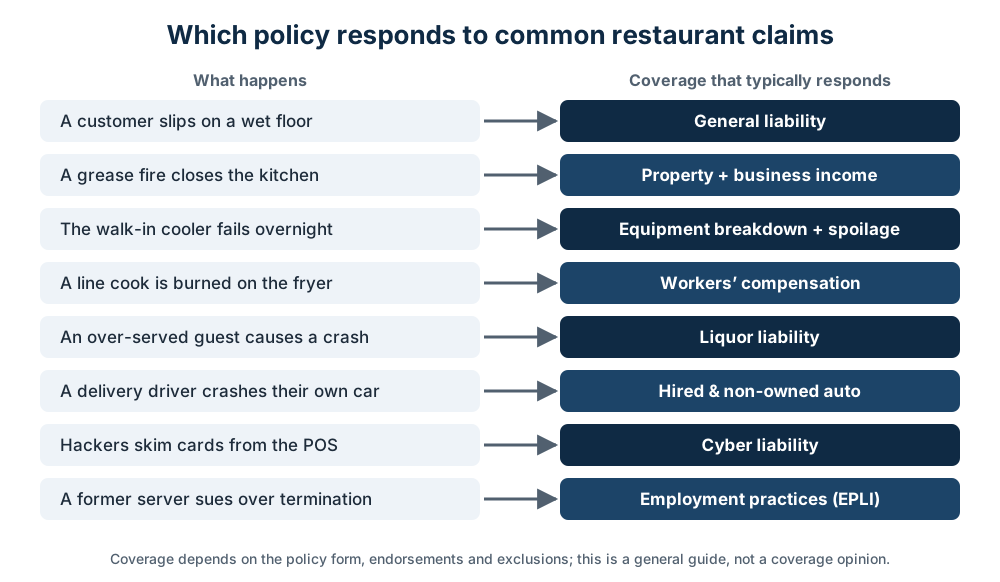
Coverage caterers and catering companies actually need
General liability with off-premises coverage
The core: guest injuries, property damage at venues, and foodborne-illness claims — with coverage that explicitly follows you to event sites, not just your commissary. $1M/$2M limits with additional-insured capability are the venue-contract standard.
Liquor liability (if you serve or staff bars)
Catering alcohol service triggers dram-shop exposure in most states — whether you supply the alcohol or just the bartenders. Host-liquor coverage on a client’s policy does not protect the caterer; your own liquor liability does.
Commercial auto
Vans and trucks moving food, equipment, and staff between kitchen and venue — personal auto excludes it, and event schedules put your fleet on the road constantly.
Equipment and inland marine
Chafing dishes, hot boxes, tents, tables, sound equipment — property coverage that travels, including theft from vehicles and venues.
Workers’ compensation
Event staff, servers, and kitchen crews — including the part-time and per-event staff catering runs on. Every one of them counts; our sister agency’s food-service workers’ comp program covers classification and pay-as-you-go billing that matches event-driven payroll perfectly.
What catering insurance costs
Every restaurant is priced individually — alcohol share, payroll, square footage, location, claims history and the limits you choose all move the number. The fastest way to see yours is a side-by-side quote: Get Multiple Quotes within minutes.
Market ranges for planning, not quotes — every operation prices individually on location, revenue, payroll, and history. Compare policy terms, limits, deductibles, and premiums when reviewing quotes.
What goes wrong: the claims that hit caterers and catering companies
- Foodborne illness at scale — one contaminated dish, hundreds of guests; the severity scenario that defines catering underwriting
- Venue property damage — burns, spills, and equipment damage at someone else’s site
- Vehicle accidents — loaded vans on tight event schedules
- Equipment theft — trailers and vans full of gear, parked overnight
- Staff injuries at events — lifting, transport, and unfamiliar kitchens drive comp claims
Certificates are your booking engine
Catering runs on certificate velocity: every venue wants proof of GL with additional-insured wording, corporate clients want their entity named, and the request always lands days before the event. We issue same-day certificates with correct wording and no per-certificate fees — because for a caterer, a slow certificate is a lost booking. We also review venue contracts’ insurance clauses before you sign, so you’re not agreeing to limits or waivers your policy doesn’t deliver.
Catering insurance FAQs
What insurance do venues require from caterers?
Almost universally $1M general liability with the venue named as additional insured, often with liquor liability if alcohol is involved and workers’ comp certificates for your staff. Requests typically arrive with days to spare — same-day certificate capability is operationally essential.
Does my catering policy cover alcohol service?
Only with liquor liability coverage — general liability excludes it for businesses in the alcohol chain. Staffing bars or serving client-supplied alcohol still creates exposure in most states.
How much does catering insurance cost?
Per-event policies exist but usually price poorly against annual programs for working caterers.
Are my per-event servers covered by workers’ comp?
If they’re your employees — even for one event — yes, they must be. Pay-as-you-go billing matches premium to your actual event payroll instead of an annual guess.
Does insurance cover food I transport to events?
With the right property/inland marine structure, yes — including spoilage in transit with refrigerated coverage. Standard property policies stop at your kitchen door; catering programs shouldn’t.
Get covered right: one application, multiple A-rated carriers that actually want caterers and catering companies — start your quote. Related: Food truck insurance · Fine dining insurance · Food vendor insurance · all coverages · what restaurant insurance costs.
US Restaurant Insure connects food service business owners with Provident Financial Group. Insurance products are offered through Provident Financial Group, a licensed independent insurance agency, and are subject to underwriting approval, policy terms, conditions, and exclusions. Cost figures on this page are illustrative market ranges for planning purposes only — they are not quotes, offers of coverage, or guarantees of premium or savings. Coverage availability varies by state and carrier. Contact us at 1-866-964-6660 for a quote specific to your business.
Catering Insurance by state
- Catering Insurance in New Jersey
- Catering Insurance in New York
- Catering Insurance in Connecticut
- Catering Insurance in Vermont
- Catering Insurance in Ohio
- Catering Insurance in Michigan
- Catering Insurance in Virginia
- Catering Insurance in Pennsylvania
- Catering Insurance in Delaware
- Catering Insurance in Maryland
- Catering Insurance in North Carolina
- Catering Insurance in South Carolina
- Catering Insurance in Georgia
- Catering Insurance in Florida
- Catering Insurance in Texas
- Catering Insurance in Kentucky
- Catering Insurance in Kansas
- Catering Insurance in California
- Catering Insurance in Indiana
- Catering Insurance in Arizona
- Catering Insurance in Washington, DC
- Catering Insurance in Massachusetts
- Catering Insurance in Nevada