
Delaware liquor liability insurance covers alcohol-related injury claims against bars, restaurants and caterers, including the cost of defending them. Delaware has no dram shop liability: in McCall v. Villa Pizza, Inc. (1994) the Delaware Supreme Court found no statutory or common-law claim against a tavern for injuries an intoxicated patron causes off the premises. Leases and lenders still commonly require the coverage, and server training is mandatory.
This page is for Wilmington bars, beach-town restaurants in Sussex County, brewery taprooms and caterers who pour at weddings and corporate events. Delaware’s legal climate is friendlier to alcohol sellers than its neighbors’, but that does not make the coverage optional in practice. For your full program, see restaurant insurance in Delaware.
Why Delaware has no dram shop claim, and what that leaves
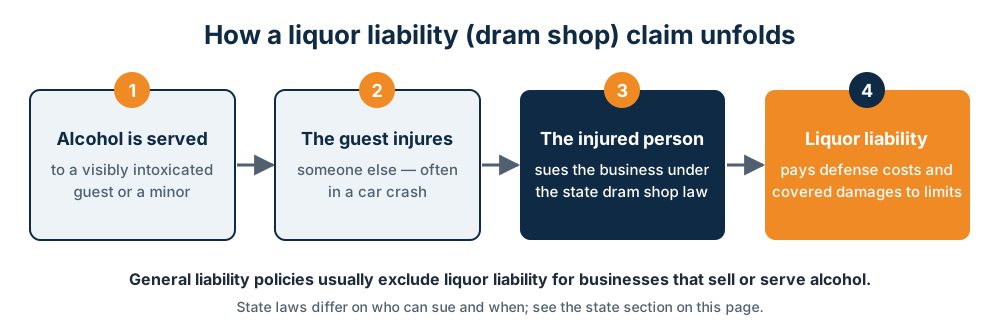
In McCall v. Villa Pizza, Inc., 636 A.2d 912 (Del. 1994), the Delaware Supreme Court held there is “no statutory or common law cause of action” against a tavern by a patron or a third party injured off the premises by an intoxicated patron. The court left the question to the General Assembly. So the classic dram shop case, where a guest leaves your bar, drives and hits someone, does not have a recognized claim against the seller in Delaware. That makes third-party liquor claims more limited here than in neighboring Pennsylvania and Maryland.
Three things keep the exposure alive. First, the decision addresses injuries off the premises; fights, falls and security incidents inside your venue or parking lot are typically pursued as ordinary premises negligence claims. Second, plaintiffs’ lawyers still file and test new theories, and defense costs accrue whether or not a claim succeeds. Third, because the court deferred to the legislature, the rule could change if lawmakers act. A Delaware liquor policy mostly buys defense, protection for on-premises incidents and contract compliance.
| Delaware situation | Where the exposure comes from | What to check |
|---|---|---|
| Patron leaves, drives and injures someone off premises | No cause of action under McCall v. Villa Pizza | Defense coverage if a plaintiff tries another theory |
| Fight, fall or security failure inside the venue | Ordinary premises negligence | Assault and battery terms, security staffing |
| Untrained or expired server | Administrative penalties under 4 Del. C. §1206 | Training roster and renewal dates |
| Guests bring their own bottles | Bottle Club license needed for a for-profit business | License status before allowing BYOB |
Social host liability in Delaware
Delaware law does not specify social host civil liability or criminal penalties for underage drinking, according to the National Conference of State Legislatures. Case law on civil liability for hosts who serve minors is unverified, so do not assume the answer either way. For restaurants that rent space for private parties and caterers who pour at homes, the gap between a liquor policy and host liquor liability still matters, because the business selling or serving the alcohol is not a social host.
Is liquor liability coverage required for a Delaware license?
We found no statutory liquor liability insurance or financial-responsibility requirement for on-premises licensees, though that point is unverified with the Office of the Delaware Alcoholic Beverage Control Commissioner (OABCC), which handles licensing. The requirement arrives through contracts: commercial landlords, lenders, event venues, franchisors and festival organizers ask for liquor liability with specific per-occurrence and aggregate limits and additional insured status. Being in a no-dram-shop state rarely changes what a landlord’s lease template demands.
Mandatory server training under Title 4, Chapter 12
Delaware requires it. Under 4 Del. C. §1203, employees who sell, serve or dispense alcohol to patrons, and their managers, must complete state-approved Responsible Alcoholic Beverage Server Training. Certification is valid for 2 years (§1205), and under §1206 the Commissioner can fine licensees, bar untrained employees from serving and suspend or revoke server cards. Enforcement is handled by the Delaware Division of Alcohol and Tobacco Enforcement (DATE). With seasonal staff turning over every summer at the beaches, track renewal dates for every server and manager; underwriters ask.
BYOB and Delaware’s Bottle Club license
BYOB is restricted. According to the OABCC, a for-profit establishment may not let people bring alcohol onto its premises to drink without first obtaining a Bottle Club license. An unlicensed restaurant advertising BYOB is therefore a regulatory problem before it is an insurance one. Our BYOB liquor liability guide covers how carriers treat licensed bottle clubs.
Claim scenarios typical for Delaware venues
A Rehoboth Beach bar packed on a July Saturday has a bouncer remove a patron, who falls and fractures a wrist, and the suit alleges excessive force. A Wilmington brewery taproom runs a production-floor tour and a guest trips over a hose after two samples. A Newark bar near campus serves a student with a fake ID who is later hurt in a fight on the sidewalk outside. A caterer pouring at a Lewes wedding is named with the venue after a guest slips on a wet dance floor. None of these depends on dram shop law.
Assault and battery, liquor exclusions and limits
Your general liability policy excludes injury arising from selling or serving alcohol once you are in that business, so even a claim that fails under McCall needs a liquor policy to pay for the defense. Assault and battery is the bigger question in Delaware: many policies exclude it or cap it with a sublimit. See whether liquor liability covers assault claims.
Per-occurrence limits cap what is paid for one incident; the aggregate caps the policy year. Leases usually set both, often matching your general liability. Check whether defense costs erode the limit and whether your umbrella sits over the liquor policy. More in our explainer on per-occurrence vs aggregate limits.
How liquor receipts drive Delaware pricing
Carriers rate on liquor receipts, meaning your annual alcohol sales and the share alcohol represents of total revenue. A seafood restaurant where wine is a side order rates very differently from a boardwalk bar where drinks are most of the check. Hours, live music, seasonal volume, security staffing, current server certifications, ID scanning and claims history adjust the rate. The absence of dram shop claims does not remove the rating base, but clean records and accurate receipts help you see what you qualify for.
Which Delaware businesses face which issues
- Bars and taverns — crowd control, ejections and parking-lot fights; A&B terms matter more than dram shop law.
- Breweries and taprooms — tours, tastings and festival pours; confirm the liquor form fits a manufacturer.
- Fine dining and restaurants with bars — lower receipts, but server certification still applies to every pour.
- Caterers — venue certificate demands and events where you do not control the premises.
- Every employer — workers’ comp is required from the first employee (19 Del. C. §2306) and rated by the DCRB’s own classifications; see Delaware restaurant workers’ comp.
Coverage checklist for Delaware licensees
- Liquor liability — defense and on-premises alcohol claims your GL excludes.
- Assault and battery — full limits for bars with doormen and late crowds.
- General liability — slips, falls and food claims.
- Umbrella — scheduled over liquor liability, not just GL.
- Property and business interruption — coastal storms and flooding in Sussex and Kent County areas.
- Commercial auto with PIP — required on Delaware policies for delivery and catering vehicles.
Quoting Delaware liquor coverage with an independent agency
Provident Financial Group sends one application to multiple carriers and compares the quotes side by side, including A&B wording and umbrella fit. Have your license type, liquor receipts, hours, server certification list and loss runs ready. After binding, live certificates of insurance for landlords and venues are issued quickly. Call (866) 964-6660 or start online.
Frequently asked questions
Can a Delaware bar be sued if a customer drives drunk after leaving?
Under McCall v. Villa Pizza there is no recognized cause of action against the tavern for injuries a patron causes off the premises. A lawsuit can still be filed and must be defended, which is what the liquor policy pays for.
How often do Delaware servers renew their training?
Every 2 years under 4 Del. C. §1205. Managers must be trained too.
Can my Delaware restaurant let guests bring wine?
Not as a for-profit business without a Bottle Club license, according to the OABCC. Check your license status before advertising BYOB.
If Delaware has no dram shop law, why does my landlord want liquor liability?
Leases protect the landlord against any alcohol-related claim at the property, including on-premises incidents and defense costs, regardless of the state’s dram shop rule.
Serving alcohol in Delaware? Compare liquor liability and assault and battery options from multiple carriers. Get Multiple Quotes within minutes.
Official Delaware sources
- Delaware Office of the Alcoholic Beverage Control Commissioner: FAQ
- Delaware Code Title 4, Chapter 12 (alcohol server training)
- Delaware Division of Alcohol and Tobacco Enforcement: server training
- Delaware Division of Small Business: roadmap for opening a bar
State facts on this page are drawn from the statutes and agency pages above. Laws and agency rules change, so confirm current requirements with the agency before relying on them. This page is general information, not legal advice or a coverage opinion.
Related pages
- Bar insurance in Delaware
- Brewery insurance in Delaware
- Catering insurance in Delaware
- Fine dining insurance in Delaware
- Restaurant insurance in Delaware
- Liquor liability laws by state