
Restaurants in Ohio must buy workers’ compensation from the Ohio Bureau of Workers’ Compensation (BWC) once they have even one employee, and most add stop-gap employer’s liability because the state fund does not include it the way a private policy does. From private carriers they typically carry general liability, property, liquor liability if they hold a permit, and commercial or hired and non-owned auto for delivery.
This guide is for independent and franchise restaurant owners across Ohio. Ohio differs from most states in two ways that shape the whole program: workers’ comp comes only from the state, and Ohio has a written dram shop statute with two different standards depending on where the injury happens.
What does monopolistic workers’ comp mean for an Ohio restaurant?
Ohio Rev. Code 4123.01(B) requires coverage for every employer with one or more employees regularly in service, with no minimum headcount. Ohio is a monopolistic state fund: coverage must be purchased from BWC, and private carriers do not write Ohio workers’ comp. BWC sets its own rates rather than relying on a private rating bureau, and it uses NCCI-based manual classifications, including 9082 Restaurant NOC in Ohio Admin. Code 4123-17-08. Sole proprietors and partners are generally not covered unless they elect coverage.
In practice, comp sits outside your private insurance package, so it cannot be bundled into a business owners policy. Multi-state franchisees should confirm their Ohio employees are reported to BWC rather than assuming a private policy from another state reaches them. Letting BWC coverage lapse is costly: under Ohio Rev. Code 4123.77, a noncomplying employer loses its immunity and can be sued by injured employees without the fellow-servant, assumption-of-risk or contributory-negligence defenses, and BWC can require dollar-for-dollar reimbursement of claim costs incurred during the lapse, assess penalties and file liens. See our Ohio restaurant workers’ comp guide.
| Item | Most private-market states | Ohio |
|---|---|---|
| Who sells workers’ comp | Private carriers, sometimes alongside a state fund | Ohio BWC only |
| Employer’s liability | Usually included in the comp policy | Not included the same way; add stop-gap |
| Who must carry it | Varies by state | Any employer with one or more employees regularly in service |
| Who sets rates | Carriers, using rating bureau loss costs | BWC |
| Bundling with your BOP | Often placed with the same carrier | Separate; everything else is placed privately |
Stop-gap employer’s liability: the gap BWC leaves
A private workers’ comp policy normally includes employer’s liability, which defends the business when an employee’s injury leads to a lawsuit outside the comp system. BWC coverage does not include it the same way, so Ohio employers commonly add stop-gap employer’s liability, often as an endorsement to a general liability or package policy.
Even stop-gap has limits for employer intentional-tort claims. Under Ohio Rev. Code 2745.01, an employee must prove the employer intended to injure or acted with deliberate intent, but deliberately removing a safety guard creates a rebuttable presumption of intent. Picture a manager who disables the guard on a meat slicer to speed up prep, and a cook who loses part of a finger. The cook files a BWC claim and an intentional-tort suit. Read your stop-gap wording closely.
Ohio dram shop law: R.C. 4399.18
Ohio Rev. Code 4399.18 sets two standards for liquor permit holders. For injuries on the premises or in the parking lot, the permit holder can be liable if the harm resulted from its own or its employees’ negligence. For injuries off the premises, the injured person must show the permit holder knowingly sold alcohol to a noticeably intoxicated person or to an underage person, and that the intoxication proximately caused the harm. The statute has no damage cap. A building owner who leases to a permit holder is not liable, unless the landlord and permit holder are the same person.
So a patron who is over-served and falls down the patio steps raises an ordinary negligence claim, while a guest who leaves visibly intoxicated and causes a crash across town requires showing that you knowingly served them. Both call for liquor liability coverage, because general liability policies typically exclude alcohol-related claims for businesses that sell alcohol. Separately, Ohio Rev. Code 4301.69 makes furnishing alcohol to underage persons a crime. See liquor liability insurance in Ohio and whether liquor liability covers assault claims.
Permits, server training and BYOB
The Ohio Department of Commerce, Division of Liquor Control, issues and renews permits; the Ohio Investigative Unit enforces liquor laws; and the Ohio Liquor Control Commission hears violations and appeals. The Ohio Investigative Unit offers the free Alcohol Server Knowledge (ASK) program on permit rules and responsibilities. It is voluntary, and we found no statutory safe harbor tied to it, but documented training still helps underwriters and supports your diligence. On BYOB, permit holders may not allow open containers of alcohol not purchased from them. Businesses without a permit risk illegal-sale violations if they charge corkage, cup or similar fees; see whether BYOB restaurants need liquor liability.
Food safety certification and licensing
Local health districts license and inspect food service operations under Ohio Department of Health rules (Ohio Rev. Code 3717.43 and 3717.51), while retail food establishments fall under the Ohio Department of Agriculture. Under Ohio Admin. Code 3717-1-02.4, each risk level III and IV food service operation must have at least one employee with supervisory authority who holds an Ohio Manager Certification in Food Protection, and a person in charge with food-safety knowledge must be present during all operating hours. Mobile operators license with the health district where they are headquartered, and that license is recognized statewide. Illness claims still land on your general liability policy.
Auto minimums, weather and property
Ohio’s auto liability minimum is 25/50/25 (in thousands of dollars) per the Ohio BMV, which is thin for a restaurant vehicle; most owners carry far higher commercial auto limits and add hired and non-owned auto if staff deliver in their own cars. On the property side, Ohio restaurants face severe thunderstorms, tornadoes, hail, winter snow and ice, lake-effect snow near Lake Erie and river flooding. Icy walkways drive winter slip claims, and flood needs its own policy.
Ohio restaurant coverage checklist
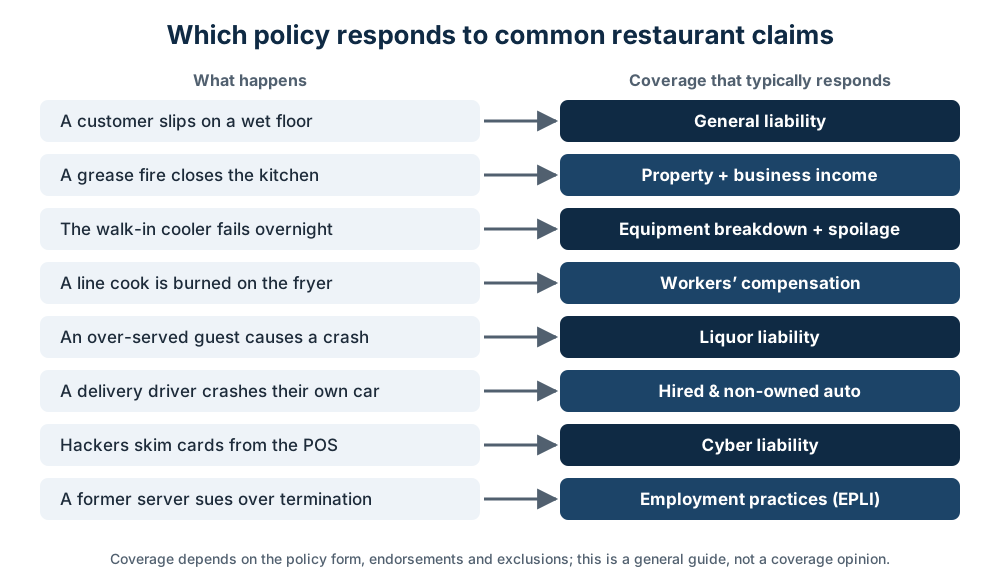
- BWC workers’ compensation — mandatory from the first employee and bought only from the state.
- Stop-gap employer’s liability — employee lawsuits outside the comp system that BWC does not defend.
- General liability — guest slips on winter ice, food illness and premises claims.
- Liquor liability — negligence claims on premises and knowing-service claims off premises under R.C. 4399.18.
- Property with business income — storm, hail and fire damage plus lost income.
- Equipment breakdown and spoilage — walk-ins and cooking equipment that property forms exclude.
- Commercial or hired and non-owned auto — delivery and catering vehicles above state minimums.
- Umbrella liability — higher limits landlords and franchisors often require.
What shapes restaurant insurance pricing in Ohio
For the private part of your program, carriers look at sales, alcohol share of sales, hours, cooking operations and fire protection, building age, location, delivery exposure, deductibles and claims history. BWC premium is driven by payroll, classification and your own claims experience. Server training through ASK, current hood cleaning, snow and ice logs, guarded equipment and a written safety program all help. See how to lower restaurant insurance premiums.
How quoting works with an independent agency
US Restaurant Insure is the restaurant site of Provident Financial Group, an independent agency licensed in Ohio. Your comp comes from BWC; for everything else, one application lets us compare multiple carriers side by side, including stop-gap employer’s liability. After you bind, you get live certificates of insurance for your landlord, lender or franchisor. Call (866) 964-6660 with questions. Coverage is subject to underwriting and policy terms.
Frequently asked questions
Can an Ohio restaurant buy workers’ comp from a private insurer?
No. Ohio is a monopolistic state, so workers’ comp must be purchased from the Ohio Bureau of Workers’ Compensation. Liability, property, liquor and auto coverage come from private carriers.
What is stop-gap coverage and do I need it in Ohio?
Stop-gap is employer’s liability coverage that BWC does not include the way a private comp policy does. It defends employee lawsuits outside the comp system, and most Ohio employers add it.
When is an Ohio permit holder liable for a drunk driver’s crash?
For off-premises injuries, R.C. 4399.18 requires showing that the permit holder knowingly served a noticeably intoxicated or underage person and that the intoxication proximately caused the harm.
Is the ASK server training program mandatory?
No. The Alcohol Server Knowledge program is voluntary, but documented training helps with underwriting and demonstrates responsible service.
Who needs an Ohio Manager Certification in Food Protection?
Risk level III and IV food service operations must have at least one supervisory employee with the certification, plus a trained person in charge during all operating hours.
Ready to compare? Get Multiple Quotes within minutes. Or call (866) 964-6660 to talk it through.
Official Ohio sources
- Ohio Revised Code § 4399.18 (liquor permit holder liability)
- Ohio Division of Liquor Control: Alcohol Server Knowledge program
- Ohio Revised Code § 4123.01 (workers' comp definitions)
- Ohio Revised Code § 4123.77 (noncomplying employer liability)
- Ohio Admin. Code 3717-1-02.4 (food code: management and personnel)
- Ohio Department of Health: food safety certification
- Ohio BMV: mandatory insurance
State facts on this page are drawn from the statutes and agency pages above. Laws and agency rules change, so confirm current requirements with the agency before relying on them. This page is general information, not legal advice or a coverage opinion.
Related pages
- Liquor liability insurance in Ohio
- Restaurant workers’ comp in Ohio
- What happens without workers’ comp
- Liquor liability laws by state
- Restaurant business owners policy
Restaurant insurance by business type in Ohio
- Bar & Tavern Insurance in Ohio
- Brewery & Taproom Insurance in Ohio
- Coffee Shop & Cafe Insurance in Ohio
- Catering Insurance in Ohio
- Bakery Insurance in Ohio
- Pizzeria Insurance in Ohio
- Food Truck Insurance in Ohio
- Ghost Kitchen Insurance in Ohio
- Fast Casual Restaurant Insurance in Ohio
- Fine Dining Restaurant Insurance in Ohio
- Deli & Sandwich Shop Insurance in Ohio
- Fast Food Restaurant Insurance in Ohio
- Ice Cream Shop Insurance in Ohio
- Food Vendor & Farmers Market Insurance in Ohio
- Juice Bar & Smoothie Shop Insurance in Ohio