
Food truck insurance is a package built around one awkward fact: your business is simultaneously a restaurant, a vehicle, and a mobile workplace — and a policy designed for any one of those alone leaves the other two exposed. This guide covers what a food truck actually needs, what it costs, and how to avoid the coverage gaps that show up at the worst possible moments.
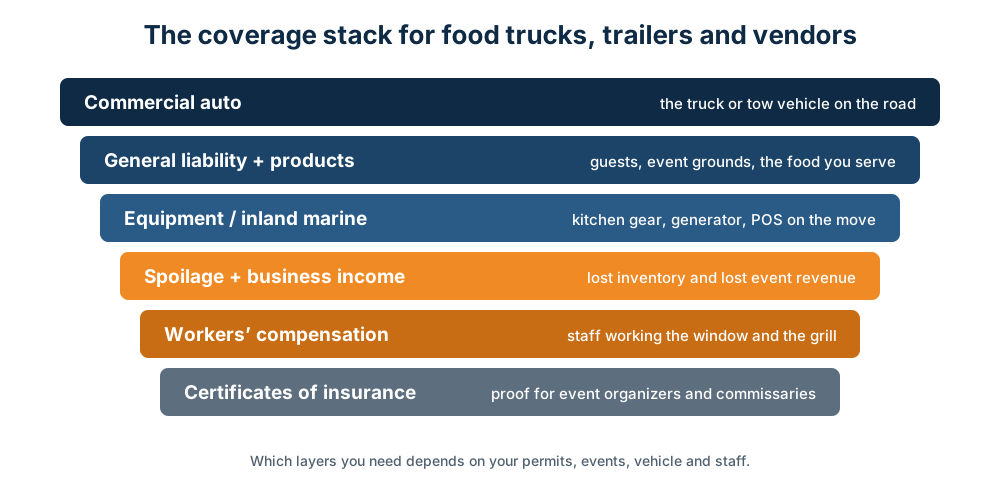
The coverage stack every food truck needs
Commercial auto — the anchor policy
Your personal auto policy excludes business use, full stop. A food truck needs a commercial auto policy covering liability on the road, physical damage to the truck itself, and — critically — the truck as your place of business. This is usually the largest single premium in the stack, and the one where carrier appetite varies most: some auto markets simply won’t write kitchens on wheels, while food-truck-friendly carriers price them sensibly.
General liability
Covers the customer side: someone trips over your generator cord, a hot coffee spill, a foodborne-illness claim from last Saturday’s festival. Events and commissaries almost universally require proof of GL — typically $1M/$2M limits — before you can park, plug in, or serve. Many organizers also demand to be named as additional insured, which your policy should allow without per-certificate fees.
Equipment and contents (inland marine)
Generators, fryers, refrigeration, POS hardware, smallwares — everything bolted into or carried on the truck. Auto physical damage often does not cover the kitchen build-out and contents the way owners assume; an inland marine or equipment endorsement closes that gap, including theft when the truck is parked overnight.
Workers’ compensation
Required in nearly every state once you hire — even part-time window staff count. Food-truck comp classification follows food-service classes with the mobile wrinkle handled by the carrier; our sister agency covers this in depth at restaurant workers’ compensation, including the pay-as-you-go billing that fits seasonal truck payrolls perfectly.
Spoilage and business interruption
A dead compressor or a blown generator can cost you a weekend’s inventory and a festival’s revenue in one stroke. Spoilage coverage is inexpensive relative to the loss; interruption coverage for a truck (including loss of use while the truck is repaired after a covered accident) is the difference between a bad week and a lost season.
What food truck insurance costs
Every restaurant is priced individually — alcohol share, payroll, square footage, location, claims history and the limits you choose all move the number. The fastest way to see yours is a side-by-side quote: Get Multiple Quotes within minutes.
Market ranges for planning, not quotes — every truck prices individually. The spread between carriers on the same truck is wide, because most auto markets treat food trucks as an exception while specialty markets treat them as a program.
The five gaps that catch food trucks
- Personal auto masquerading as coverage — claims get denied the moment the adjuster sees a fryer
- Contents not covered in transit or overnight — theft of generators and equipment is the classic uncovered claim
- No additional-insured capability — locked out of events because your policy can’t name the organizer
- Propane and generator exclusions — some policies exclude the exact equipment that powers your business; read for it, or have us read for it
- Uncovered employees — a part-timer hurt at the window is a workers’ comp claim whether or not you bought the policy
Events, commissaries, and certificates
Food trucks live on paperwork velocity: every festival, brewery partnership, and commissary agreement wants a current certificate, usually with additional-insured wording, often by tomorrow. We issue certificates same-day and structure policies so unlimited certificates don’t carry per-issue fees — because for a truck, the certificate is the ticket to revenue.
Food truck insurance FAQs
Can I insure a food truck on a personal auto policy?
No — personal auto excludes business use, and a food truck is unambiguously a business vehicle. Claims discovered to involve commercial food service get denied, leaving you personally exposed. Commercial auto built for food trucks is the foundation of the program.
How much does food truck insurance cost per month?
Radius, truck value, state, and driving records move the number.
Do I need insurance for a food trailer instead of a truck?
Yes, structured differently — the tow vehicle needs commercial auto, the trailer needs its own coverage, and the kitchen contents need equipment coverage regardless. GL and event requirements are identical to trucks.
What insurance do events require from food trucks?
Almost universally $1M general liability with the organizer named as additional insured, and often liquor liability if you serve alcohol. Same-day certificates with correct wording are the operational must-have.
Does food truck insurance cover my equipment if the truck is stolen?
Only if contents/inland marine coverage is in place — auto physical damage covers the vehicle, but build-out and equipment typically need their own coverage to be fully protected, including overnight theft.
Get your truck quoted right: one application, multiple A-rated carriers that actually write mobile food businesses — start your quote, or see all restaurant coverages and what restaurant insurance costs.
US Restaurant Insure connects food service business owners with Provident Financial Group. Insurance products are offered through Provident Financial Group, a licensed independent insurance agency, and are subject to underwriting approval, policy terms, conditions, and exclusions. Cost figures on this page are illustrative market ranges for planning purposes only — they are not quotes, offers of coverage, or guarantees of premium or savings. Coverage availability varies by state and carrier. Contact us at 1-866-964-6660 for a quote specific to your business.
Food Truck Insurance by state
- Food Truck Insurance in New Jersey
- Food Truck Insurance in New York
- Food Truck Insurance in Connecticut
- Food Truck Insurance in Vermont
- Food Truck Insurance in Ohio
- Food Truck Insurance in Michigan
- Food Truck Insurance in Virginia
- Food Truck Insurance in Pennsylvania
- Food Truck Insurance in Delaware
- Food Truck Insurance in Maryland
- Food Truck Insurance in North Carolina
- Food Truck Insurance in South Carolina
- Food Truck Insurance in Georgia
- Food Truck Insurance in Florida
- Food Truck Insurance in Texas
- Food Truck Insurance in Kentucky
- Food Truck Insurance in Kansas
- Food Truck Insurance in California
- Food Truck Insurance in Indiana
- Food Truck Insurance in Arizona
- Food Truck Insurance in Washington, DC
- Food Truck Insurance in Massachusetts
- Food Truck Insurance in Nevada