
Florida liquor liability insurance covers alcohol-related injury claims and their defense. Florida’s dram shop statute, Fla. Stat. 768.125, is narrow: a seller is not liable for injuries caused by an intoxicated adult unless it willfully and unlawfully served someone under the legal drinking age or knowingly served a person habitually addicted to alcohol. We found no statutory mandate, but leases and lenders routinely require the coverage.
This guide is for Florida bars, brewery taprooms, restaurants with a bar program and caterers, from Miami Beach to the Panhandle. Tourism brings high volume and unfamiliar guests, which makes the practical exposure larger than the statute reads. For your full program, see restaurant insurance in Florida.
Florida Statute 768.125: the two ways a seller becomes liable
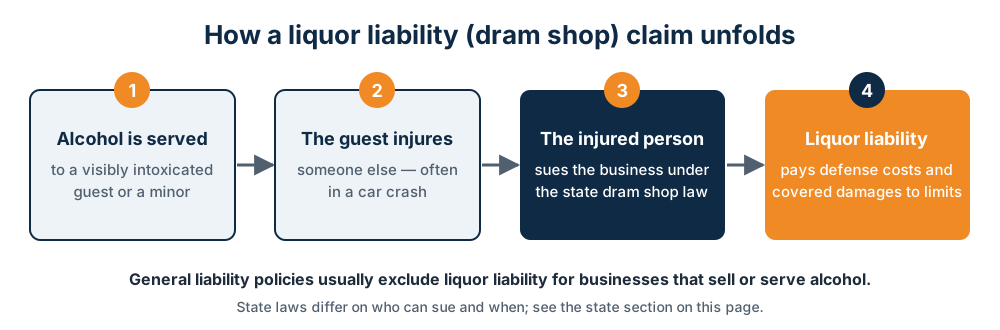
The general rule protects sellers: a person who sells or furnishes alcohol to someone of lawful drinking age is not liable for injury or damage caused by that person’s intoxication. There is no liability for serving an adult who merely appears visibly intoxicated, which is the standard many other states use. Florida has no statutory damage cap on the claims that do fit the exceptions.
The exceptions are specific. Liability attaches if the seller willfully and unlawfully sells or furnishes alcohol to someone under the legal drinking age, or knowingly serves a person habitually addicted to alcohol. The first turns on ID practices. The second turns on what your staff knew about a particular guest, so plaintiffs look closely at regulars, tab histories and bartender testimony. A neighborhood bar with a loyal daily crowd faces a different version of this risk than a beach bar serving tourists who never return.
| Florida situation | Exposure under 768.125 or other law | What decides it |
|---|---|---|
| Visibly intoxicated adult served, later injures someone | No statutory liability | Whether a plaintiff can fit another theory |
| Person under the legal drinking age willfully and unlawfully served | Seller can be liable | ID checks and training records |
| Person known to be habitually addicted is served | Seller can be liable | What staff knew about the guest |
| Fight, fall or security failure on premises | Premises negligence | Assault and battery terms, staffing |
| Minors drinking at an open house party | Crime under Fla. Stat. 856.015 | Relevant to private hosts, not a liquor policy |
Social hosts and Florida’s open house party law
The 768.125 exceptions apply to “a person who sells or furnishes” alcohol, not only licensees, so a private host who furnishes alcohol to a minor or knowingly serves a habitual drinker can face the same exposure. Separately, Fla. Stat. 856.015 makes it a crime to knowingly allow an open house party where minors possess or drink alcohol: a second-degree misdemeanor, or first-degree for repeat offenses or where serious injury or death results. For businesses renting event space, see liquor liability vs host liquor liability.
Does Florida law require liquor liability insurance?
We identified no statutory requirement, and that point is unverified, so confirm it with the Department of Business and Professional Regulation (DBPR), Division of Alcoholic Beverages and Tobacco (ABT). Contracts fill the gap: shopping-center and waterfront leases, lenders, hotel and resort venues, event organizers and franchise agreements routinely require liquor liability with named limits and additional insured status.
Florida’s Responsible Vendor Program: voluntary, with a license payoff
Server training is voluntary in Florida, but the Responsible Vendor Program (Fla. Stat. 561.701–561.706) gives it teeth. A qualified responsible vendor’s license cannot be suspended or revoked because an employee sold to a minor if that employee was trained and the vendor did not know of the violation, and ABT must weigh responsible-vendor status when mitigating administrative penalties. Documented training also supports your defense when a plaintiff alleges willful service to a minor.
Bottle clubs and BYOB in Florida
Florida licenses bottle clubs (the 14BC license under Fla. Stat. 561.01(15) and 561.14(6)) for commercial businesses where patrons drink alcohol they bring in. The statutory definition excludes restaurants licensed by the Division of Hotels and Restaurants, and how the state treats BYOB at those restaurants is unverified, so ask ABT before allowing it. Our BYOB liquor liability guide explains the coverage side.
Claim scenarios typical for Florida venues
During spring break a Panhandle beach bar serves a 19-year-old with a borrowed ID, who later crashes a rental scooter into a pedestrian. A Key West bar serves a daily regular whom the staff all know to be a heavy drinker, and his later crash puts the habitual-addiction exception at issue. A St. Petersburg brewery taproom has two patrons fight on the patio during a game-day event. A caterer pouring at a Tampa waterfront wedding is named with the venue after a guest falls off a dock.
Assault and battery and the liquor exclusion
General liability excludes injury arising from selling or serving alcohol once you are in that business, so alcohol claims belong on a liquor policy. Because Florida’s statute is narrow, many of the claims that actually reach bars are fights and security incidents, and many policies exclude assault and battery or cap it with a small sublimit. See does liquor liability cover assault claims.
Choosing per-occurrence and aggregate limits
The per-occurrence limit caps what the policy pays for one incident; the aggregate caps the policy year. Leases usually specify both. With no statutory cap on 768.125 claims, size limits to your worst realistic night, check whether defense erodes the limit and confirm an umbrella sits over liquor. See per-occurrence vs aggregate limits.
How liquor receipts shape Florida pricing
Liquor liability is rated mainly on liquor receipts, meaning annual alcohol sales and their share of total revenue. A family seafood restaurant where beer is a side order is priced very differently from a late-night club where drinks are most of the sales. Carriers also consider hours, entertainment, drink specials, security, Responsible Vendor status, ID scanning and loss history. Accurate receipts and training files help you see what you qualify for.
Which Florida businesses face which issues
- Bars and nightlife — tourist crowds, underage fake IDs and fights; A&B limits come first.
- Breweries and taprooms — patio events and festival pours alongside manufacturing risks.
- Fine dining and restaurants with bars — lower receipts, but regulars and private events still create exposure.
- Caterers — resort and waterfront venues that demand certificates before load-in.
- Employers with 4 or more employees — workers’ comp is required outside construction, and corporate officers and LLC members count toward that number; see Florida restaurant workers’ comp.
Coverage checklist for Florida alcohol sellers
- Liquor liability — responds to 768.125 claims your GL excludes.
- Assault and battery — a real limit, not a token sublimit.
- General liability — slips, falls and food claims.
- Umbrella — confirm it schedules the liquor policy.
- Commercial property with windstorm — hurricane exposure is high statewide.
- Employment practices liability — seasonal hiring and staffing disputes.
How quoting works with Provident Financial Group
As an independent agency, we take one application to multiple carriers and compare quotes side by side, including A&B terms and umbrella fit. Have your license type, liquor receipts, hours, training records and loss runs ready. After binding, live certificates of insurance for landlords and venues are issued quickly. Call (866) 964-6660 or start online.
Frequently asked questions
Can a Florida bar be sued for serving a visibly drunk adult?
Not under 768.125, which removes liability for serving intoxicated adults except where the seller knowingly served a person habitually addicted to alcohol. Claims on other theories, like negligent security, can still be filed.
What does the habitual addiction exception mean for my bar?
It turns on what you knew about the guest, not how drunk they looked that night. Staff familiarity with regulars is what plaintiffs probe.
Is the Responsible Vendor Program required?
No, it is voluntary. Its benefit is protection for your license when a trained employee sells to a minor without your knowledge, plus mitigation of ABT penalties.
Can my Florida restaurant allow BYOB?
Bottle clubs need a 14BC license, but that definition excludes restaurants licensed by the Division of Hotels and Restaurants, and state treatment of BYOB there is unverified. Ask ABT first.
Serving alcohol in Florida? Compare liquor liability, A&B and umbrella options from multiple carriers. Get Multiple Quotes within minutes.
Official Florida sources
- Florida Statutes § 768.125 (dram shop liability)
- Florida DBPR Division of Alcoholic Beverages and Tobacco: license types
- Florida Statutes § 561.706 (Responsible Vendor Act)
- Florida Statutes § 856.015 (open house parties)
- Florida Statutes § 561.01 (beverage law definitions, incl. bottle clubs)
State facts on this page are drawn from the statutes and agency pages above. Laws and agency rules change, so confirm current requirements with the agency before relying on them. This page is general information, not legal advice or a coverage opinion.
Related pages
- Bar insurance in Florida
- Brewery insurance in Florida
- Catering insurance in Florida
- Fine dining insurance in Florida
- Restaurant insurance in Florida
- Liquor liability laws by state
- Nightclub insurance