
North Carolina restaurants and bars need liquor liability insurance because general liability excludes alcohol claims, and the state’s Dram Shop Act, G.S. 18B-120 to 18B-129, lets injured people sue a permittee that negligently sold to an underage person who then drove impaired. Damages under the act are capped at $500,000 per occurrence, and seller/server training is required before an ABC permit issues.
This guide is for North Carolina ABC permittees: uptown bars in Charlotte, brewery taprooms in Asheville, beach bars on the coast, and restaurants that let guests brown-bag. The North Carolina Alcoholic Beverage Control Commission issues permits and sets training rules; the Dram Shop Act and related statutes decide civil exposure.
What North Carolina’s Dram Shop Act actually covers
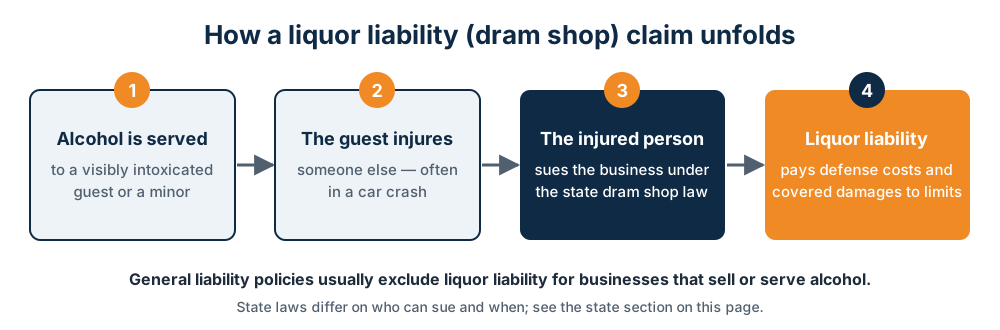
The act is narrower than many owners assume. It makes a permittee, or a local ABC board, liable when it negligently sells or furnishes alcohol to an underage person, and that person’s resulting impairment causes injury through negligent driving. The injured party sues for the harm the underage driver caused. Total damages under the act are capped at $500,000 per occurrence (G.S. 18B-123), regardless of how many people were hurt.
Brown-bagging, special occasion and special one-time permit holders are excluded from the act (G.S. 18B-125). That exclusion is about the statute, not about every possible lawsuit, so it is not a reason to go without coverage. The act also contains other procedural and defense rules; a North Carolina attorney can walk you through how they apply to a specific claim.
Serving intoxicated adults: G.S. 18B-305 and an open question
Separately, G.S. 18B-305 makes it unlawful for a permittee or employee to knowingly sell or give alcohol to an intoxicated person. That is a clear licensing rule the ABC system enforces. Whether, and how, injured people can build a common-law negligence claim on it outside the Dram Shop Act is not something we have verified, so do not assume the act’s cap limits every alcohol claim against you. Buy limits for the claims the cap may not reach.
Social hosts in North Carolina
The Dram Shop Act applies only to permittees and ABC boards, not private hosts. Common-law social host liability is unverified. If you run private events at your venue, the distinction between host liquor coverage and a full liquor policy matters; see liquor liability vs. host liquor liability.
Is liquor liability insurance required in North Carolina?
We have not identified a statute requiring it. Leases, lenders, event venues and festival organizers are where the requirement shows up, usually with minimum limits and additional insured wording. A brewery signing a lease in a new mixed-use building, or a caterer booking a historic estate, should expect the question before the contract is signed.
Seller/server training: required for the permit, useful in court
The NC ABC Commission requires proof of alcohol seller/server training before it issues an ABC permit, covering ID checks, underage and intoxicated-patron sales, dram shop liability and hours of sale. Its Responsible Alcohol Seller/Server Program (RASP) is offered at no charge. Training also has a legal payoff: under G.S. 18B-122, employee instruction and training are factors a permittee can prove in defending a dram shop negligence claim. Keep certificates and attendance records where you can find them.
Brown-bagging and special occasion permits
A restaurant that lets patrons bring their own fortified wine or spirituous liquor, up to 8 liters per patron, needs a brown-bagging permit under G.S. 18B-1001(7). A special occasion permit under 18B-1001(8) lets a host bring fortified wine and spirits to a private event. Both sit outside the Dram Shop Act, but fights, falls and over-consumption on your premises still generate claims, so confirm how your policy treats brown-bagged alcohol.
Claim scenarios North Carolina venues should expect
| Scenario | Which rule applies | Coverage point |
|---|---|---|
| An uptown bar serves a 19-year-old who crashes on the way home | Dram Shop Act; damages capped per occurrence | Liquor liability; limit at or above the cap |
| A visibly drunk regular at a taproom injures a pedestrian | G.S. 18B-305 licensing rule; civil theory unverified | Liquor liability; do not rely on the cap |
| A beach bar fight during a holiday weekend | Premises and assault claim | Assault and battery at full limits |
| A barback is cut breaking up that fight | Employee injury | Workers’ compensation |
North Carolina requires workers’ comp once three or more employees are regularly employed, with rates filed by the North Carolina Rate Bureau. See restaurant workers’ comp in North Carolina.
Assault and battery and the GL liquor exclusion
Your GL excludes intoxication-related injury once you sell alcohol. Inside the liquor policy, assault and battery is commonly excluded or sublimited, and claims arising from your own staff’s use of force are sometimes carved out. For a coastal bar with a seasonal crowd, that wording deserves as much attention as the limit. See does liquor liability cover assault claims?
The statutory cap vs. the limits you buy
The per-occurrence limit is what the carrier pays for one incident; the aggregate caps the policy year. The act’s per-occurrence cap gives a useful benchmark for underage-sale claims, but claims outside the act, assault claims and defense costs are not bound by it. More on per-occurrence vs. aggregate.
North Carolina coverage checklist
- Liquor liability — responds to Dram Shop Act and other alcohol suits
- Per-occurrence limit sized to the cap and beyond — non-act claims are not capped
- Assault and battery at full limits — crowded weekends and ejections
- Coverage for brown-bagging service — confirm the carrier knows about it
- Additional insured endorsements — landlords and festivals require them
- Defense outside the limit where available
- Workers’ compensation — required at three or more employees
How liquor receipts shape North Carolina pricing
Carriers rate largely on annual alcohol receipts and on alcohol’s share of sales. A brewery selling mostly its own beer, a steakhouse with a wine list and a late-night bar all land differently. Closing time, live music, occupancy, security, ABC violations and claim history follow. Current RASP records, ID scanners and a written cut-off policy help.
Which North Carolina businesses face which issues
Bars face the most underage and assault exposure. Breweries add product liability and tour groups. Caterers need to know which permit covers each event. Fine dining rooms have lower alcohol shares but still face over-service claims.
How quoting works with Provident Financial Group
One application reaches multiple carriers, and Provident Financial Group compares limits, assault terms and defense treatment side by side. After binding we issue certificates for landlords and venues. Call (866) 964-6660. See also restaurant insurance in North Carolina.
Frequently asked questions
Does North Carolina cap dram shop damages?
Yes for claims under the Dram Shop Act: total damages are capped at $500,000 per occurrence (G.S. 18B-123). Other theories may not be capped.
Do I need server training to get an ABC permit?
Yes. The NC ABC Commission requires proof of seller/server training before issuing a permit, and RASP is available at no charge.
Is a brown-bagging restaurant covered by the Dram Shop Act?
No. Brown-bagging, special occasion and special one-time permit holders are excluded under G.S. 18B-125, but other premises claims remain.
Does training help if I am sued?
Yes. G.S. 18B-122 lets a permittee prove employee instruction and training as factors in its defense.
Compare North Carolina liquor coverage today. Get Multiple Quotes within minutes.
Official North Carolina sources
- N.C. General Statutes Chapter 18B, Article 1A (Dram Shop Act)
- N.C. General Statutes § 18B-305 (sales to intoxicated persons)
- N.C. General Statutes § 18B-1001 (ABC permits, incl. brown-bagging)
- NC ABC Commission: Responsible Alcohol Seller/Server Program (RASP)
- NC ABC Commission: proof of alcohol seller/server training
State facts on this page are drawn from the statutes and agency pages above. Laws and agency rules change, so confirm current requirements with the agency before relying on them. This page is general information, not legal advice or a coverage opinion.
Related pages
- Restaurant insurance in North Carolina
- Bar insurance in North Carolina
- Brewery insurance in North Carolina
- Catering insurance in North Carolina
- Fine dining insurance in North Carolina
- Restaurant insurance in Raleigh
- Liquor liability laws by state