
Connecticut liquor liability insurance covers claims that your alcohol service contributed to someone’s injury. Connecticut has a true Dram Shop Act, Conn. Gen. Stat. §30-102: a seller who serves an intoxicated person can be liable when that person injures someone, with damages capped at $250,000 per injured person and $250,000 in the aggregate. No statute requires the coverage, but landlords and lenders expect it.
This guide is for Connecticut bar and tavern owners, brewery taprooms, restaurants with a wine or cocktail program, and caterers working weddings from Fairfield County to the shoreline. It walks through the Dram Shop Act’s notice rules, the claims that fall outside its cap, and how carriers look at your operation. For your broader program, see restaurant insurance in Connecticut.
How Connecticut’s Dram Shop Act works
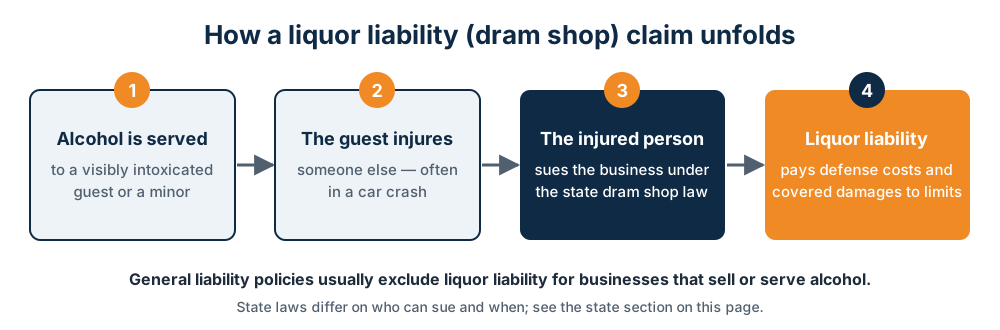
Under §30-102, anyone who sells alcohol to an intoxicated person is liable when that person, because of the intoxication, injures another person or damages property. The injured third party brings the claim. The regulator on the licensing side is the Department of Consumer Protection (DCP), Liquor Control Division, but the civil claim runs through the courts under the statute.
The Act comes with procedural rules that shape every claim. Damages are capped at $250,000 per injured person and $250,000 in the aggregate. The injured party must give the seller written notice within 120 days of the injury, or 180 days in cases of death or incapacity, and must sue within one year. For sales to someone 21 or older there is no separate negligence claim. Claims alleging wanton or reckless service, however, rest on common law and fall outside the statutory cap.
That last point is why the cap should never set your insurance limits. A reckless-service allegation, such as pouring another round for a guest who is visibly stumbling, can seek damages above the statutory figure, and defense costs come on top.
| Element | Connecticut rule under §30-102 |
|---|---|
| Who can sue | A person injured, or whose property is damaged, by the intoxicated buyer |
| Standard | Sale of alcohol to an intoxicated person |
| Damages cap | $250,000 per injured person; $250,000 aggregate |
| Notice | Written notice within 120 days (180 days for death or incapacity) |
| Deadline to sue | One year |
| Outside the cap | Common-law claims for wanton or reckless service |
Social host rules for Connecticut hosts
Conn. Gen. Stat. §30-89a makes it a crime to knowingly or recklessly permit a minor to possess alcohol in a dwelling or on private property, or to fail to halt that possession; a first violation is a class A misdemeanor. Civil liability for hosts who serve minors rests on common-law negligence case law, and the scope of any statutory civil social-host liability is unverified. For restaurants that host private events, the difference between your liquor policy and host liquor liability matters.
Does Connecticut require liquor liability insurance?
Not by statute; we found no statutory liquor liability insurance mandate for permittees. The requirement arrives through contracts instead: commercial leases, mortgage and equipment lenders, event venues that make caterers show coverage before load-in, and franchise agreements. Those contracts typically specify per-occurrence and aggregate limits, additional insured status and sometimes assault and battery coverage. Keep a current certificate of insurance ready for each of them.
Server training and the Liquor Law Education Program
Server training is voluntary in Connecticut. DCP recognizes approved alcohol seller and server training programs under §30-47(b), with at least five classroom hours covering sales to minors, over-service, promotions and liability. Separately, since January 1, 2026, applicants, permittees and backer owners on new on-premises and off-premises permit applications, transfers and substitute-permittee applications must complete DCP’s free Liquor Law Education Program before the permit issues. In a dram shop state, a trained staff and a written refusal log are useful evidence, and underwriters notice both.
BYOB is unsettled: we did not locate a state statute or DCP guidance on BYOB at unlicensed restaurants, so treat the rules as unverified and check with DCP and your town. Our BYOB liquor liability guide covers the insurance questions.
Claims that start in Connecticut dining rooms and taprooms
A Hartford sports bar keeps serving a regular through a playoff game; he drives home and strikes a pedestrian, whose attorney sends the 120-day notice letter and later adds a reckless-service count. A New Haven brewery taproom runs a trivia night where two patrons fight over a table, and the injured guest sues for negligent security. A shoreline seafood restaurant hosts a rehearsal dinner and a guest under 21 is served at the bar. A caterer working a barn wedding is named alongside the venue after a guest’s crash on the way home.
Assault and battery, liquor exclusions and your limits
Your general liability policy excludes alcohol-related injury once you are in the business of selling alcohol, so the liquor policy is where a §30-102 claim lands. Check whether that policy covers assault and battery or pushes it to a small sublimit; many do. See does liquor liability cover assault claims.
Limits come as two numbers: per occurrence, the most paid for one incident, and aggregate, the most paid in the policy year. Because reckless-service claims are uncapped, size limits to your worst realistic night rather than to the statutory figure, and consider an umbrella that sits over the liquor policy. Our explainer on per-occurrence vs aggregate limits goes deeper.
What moves the price of Connecticut liquor coverage
Carriers rate primarily on liquor receipts: annual alcohol sales and their share of total revenue. A restaurant where wine is a small part of the check is a different risk from a late-night bar where drinks are most of the sales. Hours, live music, promotions, security staffing, completed server training, ID scanning and loss history all adjust the rate. Clean POS reporting that splits food from alcohol, training certificates and an incident log help you see what you qualify for.
Which Connecticut businesses face which issues
- Bars and taverns — the most direct §30-102 exposure, late hours and fights; set limits well above the cap.
- Breweries and taprooms — on-site pours, events and to-go sales; make sure the liquor form fits a manufacturer with a taproom.
- Fine dining and restaurants with bars — lower receipts ratio, but private dining and pairings still produce over-service claims.
- Caterers — off-premises service, venue certificate demands and under-21 wedding guests.
- Every employer — workers’ comp is required under §31-284(b) with no minimum employee count; see Connecticut restaurant workers’ comp.
Coverage checklist for Connecticut permittees
- Liquor liability — the policy that answers a §30-102 claim.
- Assault and battery — full limits, not a sublimit, for bars and late-night rooms.
- General liability — premises and food claims unrelated to alcohol.
- Umbrella — confirm it follows form over liquor liability.
- Employment practices liability — staffing disputes and harassment claims.
- Defense cost terms — defense inside or outside limits changes what is left for a settlement.
How the quote process works with Provident Financial Group
As an independent agency, we submit one application to multiple carriers and lay the quotes side by side, comparing liquor limits, A&B terms and umbrella fit. Bring your permit type, liquor receipts, hours, training records and loss runs. After binding, live certificates of insurance for landlords and venues are issued quickly. Call (866) 964-6660 or start online.
Frequently asked questions
How long does an injured person have to notify my bar in Connecticut?
Written notice is due within 120 days of the injury, or 180 days in cases of death or incapacity, and suit must be filed within one year. Send any notice letter to your agent and carrier the day it arrives.
Does the statutory cap mean I only need that much coverage?
No. Common-law claims for wanton or reckless service fall outside the cap, defense costs add up separately, and landlords usually require higher limits anyway.
Is server training required for Connecticut bartenders?
For servers it is voluntary, through DCP-approved programs. Owners on new permit applications and transfers must complete the Liquor Law Education Program as of January 1, 2026.
Does a caterer need its own liquor liability in Connecticut?
Usually. Venues typically require caterers who serve alcohol to carry liquor liability and name the venue as additional insured, and a §30-102 claim targets whoever sold the alcohol.
Serving alcohol in Connecticut? Compare liquor liability and assault and battery options from multiple carriers. Get Multiple Quotes within minutes.
Official Connecticut sources
- Connecticut General Statutes § 30-102 (Dram Shop Act)
- Connecticut Department of Consumer Protection: Liquor Control Division
- Connecticut DCP: Liquor Law Education Program requirements for new applicants
- Connecticut eRegulations: liquor control regulation
State facts on this page are drawn from the statutes and agency pages above. Laws and agency rules change, so confirm current requirements with the agency before relying on them. This page is general information, not legal advice or a coverage opinion.
Related pages
- Bar insurance in Connecticut
- Brewery insurance in Connecticut
- Catering insurance in Connecticut
- Fine dining insurance in Connecticut
- Restaurant insurance in Connecticut
- Liquor liability laws by state
- Do caterers need liquor liability?