
Food trucks in Texas typically need commercial auto insurance meeting at least the state’s 30/60/25 minimum (in thousands of dollars), general liability for customers at the window, and coverage for the kitchen equipment on board. Workers’ compensation is optional for most private Texas employers, but opting out carries legal duties. Since July 1, 2026, mobile food vendors also need a state DSHS license.
This guide is for Texas operators working brewery lots in Austin, office parks in Plano, church festivals in San Antonio and rodeo-season events in Houston. It focuses on what is different in Texas: a new statewide license, an elective comp system, the Dram Shop Act and weather that punishes anything parked outside. The general picture is on our food truck insurance page.
What changed with the statewide DSHS license in 2026?
According to the Texas Department of State Health Services, beginning July 1, 2026 all mobile food vendors must hold a DSHS license to operate in Texas, replacing the separate licenses cities and counties used to issue. DSHS lists license types I through III and requires a pre-licensing inspection. The DSHS page we reviewed did not spell out central preparation facility (commissary) rules, so confirm those with DSHS rather than relying on older city guidance.
Food safety rules still apply on the truck under the Texas Food Establishment Rules (25 TAC Chapter 228). Under §228.31, food employees must complete an accredited food handler course within 30 days of employment, and operations handling time/temperature-control foods may need a Certified Food Manager under Health & Safety Code §437.0076. Cities may still regulate where and when you set up, so ask about parking and fire rules wherever you vend.
Subscriber or non-subscriber: the Texas workers’ comp decision
Texas is the one state in our footprint where most private employers can legally skip workers’ comp. Labor Code §406.002 says an employer may elect to obtain coverage, and TDI estimated that in 2022 about 27% of employers in the arts, entertainment, accommodation and food services sector were non-subscribers. For a truck with a small crew, the trade-offs look like this.
| Question | Subscriber (buys comp) | Non-subscriber (opts out) |
|---|---|---|
| Who pays for a burned cook’s medical care and lost wages? | The comp policy, under the statutory system | The business, if the employee sues and wins |
| Can the employee sue you for negligence? | Generally no; comp is the remedy | Yes, and under §406.033 you lose the contributory-negligence and assumption-of-risk defenses |
| Paperwork duties | Post coverage notices | File a non-coverage notice with TDI-DWC and notify and post notices for employees (§§406.004–406.005) |
| Where to buy if the market says no | Texas Mutual Insurance Company, the insurer of last resort | Not applicable |
Many event organizers and property managers ask for evidence of comp regardless of state law, so a non-subscriber truck can lose bookings. See Texas restaurant workers’ comp and what happens without comp.
Why 30/60/25 is only the starting line on Texas highways
The Texas Department of Insurance describes the minimum as 30/60/25 (in thousands of dollars): per-person injury, per-accident injury and property damage. A truck running I-35 between Austin and San Antonio, or crossing Houston on the 610 Loop, carries weight, propane and hot oil through heavy traffic. One multi-car crash can exceed those numbers quickly, which is why venues often specify higher auto limits.
Use a commercial auto policy for the truck, schedule every driver and declare the value of the build-out. If employees make supply runs in their own pickups, hired and non-owned auto fills that gap. Trailers are rated differently; see food trailer insurance.
Hail, hurricanes and heat on a Texas route
Hail damage to the truck is typically handled under comprehensive physical damage on the auto policy, so the deductible you choose there matters. If you own a commissary or storage building on the coast, windstorm is its own market: the Texas Windstorm Insurance Association writes wind and hail coverage in the 14 first-tier coastal counties and parts of Harris County east of Highway 146, but only after an authorized insurer declines, and buildings generally need a windstorm certificate. TWIA does not cover flood. Summer heat is the quieter risk: a cooler that fails on a triple-digit afternoon can wipe out a weekend of inventory, which spoilage coverage is built for.
Beer at the festival: the Texas Dram Shop Act and TABC training
Most trucks do not hold a TABC permit; at many events the permit holder is the organizer or a partner brewery. If you do sell alcohol, Texas Alcoholic Beverage Code §2.02 makes a provider liable only when the person served was obviously intoxicated to the point of presenting a clear danger, and §2.03 makes that chapter the exclusive civil remedy for serving anyone 18 or older. The §106.14 safe harbor protects the permit from TABC administrative action if you require TABC-approved seller-server training and staff attended it; certificates last two years. It does not protect the business from lawsuits. See Texas liquor liability insurance.
Event COIs across Houston, Austin, San Antonio and DFW
Rodeos, music festivals, food truck parks, brewery taprooms, HOA block parties and stadium tailgates nearly all want a certificate before you arrive. Expect requests for additional insured status, primary and non-contributory wording and a waiver of subrogation, often with several entities named. Truck parks may want to be named for the whole lease term rather than per event. Blanket endorsements let us issue certificates quickly; our Houston restaurant insurance page covers fixed-location considerations.
Texas food truck coverage checklist
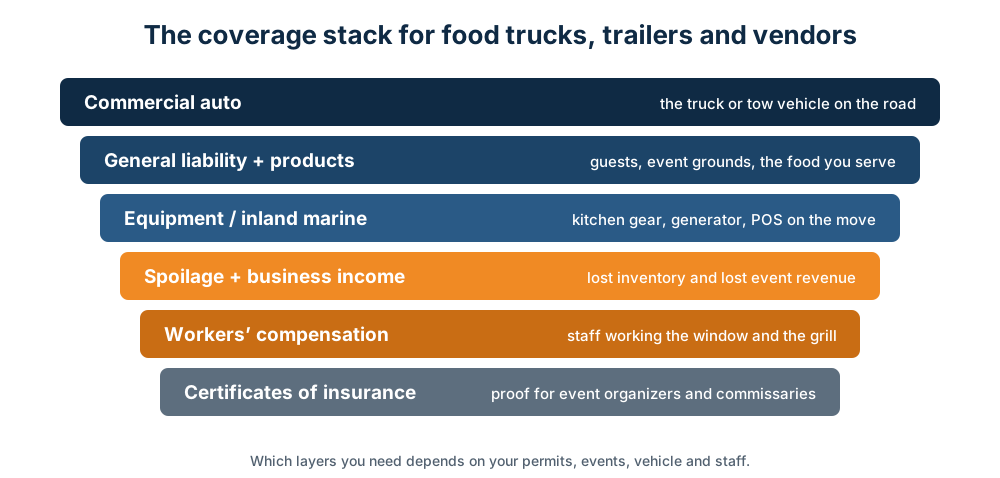
- Commercial auto liability — at least 30/60/25 (in thousands of dollars), higher for venue contracts.
- Comprehensive and collision — hail is a Texas reality; declare the build-out.
- General liability — guest injuries at the window and foodborne illness claims.
- Workers’ comp or a documented non-subscriber plan — a decision, not a default.
- Equipment coverage — generators, smokers and tents used off the truck.
- Spoilage and equipment breakdown — heat-related refrigeration losses.
- Liquor liability — only if you or your staff sell or serve alcohol.
- Umbrella — extra limits for big festivals and corporate catering.
Rating factors Texas underwriters look at
Premiums reflect where the truck garages (coastal and hail-prone counties rate differently), mileage, driver records, vehicle and kitchen value, and cooking method; wood-fired smokers and fryers are underwritten differently from coffee or dessert trucks. Comp pricing turns on payroll and classification, and on whether you buy it at all. What helps: covered parking in storm season, a maintained fire suppression system, written driver rules, current food handler records and clean inspections under your DSHS license.
How the quote process works
With Provident Financial Group, you fill out one application and we compare multiple carriers side by side, including options with and without comp. After you bind, we issue live certificates of insurance for truck parks and event organizers. Call (866) 964-6660 with questions.
Frequently asked questions
Do I still need a city health permit after the 2026 DSHS license?
DSHS says its license replaces separate local-jurisdiction licenses for mobile food vendors starting July 1, 2026. Cities can still regulate where you set up, so check local parking and fire rules.
Is it legal to run my Texas food truck without workers’ comp?
For most private employers, yes, but you must file a non-coverage notice with TDI-DWC and notify employees, and you lose key defenses if a worker sues.
Does TABC server training protect me from a drunk-driving lawsuit?
No. The §106.14 safe harbor protects your permit from TABC administrative action; civil claims fall under the Dram Shop Act, which liquor liability insurance addresses.
Is hail damage to my truck covered?
Usually under the comprehensive portion of a commercial auto policy, subject to your deductible and policy terms. Liability-only auto does not cover your own vehicle.
Can a truck park be named on my policy for the whole year?
Yes. Blanket additional insured wording, or naming the park specifically, supports a certificate that runs for your lease term.
Ready to see what you qualify for? Get Multiple Quotes within minutes. Prefer to talk it through? Call Provident Financial Group at (866) 964-6660.
Official Texas sources
- Texas DSHS: Certified Food Manager program FAQ
- Texas DSHS: food handler training program FAQ
- Texas DSHS: mobile food vendors
- Texas Department of Insurance: car insurance tips
- Texas Alcoholic Beverage Code, Chapter 2 (dram shop liability)
State facts on this page are drawn from the statutes and agency pages above. Laws and agency rules change, so confirm current requirements with the agency before relying on them. This page is general information, not legal advice or a coverage opinion.