
Food trucks in New Jersey typically need commercial auto insurance meeting the 35/70/25 minimum (in thousands of dollars) for policies issued or renewed since January 1, 2026, plus general liability, equipment coverage and workers’ compensation, which New Jersey requires for virtually every employer. Trucks are licensed town by town, so expect several local permits and a certificate of insurance for each.
This page is for operators working the Shore in summer, brewery and winery lots in the fall, and office campuses and municipal concerts around Hoboken, Jersey City, Newark and Princeton year-round. It explains what New Jersey requires and how to keep one policy working across many towns. The broader picture is on our food truck insurance page.
Town-by-town permits: why one truck may need several
New Jersey has no single statewide food truck license. Trucks are licensed and inspected by local health departments under N.J.A.C. 8:24 (Sanitation in Retail Food Establishments), and most towns layer a municipal vendor permit on top. A truck that works Asbury Park on Saturday and a corporate park in Morris County on Monday may hold permits from each, and many municipalities ask for a certificate of insurance with the township listed before issuing one. Statewide rules on commissary bases were not something we could verify, so ask each health department what it requires.
| Where you set up | Who grants permission | What they usually want from your insurance |
|---|---|---|
| Boardwalk or beach town | Municipal clerk and local health department | Certificate listing the municipality; sometimes additional insured status |
| Brewery or winery lot | The property owner | Additional insured, primary and non-contributory wording |
| Corporate or university campus | Facilities or risk management office | Higher limits, waiver of subrogation, workers’ comp evidence |
| Street fair or municipal concert | Event producer plus the town | Several named entities on one certificate |
Certified food protection manager rules under N.J.A.C. 8:24
N.J.A.C. 8:24-2.1 requires at least one person in charge at Risk Type 3 food establishments to be a certified food protection manager, using an exam from a Conference for Food Protection-recognized program. Whether your truck is classified Risk Type 3 depends on the menu and preparation steps the local health department reviews. Either way, a certified manager on the truck is a good underwriting signal and a practical defense if an illness claim is filed.
New Jersey’s 35/70/25 auto minimum, and what it misses
Under P.L.2022, c.87, confirmed in NJ DOBI Bulletin 25-06, New Jersey’s minimum auto liability rose to 35/70/25 (in thousands of dollars) for policies issued or renewed on or after January 1, 2026, up from 25/50/25. New Jersey is also a no-fault (PIP) state. A food truck on the Turnpike or the Parkway during Shore traffic can easily be involved in a crash that exceeds those limits, and campus and event contracts often specify more.
The truck needs commercial auto, not a personal policy, with physical damage that values the kitchen build-out. Staff who pick up supplies in their own cars create a hired and non-owned auto exposure. See also when restaurants need commercial auto.
Workers’ comp with no employee threshold
New Jersey requires virtually every employer to carry workers’ compensation. A corporation must insure if anyone, including corporate officers, performs services for pay; partnerships, LLCs and sole proprietors must insure once they employ anyone other than the partners, members or owner. There is no state fund, so coverage comes from private carriers or approved self-insurance, and rates follow the New Jersey Compensation Rating & Inspection Bureau (NJCRIB), which uses its own manual rather than NCCI’s.
Failure to insure is a disorderly persons offense, and a knowing failure is a fourth-degree crime. The Division can assess penalties for every 10-day period of noncompliance, issue stop-work orders, and hold the employer directly liable for benefits (N.J.S.A. 34:15-79). One summer hire without coverage is a real risk. See New Jersey restaurant workers’ comp.
TDI and Family Leave Insurance: the payroll item owners forget
Separate from comp, New Jersey employers must take part in state Temporary Disability Insurance and Family Leave Insurance through payroll contributions, or provide an approved private plan with benefits at least equal to the State Plan. You must display TDI and FLI posters and give written notice of benefits at hire. It is not a policy we sell with your truck coverage, but it belongs on the same compliance checklist.
Shore storms, nor’easters and winter freeze-ups
Coastal New Jersey is exposed to hurricanes, nor’easters and storm-surge flooding; Superstorm Sandy in 2012 caused widespread coastal damage. A truck parked near the water during a surge event is a comprehensive physical damage claim, so keep that coverage in place. Winter brings the opposite problem: frozen water lines and tanks on a truck parked outdoors, plus snow load on any storage structure. Spoilage when commissary power fails is covered by equipment breakdown and spoilage coverage.
Pouring beer or wine: the Fair Liability Act
If your truck serves alcohol under a license, the Licensed Alcoholic Beverage Server Fair Liability Act (N.J.S.A. 2A:22A-1 et seq.) makes a licensed server liable when it serves a visibly intoxicated person, or a minor it knew or reasonably should have known was underage, and the injury was a foreseeable result. Fault is apportioned under comparative negligence. Server training is voluntary in New Jersey, but it is still worth documenting. See New Jersey liquor liability.
New Jersey food truck coverage checklist
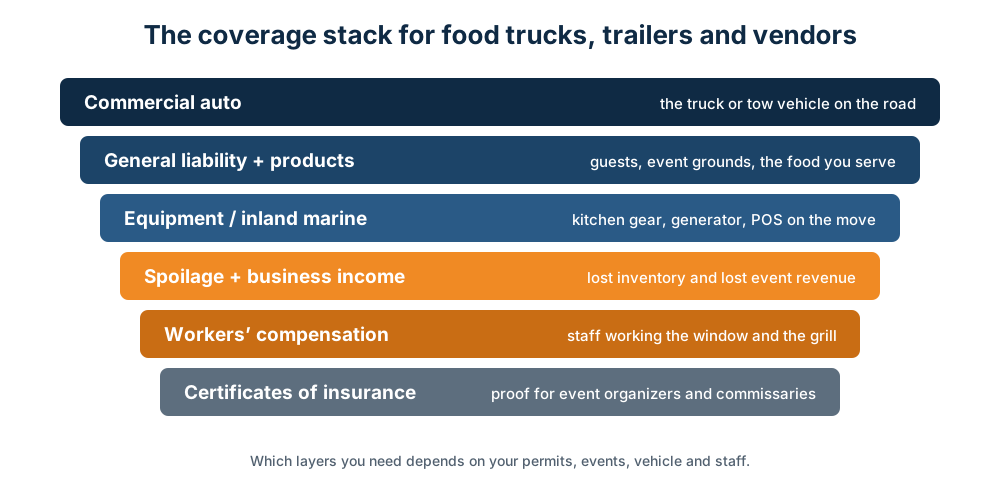
- Commercial auto liability — 35/70/25 (in thousands of dollars) is the minimum since 2026.
- Physical damage with the build-out declared — surge, theft and collision.
- General liability with products coverage — guest injuries and foodborne illness.
- Blanket additional insured — one endorsement for many towns and venues.
- Workers’ compensation — required with virtually any paid help.
- Equipment and spoilage — generators, coolers and inventory.
- Liquor liability — only if you serve alcohol.
- Umbrella — for campus and large-event contracts.
How New Jersey carriers price a food truck
Pricing reflects garaging location, routes and seasonal mileage, driver records, vehicle and kitchen value, cooking method, payroll under NJCRIB classifications and prior claims. What helps: fire suppression and K-class extinguishers, winterization procedures, a certified food protection manager on staff and clean local inspections in every town you work.
How we quote it
Provident Financial Group is an independent agency. One application lets us compare multiple carriers side by side, and after binding we issue live certificates of insurance you can send to each municipality and venue. Call (866) 964-6660.
Frequently asked questions
Does New Jersey have a statewide food truck license?
No. Trucks are licensed and inspected locally under N.J.A.C. 8:24, and many towns add their own vendor permit, so multi-town operators often hold several.
My policy renewed in March 2026. Which auto minimum applies?
Policies issued or renewed on or after January 1, 2026 must meet 35/70/25 (in thousands of dollars), so your renewal should already reflect it.
Do I need workers’ comp for one seasonal helper at the Shore?
Yes. New Jersey has no minimum employee threshold, so a single paid helper triggers the requirement.
Can I list several towns on one certificate?
Often yes, if the policy carries blanket additional insured wording, though many municipalities want their own certificate. We issue them as needed.
Is server training required to pour beer at a New Jersey event?
New Jersey does not mandate responsible-server training, but documented training helps show reasonable care under the Fair Liability Act.
Ready to see what you qualify for? Get Multiple Quotes within minutes. We will line up carriers before your next permit deadline.
Official New Jersey sources
- New Jersey Department of Health: retail food program
- N.J.A.C. 8:24-2.1 (person in charge; certified food protection manager)
- New Jersey DOBI Bulletin 25-06 (auto liability minimums)
- N.J.S.A. 2A:22A-5 (Licensed Alcoholic Beverage Server Fair Liability Act)
State facts on this page are drawn from the statutes and agency pages above. Laws and agency rules change, so confirm current requirements with the agency before relying on them. This page is general information, not legal advice or a coverage opinion.