
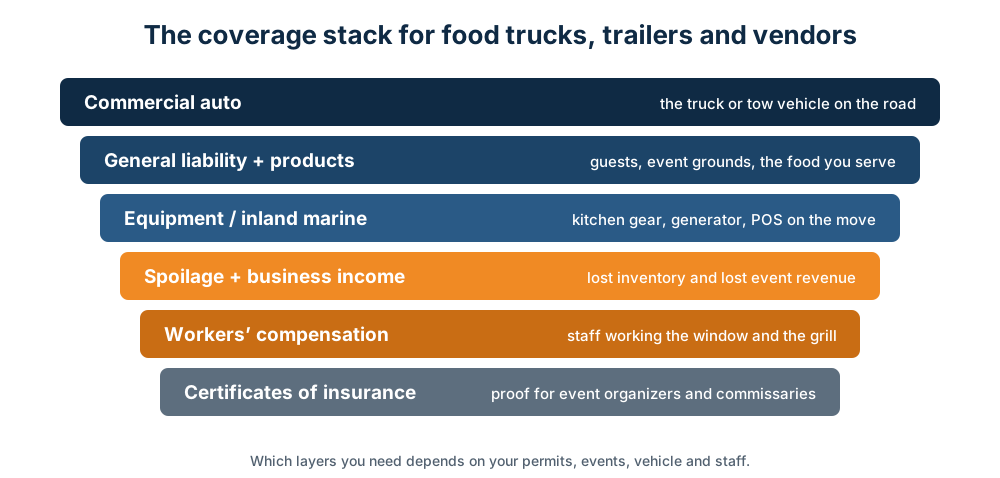
Food trucks in Florida typically need a commercial auto policy, general liability, coverage for onboard kitchen equipment and, once the business has four or more employees, workers’ compensation. The state licenses mobile food dispensing vehicles through DBPR, and Florida’s own auto minimums of 10 PIP and 10 property damage (in thousands of dollars) are far below what event organizers and venues usually expect.
This page is for operators running trucks and mobile kitchens from Jacksonville to Miami, whether the calendar is farmers markets, beach-town festivals, stadium lots or corporate lunches around Orlando and Tampa. Florida’s rules differ from most states in three ways: one state license, a four-employee comp threshold and a long hurricane season. Our food truck insurance overview covers the basics.
How DBPR licenses mobile food dispensing vehicles
Florida calls a food truck a mobile food dispensing vehicle (MFDV), and it is licensed by the Department of Business and Professional Regulation, Division of Hotels and Restaurants. A vehicle that is not fully self-sufficient must report daily to a licensed commissary, permitted by DBPR or FDACS, and identified on Form HR-7022. The same division licenses and inspects stand-alone restaurants and fast food operations, so your truck sits under the regulator that sees most of the state’s food service.
Florida Statute 509.039 requires all managers of a food service establishment to pass an approved food manager certification test within 30 days of employment. Keep that certificate current; underwriters ask about it, and a lapse can show up on an inspection report.
Can a Florida city require its own food truck permit?
Largely no. Florida Statute 509.102 preempts local governments from requiring separate MFDV licenses, permits, registrations or fees, and from banning trucks across their whole jurisdiction. Cities can still regulate other parts of your operation, such as where and when you park, and ports and airports are excepted. In practice, the paperwork burden shifts from city permits to private gatekeepers: market managers, property owners and event producers, each of whom wants a certificate of insurance.
| Requirement | Florida rule | Insurance angle |
|---|---|---|
| State license | DBPR Division of Hotels and Restaurants licenses MFDVs | Carriers ask for your license number and inspection history |
| Commissary | Daily reporting if not self-sufficient, listed on Form HR-7022 | Commissary agreements often ask to be named as additional insured |
| Local permits | Separate local licenses and fees preempted (Fla. Stat. 509.102) | Venues and events, not cities, drive certificate requests |
| Food manager | Certification within 30 days (Fla. Stat. 509.039) | Documented training supports underwriting |
| Workers’ comp | Required at four or more employees, officers and LLC members counted | Set payroll and class codes correctly at application |
Florida’s no-fault auto rules and why the minimum is not enough
Florida is a no-fault state. The Department of Highway Safety and Motor Vehicles requires at least 10 PIP and 10 property damage liability (in thousands of dollars), and standard vehicles are not required to carry bodily injury liability at all. For a truck carrying propane and hot oil through I-4 traffic, that leaves the business exposed if someone is hurt, and nearly every festival, stadium and private venue wants bodily injury liability on the certificate.
A commercial auto policy with meaningful liability limits, physical damage that values the kitchen build-out and hired and non-owned auto for supply runs in personal cars is the usual structure. Rules for heavier commercial vehicles can differ, so confirm your truck’s weight class with FLHSMV. Towing a concession trailer instead? See food trailer insurance.
The four-employee comp line, and who counts toward it
Outside construction, Florida employers must carry workers’ compensation once they have four or more employees (Fla. Stat. 440.02). The count includes corporate officers and LLC members, and anyone paid for work counts, with no part-time exception. A truck owned by a two-member LLC with two part-time cashiers is already at four. Corporate officers may elect an exemption by filing with the Division of Workers’ Compensation.
Enforcement is serious: DFS can issue a stop-work order ending all business operations, plus a penalty of twice the premium you would have paid over the noncompliance period, looking back 12 months or 24 for repeat or understated-payroll cases (Fla. Stat. 440.107). Florida rates, filed by NCCI and approved by the Office of Insurance Regulation, dropped 6.9% for policies effective January 1, 2026, the ninth straight annual decrease. Restaurant work generally falls under NCCI codes 9082 or 9083. See Florida restaurant workers’ comp.
Hurricane season planning for a mobile kitchen
A truck can drive away from a storm, but a truck parked at a commissary in a flood-prone lot often does not. Damage to the vehicle from wind, falling trees or flood water is typically a comprehensive physical damage claim on the auto policy, so do not drop comprehensive to save premium. Anything stored off the truck, such as paper goods, a walk-in cooler or a smoker kept at the commissary, needs its own property or equipment coverage.
If you own a building and cannot place it in the regular market, Citizens Property Insurance Corporation writes commercial non-residential policies, including wind-only where available, for eligible property. Plan for the income side too: evacuation orders cancel festivals, and power outages spoil inventory. Hurricane coverage and spoilage coverage explain what responds.
Claims that start at a Florida service window
- A guest slips on melted ice and grease at a crowded Orlando-area night market.
- A cook burns an arm on the flat-top during a July lunch rush with the generator struggling in the heat.
- Undercooked seafood served at a beach-town festival leads to several foodborne illness complaints.
- Afternoon lightning knocks out commissary power, spoiling a weekend of inventory before a Tampa event.
Beer, wine and Florida’s dram shop statute
Florida Statute 768.125 limits seller liability for injuries caused by an intoxicated adult, with two exceptions: willfully and unlawfully serving someone under the legal drinking age, and knowingly serving a person habitually addicted to alcohol. If your truck sells beer or wine under an ABT license, the voluntary Responsible Vendor Program (Fla. Stat. 561.706) can protect the license from suspension or revocation over an employee’s sale to a minor. Liquor liability is still what pays a lawsuit; see Florida liquor liability.
Florida food truck coverage checklist
- Commercial auto with bodily injury liability — the state minimum does not include it.
- Comprehensive physical damage — storms, flood water and falling limbs.
- General liability with products coverage — guest injuries and illness claims.
- Additional insured and waiver of subrogation endorsements — for markets, stadiums and commissaries.
- Workers’ compensation — required at four employees, officers and LLC members counted.
- Equipment and spoilage coverage — generators, coolers and inventory.
- Liquor liability — if you sell beer or wine.
- Umbrella — higher limits for large festivals and corporate contracts.
What drives the price of Florida food truck coverage?
Underwriters look at where the truck garages (coastal counties rate differently), how far it travels, driver records, vehicle and build-out value, cooking method, payroll and claims history. Ways to improve pricing: a documented hurricane plan with an inland parking spot, a serviced fire suppression system, current food manager certificates and clean DBPR inspections.
Quoting with Provident Financial Group
You complete one application, and we compare multiple carriers side by side for auto, liability, comp and equipment. After binding, we issue live certificates of insurance you can send to market managers and event producers. Call (866) 964-6660.
Frequently asked questions
Does my Florida city get to charge me a separate food truck permit fee?
Under Fla. Stat. 509.102, local governments generally cannot require separate MFDV licenses, permits or fees, though they can still regulate other aspects of operation such as parking.
Is PIP enough insurance for a Florida food truck?
No. PIP and property damage meet the state minimum, but they do not cover injuries you cause to others, and events almost always require bodily injury liability.
Do LLC members count toward Florida’s four-employee comp threshold?
Yes. Outside construction, corporate officers and LLC members count toward the four, though officers can file for an exemption.
Is flood damage to my truck covered?
Flood damage to the vehicle is typically a comprehensive physical damage claim on the auto policy, subject to terms and deductible. Equipment stored off the truck needs separate coverage.
What does a commissary need from me?
If your truck is not self-sufficient, the commissary is listed on DBPR Form HR-7022, and most commissary agreements ask for a certificate naming them as additional insured.
Ready to see what you qualify for? Get Multiple Quotes within minutes. We compare carriers so your truck is covered before the next event.
Official Florida sources
- Florida DBPR Division of Hotels and Restaurants: licensing jurisdiction
- Florida Statutes § 509.039 (food service manager certification)
- Florida Statutes § 509.102 (mobile food dispensing vehicles)
- Florida Highway Safety and Motor Vehicles: insurance requirements
- Florida Statutes § 768.125 (dram shop liability)
State facts on this page are drawn from the statutes and agency pages above. Laws and agency rules change, so confirm current requirements with the agency before relying on them. This page is general information, not legal advice or a coverage opinion.