
Food trucks in Kentucky typically need commercial auto insurance that meets the state’s 25/50/25 liability minimums (in thousands of dollars), general and product liability for the food served at the window, workers’ comp from the very first employee, and equipment coverage for the fryers, griddles and generators built into the truck. Festivals and commissaries usually also ask for a certificate naming them as additional insured.
This page is for owner-operators running a truck or trailer anywhere from Louisville breweries to county fairs and Lexington office parks. A truck is a restaurant, a commercial vehicle and a traveling event vendor all at once, and the policy has to follow each of those roles. Below is how Kentucky’s rules shape that policy and what we look for when we build one. For the broader picture, see our national food truck insurance guide.
Kentucky’s statewide mobile food unit permit and your policy
The Kentucky Cabinet for Health and Family Services issues a statewide mobile food unit permit under 902 KAR 45:005, Section 3. All food served must be cooked or prepared in a cabinet-permitted mobile unit or a cabinet-permitted food service establishment, and complex food preparation is not allowed inside the unit. In practice, many operators do their heavier prep at a permitted kitchen, which means your liability and property coverage should reach that location too, not just the truck. Confirm servicing-area and commissary details with the cabinet or your local health department before you finalize a route.
On the road, Kentucky requires auto liability of at least 25/50/25 (in thousands of dollars), or a 60 (thousand-dollar) single limit, under KRS 304.39-110. Kentucky is also a choice no-fault state, with basic reparation benefits (PIP) paying up to $10,000 per person for economic loss. Those are floors; most event organizers and commissary agreements expect much higher liability limits. A personal auto policy generally excludes a vehicle used as a business, so the truck belongs on a commercial auto policy.
Workers’ comp applies once you have one employee, and part-time, temporary and family helpers count. That weekend cousin working the register is an employee for comp purposes. Details are on our Kentucky restaurant workers’ compensation page.
Where Kentucky food truck claims start
Truck losses look different from brick-and-mortar losses because the kitchen moves. A few patterns we see across mobile vendors:
- A propane fitting loosens on a bumpy county road, and when the burner is lit at the next stop a flash fire scorches the service window and the menu board.
- A customer waiting in a crowded festival line trips over the generator cord you ran across the grass and breaks a wrist.
- Your truck is rear-ended at a stoplight on the way home, and the fryer cabinet shifts and damages the hood system.
- An employee grabs a handrail and slips on the step while carrying a hot pan during a rush.
- The generator dies mid-event on a hot afternoon and a full cooler of proteins has to be thrown out.
- A chalkboard menu leaves off the peanut oil, and a guest with a nut allergy ends up in the emergency room.
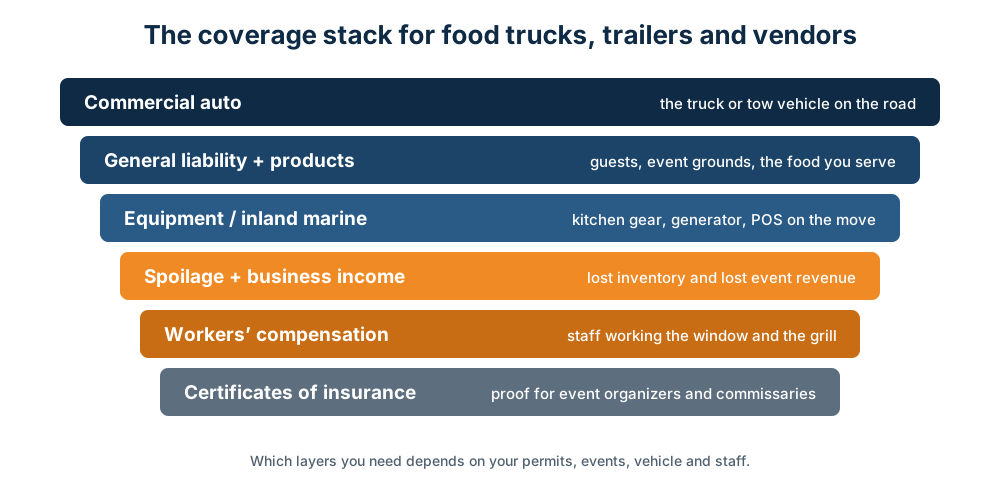
Each of these lands on a different part of the policy: auto, general liability, inland marine or equipment coverage, workers’ comp, spoilage and product liability. A single gap can leave you paying out of pocket.
Food truck coverage checklist for Kentucky operators
- Commercial auto liability and physical damage — covers the truck itself and injuries or damage you cause while driving between stops.
- General liability — handles customer injuries at the window, in your line or around your setup at a venue.
- Product liability — responds when someone claims your food made them sick or triggered an allergic reaction.
- Inland marine or business personal property — protects fryers, flat-tops, generators and point-of-sale gear, including permanently installed equipment the auto policy may not fully cover.
- Spoilage and equipment breakdown — pays for lost inventory when a cooler or generator fails.
- Workers’ comp — required from the first employee in Kentucky and covers burns, cuts and falls from the truck step.
- Additional insured endorsements — satisfy festival, brewery and commissary contracts that name them on your certificate.
- Umbrella liability — adds limits above your auto and liability policies when an event demands more than your base limits.
How underwriters price a kitchen on wheels
Carriers look at the value and age of the truck, the driving records of anyone who drives it, how far you travel, and how many events you work in a year. The cooking method matters a great deal: a truck running deep fryers and open-flame grills is rated differently from one selling cold brew and wraps. Carriers also ask about hood suppression, fire extinguishers, propane system inspections and how you secure equipment while driving.
Ways to improve pricing include keeping drivers limited to a short list with clean records, documenting propane and suppression inspections, shutting down and securing hot oil before moving, and bundling liability and property on one package where a carrier allows it. A clean claims history is the single biggest long-term advantage.
Getting Kentucky food truck quotes and event certificates
As an independent agency, Provident Financial Group takes one application and shops it with multiple carriers quoted through our agency, then lays the options side by side so you can compare limits, deductibles and exclusions. Once you bind, you can request live certificates of insurance for festivals, breweries and property owners, often the same day. Call (866) 964-6660 if you have an event deadline coming up.
Frequently asked questions
Does my personal auto policy cover the truck on the way to an event?
Usually not. Personal auto policies commonly exclude vehicles used for business, so a food truck should be written on commercial auto that meets Kentucky’s 25/50/25 minimums (in thousands of dollars) at a minimum.
Can a festival get my certificate the same day?
In most cases, yes. Once coverage is bound we can issue a certificate naming the festival or venue as additional insured, subject to the carrier’s endorsement terms.
Am I covered while prepping at a rented commercial kitchen?
It depends on how the policy is written. Because Kentucky requires food to be prepared in a permitted unit or establishment, we make sure your liability and property coverage extends to the kitchen you use, not just the truck.
Does a food trailer need different coverage than a truck?
A trailer is usually scheduled on the auto policy of the vehicle that tows it, with its own physical damage coverage. Our food trailer insurance page explains the differences.
Ready to put your truck on the road with the right protection? Get Multiple Quotes within minutes.