
Kentucky restaurants must carry workers’ compensation as soon as they have one employee, and family members, part-time and temporary workers all count. Coverage can be bought from private carriers or from Kentucky Employers’ Mutual Insurance (KEMI), which competes in the market and is the insurer of last resort. Restaurants are generally classified under NCCI codes 9082 (Restaurant NOC) or 9083 (Restaurant: Fast Food).
This page is for Kentucky restaurant, bar, cafe and food service owners who want a clear view of the comp rules, what claims actually look like in a kitchen, and how premium is built. For how comp fits with the rest of your insurance, see our Kentucky restaurant insurance hub.
Who has to carry comp in a Kentucky restaurant
Under Kentucky law, an employer with one or more employees must carry workers’ comp unless the Commissioner approves self-insurance. Family members, temporary workers and part-time workers are counted as employees. That is stricter than neighboring states that set thresholds of three or four employees, and it catches many small operators: the owner-run coffee shop with one weekend barista, the food truck with a cousin at the window, the bar with a single part-time bartender.
KRS 342.650 lists narrow exemptions, such as agricultural employees and certain domestic workers in private homes, none of which typically fit a restaurant. Rules on whether owners or corporate officers can elect out of coverage are specific, so ask before assuming you can exclude yourself. The Kentucky Department of Workers’ Claims, part of the Education and Labor Cabinet, administers the system.
Private carriers, KEMI and the NCCI rating system
Kentucky is a competitive state fund market. Private carriers write restaurant comp alongside KEMI, a nonprofit, self-supporting authority created in 1994 under KRS 342.803. KEMI competes in the voluntary market and also serves as the market of last resort, so a new restaurant or one with a difficult loss history can still get coverage.
Kentucky uses NCCI as its uniform classification and experience rating system. Most sit-down restaurants fall under Restaurant NOC (9082), while quick-service operations may be classified as Restaurant: Fast Food (9083). The carrier assigns the class based on how you actually operate, and getting it right matters because rates differ by class.
Penalties for running a Kentucky kitchen without comp
KRS 342.990 sets civil fines of $100 to $1,000 per offense, and each employee and each day without coverage counts as a separate offense, so penalties compound quickly. Criminal penalties can include fines and 30 to 180 days in jail. An uninsured employer must also reimburse the Uninsured Employers’ Fund for benefits paid to an injured worker and loses the exclusive-remedy protection that normally bars employees from suing, so an injured cook can bring a lawsuit for damages. See what happens if a restaurant has no workers’ comp.
The kitchen and dining room injuries that drive comp claims
- Burns — fryer oil changes, sheet pans from a convection oven, steam from a dish machine or a tipped stockpot.
- Cuts — knives during prep, meat slicers, mandolines, broken glassware in the bar sink.
- Slips and falls — grease near the line, wet floors at the dish pit, ice spills behind the bar, walk-in thresholds.
- Lifting and strain — hauling cases from deliveries, kegs, full bus tubs and heavy stockpots.
- Workplace violence — late-night robberies at a register or drive-thru window, and confrontations with intoxicated patrons.
Most restaurant comp losses come from these ordinary events, which is why prevention pays off. For a specific example, see does workers’ comp cover kitchen burns.
How a Kentucky restaurant’s comp premium is figured
Comp premium starts with your estimated payroll in each class code, multiplied by the rate for that class. If you are large enough to qualify for experience rating, NCCI applies an experience modification factor that compares your actual losses to what is expected for similar businesses: better than average pushes the price down, worse pushes it up. The policy is then audited after the term, and premium is adjusted to your real payroll. Carrier schedule credits, deductibles and premium discounts can also play a role.
Controlling comp costs in a busy kitchen
- Classify correctly — make sure front-of-house and kitchen payroll are described accurately for the class the carrier uses.
- Report claims promptly — early reporting keeps medical costs and lost-time claims smaller.
- Build a return-to-work program — light duty such as hosting or prep keeps injured staff engaged and shortens claims.
- Invest in prevention — oil shuttles, cut-resistant gloves, anti-slip mats, lift training and cash-handling limits.
- Keep payroll estimates realistic — avoid surprise audit bills or overpaying all year.
- Compare carriers at renewal — pricing and credits differ between KEMI and private carriers.
Provident Financial Group is an independent agency: one application, multiple carriers quoted through our agency, compared side by side, with live certificates of insurance for landlords and clients. Call (866) 964-6660. For comp across other industries, visit our sister site USA Workers Comp.
Frequently asked questions
Do I need workers’ comp if my only employee is my spouse?
Kentucky counts family members as employees under the one-employee rule. Owner and officer election rules are specific, so confirm your situation before going without coverage.
Can a brand-new Kentucky restaurant get comp with no loss history?
Yes. Private carriers write new ventures, and KEMI serves as the market of last resort if other carriers decline.
Is a server who slips in the dining room a comp claim or a liability claim?
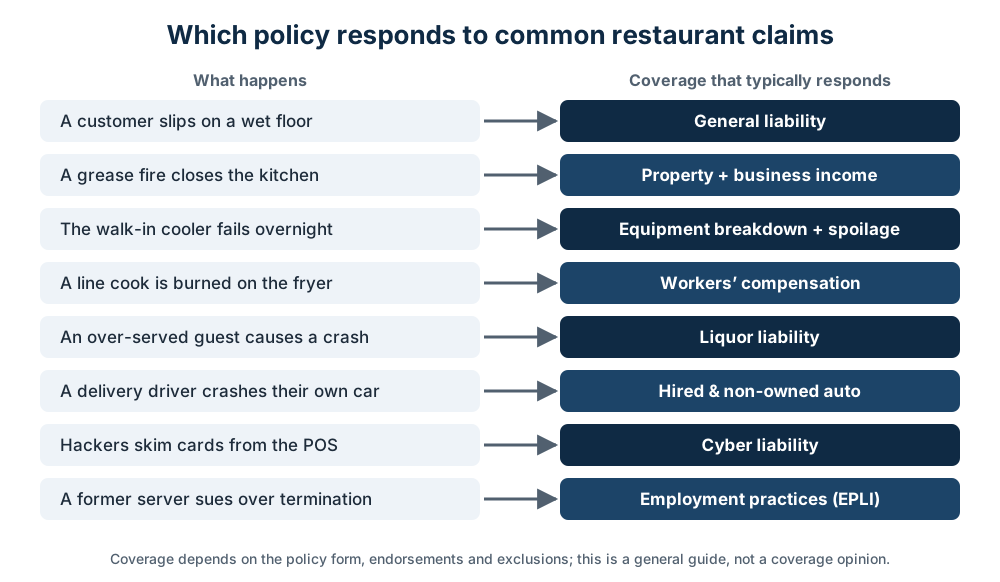
An employee injured on the job is generally a workers’ comp claim. A customer who slips in the same spot would be a general liability claim.
Does KEMI cost more than a private carrier?
Not necessarily. KEMI competes in the voluntary market, and pricing depends on your class, payroll and loss history, so compare quotes side by side.
Ready to review your restaurant’s comp coverage? Get Multiple Quotes within minutes.
Related pages
- Restaurant insurance in Kentucky
- Fast food restaurant insurance in Kentucky
- Bar and tavern insurance in Kentucky
- Does workers’ comp cover kitchen burns?
- What happens if a restaurant has no workers’ comp?
- Liquor liability insurance in Kentucky
Kentucky restaurant insurance by business type
- Kentucky Restaurant Insurance
- Bar & Tavern Insurance in Kentucky
- Brewery & Taproom Insurance in Kentucky
- Coffee Shop & Cafe Insurance in Kentucky
- Catering Insurance in Kentucky
- Bakery Insurance in Kentucky
- Pizzeria Insurance in Kentucky
- Food Truck Insurance in Kentucky
- Ghost Kitchen Insurance in Kentucky
- Fast Casual Restaurant Insurance in Kentucky
- Fine Dining Restaurant Insurance in Kentucky
- Deli & Sandwich Shop Insurance in Kentucky
- Fast Food Restaurant Insurance in Kentucky
- Ice Cream Shop Insurance in Kentucky
- Food Vendor & Farmers Market Insurance in Kentucky
- Juice Bar & Smoothie Shop Insurance in Kentucky