
Fast casual restaurants in Kentucky typically need a business owner’s policy that combines property and general liability, product liability for made-to-order bowls, wraps and salads, workers’ comp from the first employee, and liquor liability if beer or wine is on the menu. Many owners add equipment breakdown, cyber coverage for kiosk and app ordering, and hired and non-owned auto for catering drop-offs.
This page is for counter-service concepts in Kentucky: build-your-own bowl shops, burger and chicken concepts with a real kitchen, taco counters and similar formats with high ticket counts and quick turns. The model is efficient, but volume multiplies small risks. Our national fast casual insurance page covers the basics; below we apply them to Kentucky.
What Kentucky law asks of a counter-service restaurant
Food service in Kentucky is regulated by the Cabinet for Health and Family Services under 902 KAR 45:005, which adopts the FDA Food Code with state amendments. A person in charge can demonstrate knowledge by being a certified food protection manager through an accredited program or a local health department class. Carriers routinely ask whether you have one on every shift.
Workers’ comp is required from the first employee, and part-time and temporary workers count, which catches many fast casual owners who staff mostly with part-timers. Kentucky uses NCCI classifications, which include separate codes for Restaurant NOC (9082) and Restaurant: Fast Food (9083). Which one fits depends on how your operation actually runs, so describe your service model accurately on the application. More on the comp side is on our Kentucky restaurant workers’ comp page.
If you sell beer or wine, Kentucky’s dram shop statute, KRS 413.241, generally treats drinking rather than serving as the cause of injury, but a licensee can still be liable when a reasonable person should have known the patron was already intoxicated when served. See our Kentucky liquor liability page for details.
Counter-line and dining-room incidents in fast casual
- A guest slips on ice spilled beside the self-serve fountain during the lunch rush and fractures an ankle.
- An employee on the line reaches across the flat-top during a mobile-order surge and suffers a forearm burn.
- A build-your-own format leads to cross-contact when a scoop moves from the shellfish bin to the rice, and a guest has a serious reaction.
- A prep cook cuts a hand on a mandoline while slicing vegetables for the afternoon.
- Your ordering kiosk vendor is breached, and customer card data from your location is exposed.
- A walk-in failure over a holiday weekend spoils a full delivery of proteins and produce.
Fast casual losses tend to be frequent and moderate rather than rare and catastrophic, which is why underwriters pay close attention to housekeeping and training.
Fast casual policy essentials in Kentucky
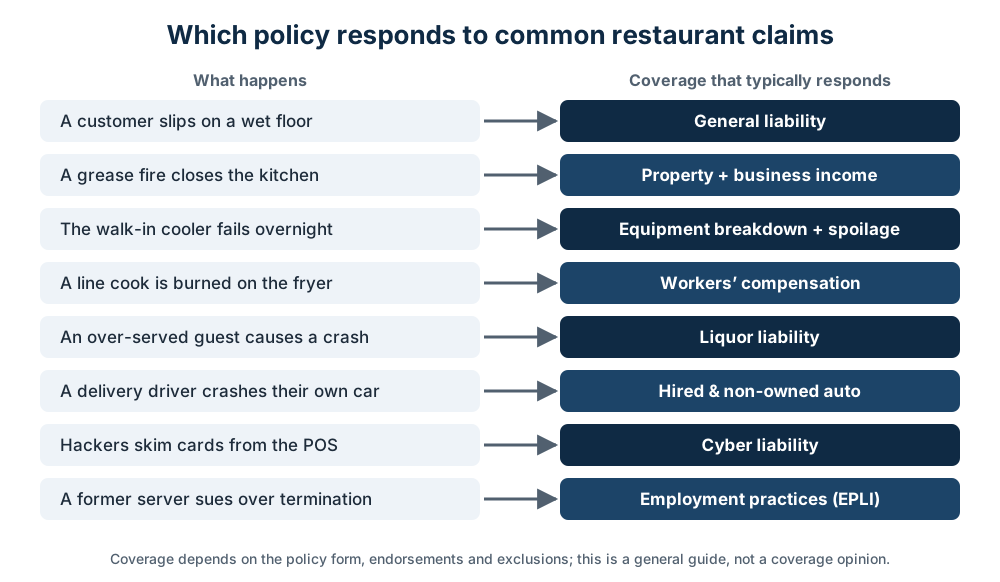
- Business owner’s policy — bundles property and general liability, a practical base for a single-unit fast casual location.
- Product liability — protects against illness and allergen claims tied to customizable menus.
- Workers’ comp — required from the first employee and central for a staff that works hot lines and knives all day.
- Liquor liability — needed if you sell beer or wine; general liability usually excludes alcohol claims for a licensed seller.
- Equipment breakdown and spoilage — covers compressors, rice cookers, ovens and lost inventory.
- Cyber liability — addresses kiosk, POS and online ordering breaches.
- Hired and non-owned auto — protects the business when staff run catering orders in their own cars.
- Employment practices liability — responds to wrongful termination, harassment or scheduling-related claims from a large hourly team.
Factors behind a fast casual premium
Carriers rate fast casual concepts on annual sales, square footage, cooking methods (a fryer line rates differently from a cold-assembly line), alcohol sales as a share of revenue, and payroll by class code. Loss history, hood suppression and cleaning, floor surfaces and mat programs, and whether you are a franchise with a required insurance program all matter.
To improve pricing, keep a slip-prevention routine at the drink station, document hood cleaning, train on allergen handling, and keep alcohol sales modest and well controlled. Building a few claim-free years at one location also helps when you open a second.
Quoting a fast casual concept side by side
Provident Financial Group is an independent agency, so you complete one application and we compare multiple carriers quoted through our agency, laying out limits, deductibles and exclusions side by side. Once bound, we can issue live certificates of insurance for your landlord or franchisor. Call (866) 964-6660 to talk it through.
Frequently asked questions
Is a fast casual restaurant classified as fast food for workers’ comp?
Not automatically. NCCI has separate classifications for Restaurant NOC (9082) and Restaurant: Fast Food (9083), and the carrier assigns the one that matches how your operation actually runs.
Do I need liquor liability if I only sell canned beer?
If you hold a license and sell alcohol, liquor liability is strongly recommended, and landlords often require it. Kentucky’s dram shop standard still applies to a single canned beer served to an intoxicated guest.
Does a BOP cover a kiosk or app data breach?
Usually only in a limited way, if at all. Separate restaurant cyber insurance is designed for breaches, notification costs and related liability.
Is a customer slip at the drink station a general liability claim?
Yes, customer injuries on your premises generally fall under general liability, subject to policy terms. See our slip-and-fall Q&A.
Ready to compare options for your counter-service restaurant? Get Multiple Quotes within minutes.