
Ghost kitchens in Kentucky typically need general and product liability for food that leaves the building in a bag, hired and non-owned auto if employees ever drive orders in their own cars, workers’ comp from the first employee, and property, equipment breakdown and spoilage coverage for a kitchen with no dining room that often runs late into the night. Shared-kitchen operators usually require additional insured status as well.
This page is for delivery-only concepts, virtual brands operating out of an existing restaurant, and tenants of shared commissary spaces in Kentucky. With no front of house, your exposure shifts toward product liability, delivery, contracts and the equipment that keeps orders moving. Our national ghost kitchen insurance page covers the concept in general; here we apply it to Kentucky.
Kentucky rules behind a delivery-only kitchen
A ghost kitchen is still a food service establishment in the eyes of the Kentucky Cabinet for Health and Family Services, which regulates food service under the state food code, 902 KAR 45:005. That regulation lets a person in charge show food safety knowledge by being a certified food protection manager through an accredited program or a local health department class. Keeping that certification current is also something underwriters like to see on an application.
Workers’ comp is required as soon as you have one employee, and part-time and temporary workers count, which matters for kitchens that staff up with short shifts during dinner peaks. Kentucky Employers’ Mutual Insurance (KEMI) competes with private carriers and serves as the market of last resort, so a new kitchen with no loss history can still find comp coverage.
If anyone drives for the business, Kentucky’s auto liability minimums are 25/50/25 (in thousands of dollars). A personal policy on an employee’s car may not respond to business use, and even when it does, the injured party can still pursue your business. That is the gap hired and non-owned auto coverage is built to address. See our comparison of hired and non-owned auto vs. commercial auto.
Ghost kitchen loss scenarios: tickets, couriers and shared hoods
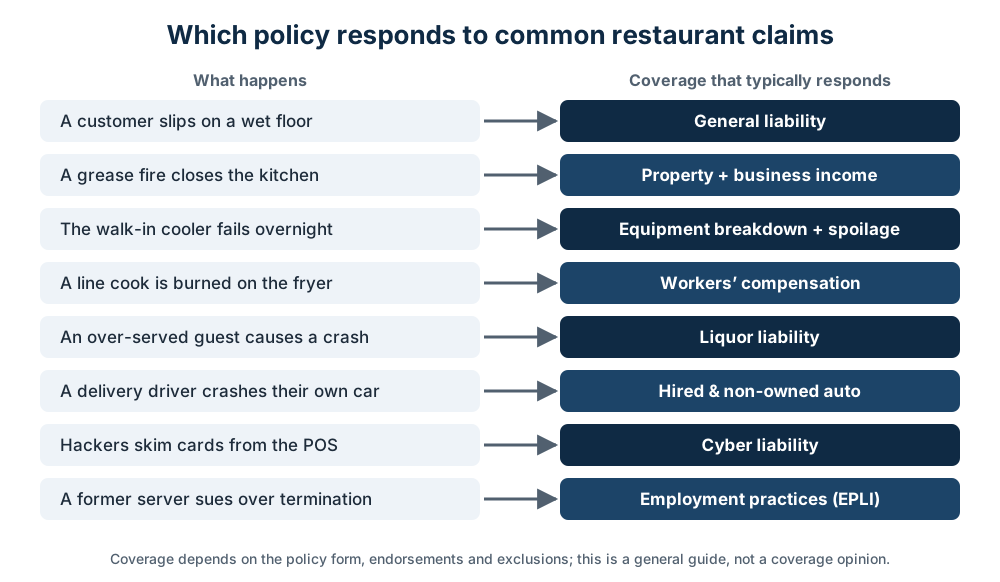
- In a shared commissary, a grease fire at the station next to yours smokes out the space and damages your reach-ins. Whose policy pays depends on your license agreement and on whether you carry your own property coverage.
- You run three virtual brands on three apps, and one listing never got updated when you switched to a sesame-based dressing. A customer reacts and files a claim against the kitchen.
- A line cook uses his own car to run a large office order across town and causes a crash. The other driver’s attorney names your business.
- The walk-in compressor quits overnight after a storm-related outage and nobody is in the building until the morning prep shift.
- A phishing email compromises the tablet that manages your delivery accounts, and payouts are rerouted before you notice.
None of these involve a guest walking through a front door, which is why a standard restaurant package built around dining-room slips can miss what actually threatens a delivery-only operation.
Coverage map for a Kentucky ghost kitchen
- Product liability — your largest exposure when every order is eaten off-site and labels are spread across several apps.
- General liability — covers injuries to couriers and visitors at your pickup door and damage you cause to a shared facility.
- Hired and non-owned auto — protects the business when staff drive their own or rented vehicles on company errands.
- Business personal property — insures your equipment and inventory, especially inside a space you do not own.
- Equipment breakdown and spoilage — responds to a failed walk-in, blast chiller or combi oven and the food lost with it.
- Business interruption — replaces income if a covered loss shuts the kitchen down.
- Cyber liability — addresses compromised ordering tablets, POS systems and customer data.
- Workers’ comp — required from the first hire and critical for high-volume fry and grill stations.
Premium drivers when you have no storefront
Underwriters price ghost kitchens mainly on sales volume and cooking method, then adjust for how deliveries are handled. Kitchens that rely only on third-party couriers present a different auto exposure than kitchens that use their own drivers. Hood suppression, cleaning schedules, alarm and temperature monitoring for coolers, and allergen control procedures all help. Shared facilities are scrutinized for how fire risk is separated between tenants.
To improve pricing, document your allergen and labeling process across every brand, keep a written policy that employees may not deliver in personal cars without approval, and install remote temperature alerts on refrigeration. Read your delivery app agreements too; they may not protect your kitchen the way you assume.
Comparing ghost kitchen carriers with one application
Not every carrier is comfortable with delivery-only concepts, so shopping matters. Provident Financial Group submits one application to multiple carriers quoted through our agency and shows you the options side by side. We can also issue live certificates of insurance for your commissary operator or landlord, including additional insured and waiver of subrogation wording where the policy allows it. Questions? Call (866) 964-6660.
Frequently asked questions
Does the delivery app’s insurance protect my kitchen?
Generally you should not count on it. App coverage, where it exists, is designed around the courier and the platform, not claims that your food caused an illness or that your equipment failed.
I run three virtual brands from one kitchen. Do I need three policies?
Usually one policy can cover multiple brands at the same location if every brand name is disclosed to the carrier. Undisclosed brands can create problems at claim time.
What if the shared-kitchen operator requires a waiver of subrogation?
Many carriers can add a waiver of subrogation by endorsement. Our waiver of subrogation explainer covers what that means for you.
Do I need auto coverage if I never deliver orders myself?
If employees ever drive for the business, even to pick up supplies, hired and non-owned auto is worth having. If you only use third-party couriers, the exposure is smaller but not zero.
Ready to see what your kitchen qualifies for? Get Multiple Quotes within minutes.