
Fast food restaurants typically need general liability, property and business income coverage built around hood and fryer fire risk, workers’ compensation, hired and non-owned or commercial auto for delivery, crime coverage for cash and robbery, and employment practices liability. Franchisees also have to meet the limits, additional insured wording and certificate deadlines their franchise agreement sets.
This page is for quick-service operators: independent burger and chicken stands, taco and sandwich counters, drive-thru-only units and franchisees running one location or a dozen. QSR risk is defined by speed and volume. More transactions per hour means more spills, hot oil, cash and late-night hours. If your model is order-at-the-counter with a more upscale menu, our fast casual insurance guide may fit better.
Drive-thru exposures most owners underestimate
The drive-thru is a premises exposure with moving vehicles in it. A driver misjudges the clearance bar and tears down part of the canopy. A customer reaching for a cup at the window spills coffee in their lap. A pedestrian cutting through the lane is clipped by a car pulling up to the speaker. Injuries to customers and passers-by fall under general liability, subject to policy terms. Damage to your canopy, menu boards and speaker posts is a property claim, and your carrier may pursue the driver’s auto insurer afterward. Our page on signage damage covers the sign side. Bollards and lids pressed on before the handoff reduce claims.
High-volume slips and burns on both sides of the counter
In the lobby, the soda fountain is the hot spot: ice on the tile, sticky syrup and rain tracked in at the door during a lunch rush. Hot beverage and hot food burns are the other classic guest claim. Behind the counter, the injuries shift to employees: fryer oil splashes during basket drops, grill burns, cuts at the prep table and falls on greasy floors near the fry station. Those are workers’ compensation claims, and they are the main reason QSR comp costs track payroll so closely. Read how workers’ comp handles kitchen burns. Slip-resistant footwear, splash guards and oil-handling equipment are controls underwriters like to see.
Hood, duct and fryer fires
Grease-laden vapor from fryers and flat-tops builds up in exhaust ducts, and a duct fire can spread into the building structure long before anyone sees flames. The loss is rarely just the kitchen: smoke damage to the dining room, a shutdown that can last months while the space is rebuilt, and payroll you may want to keep paying so your crew does not leave. Property coverage pays for the building and equipment, and business interruption coverage replaces lost income during the restoration period. Carriers want to see an automatic suppression system over every cooking appliance, a professional hood-cleaning contract on a schedule matched to your volume, and service tags on file. Our page on grease fires in the hood system explains how these claims are adjusted.
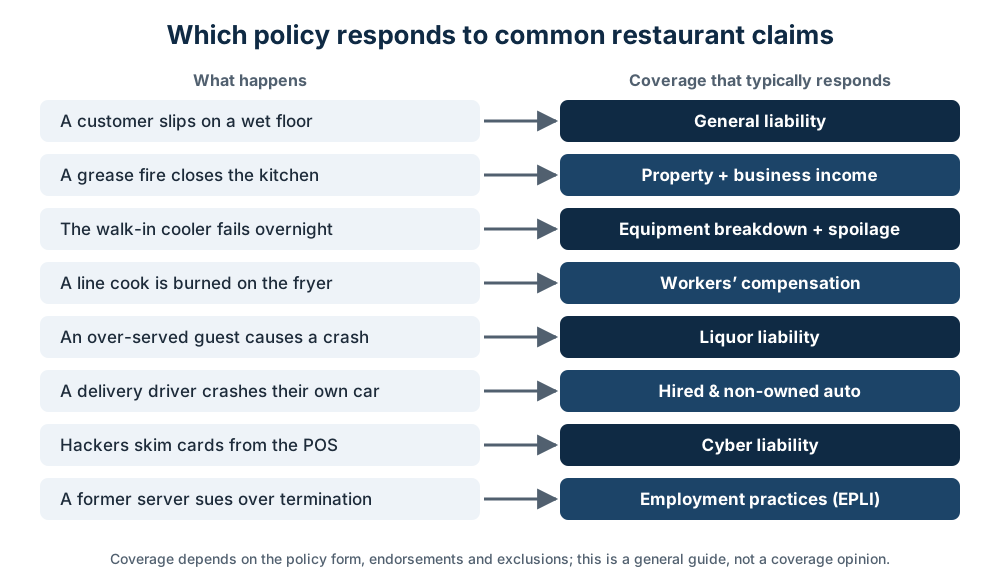
| QSR exposure | Who is harmed | Coverage that typically responds |
|---|---|---|
| Car strikes the drive-thru canopy | Your property | Commercial property |
| Guest burned by coffee at the window | Customer | General liability |
| Cook splashed by fryer oil | Employee | Workers’ compensation |
| Grease fire in the exhaust duct | Building, equipment and income | Property and business income |
| Delivery crash in a driver’s own car | Third party | Hired and non-owned auto |
| Robbery at closing | Cash and staff | Crime coverage and workers’ compensation |
| Former crew member alleges wrongful firing | Employee | Employment practices liability |
What franchisors typically require
Franchise agreements spell out the program: minimum general liability limits per occurrence and aggregate, an umbrella, auto liability, workers’ comp with employer’s liability, often employment practices liability and sometimes cyber. They usually require the franchisor and its affiliates to be named as additional insured on a primary and noncontributory basis, a waiver of subrogation, minimum carrier financial ratings and advance notice of cancellation, with certificates uploaded to a compliance portal every renewal. Falling short can be a default under the agreement. Use our FDD insurance requirements checklist, and if you are growing past a few units, see multi-unit franchise insurance.
Delivery: your drivers, app drivers and the gap between them
If crew members deliver in their own cars, their personal auto policies may exclude business use, and a serious crash can land on your restaurant. Hired and non-owned auto fills that gap; business-owned vehicles need commercial auto. Third-party app drivers are generally the platform’s contractors, but platform agreements can include indemnity terms and insurance requirements for you. Our guide to what delivery apps require walks through the contracts.
Robbery, cash handling and employee theft
QSRs handle a steady flow of cash at registers and drive-thru windows, and closing time is when robberies tend to happen. Crime coverage can pay for stolen money on premises and during bank deposit runs, employee theft such as register skimming or refund fraud, and certain forged or counterfeit payments. Many business owners policies include only small money limits, so check them. Staff injured in a holdup are covered by workers’ comp. Read how robbery claims are handled.
Late-night hours, security and assault claims
Units open past midnight see a different risk: fights in the dining room, harassment at the window and assaults in the parking lot. An injured customer may sue for negligent security, arguing the lot was poorly lit or cameras did not work. Some general liability policies exclude or sublimit assault and battery, so read that wording closely if you run late hours. Lobby closures after a set hour, drive-thru-only overnight service, bright exterior lighting, working cameras, cash drops and a two-person close all help with safety and underwriting.
Workers’ comp class codes for fast food
Most states use NCCI classifications, which separate fast food restaurants from full-service restaurants, and the class assigned to your payroll directly affects your comp rate. A misclassified location can mean an unexpected audit bill or overpaying for years, so check the class on your declarations page against how you actually operate. A few states run their own rating bureaus or a state fund, so codes and wording can differ. For state-specific comp guidance, see our sister site USA Workers Comp.
Fast food coverage checklist
- General liability — drive-thru, lobby slip and hot-beverage claims from high customer counts.
- Property and business income — hood and fryer fires, canopy damage and the income lost while you rebuild.
- Equipment breakdown — fryers, walk-ins, ice machines and POS systems that property forms exclude.
- Workers’ compensation — oil burns, cuts and slips on the line, with the right QSR class code.
- Hired and non-owned or commercial auto — in-house delivery and supply runs.
- Crime coverage — robbery, deposit runs and employee theft at the register.
- Employment practices liability — large, high-turnover crews generate wrongful termination and harassment claims.
- Umbrella liability — the extra limits franchise agreements and landlords usually require.
What affects the price of fast food insurance?
Carriers weigh sales and payroll, hours of operation, drive-thru volume, cooking equipment and fire protection, building age and construction, delivery exposure, cash handling, location crime conditions, franchise requirements, deductibles and claims history. Documented hood cleaning, suppression system inspections, oil-handling equipment, lighting and camera coverage, cash controls and a written safety program can all improve how underwriters view your location.
How quoting works with an independent agency
US Restaurant Insure is the restaurant site of Provident Financial Group, an independent agency. One application lets us compare multiple carriers side by side and quote to your franchise agreement’s exact requirements. After you bind, you get live certificates of insurance to upload to your franchisor portal or send to your landlord. Call (866) 964-6660 with questions. Coverage is subject to underwriting and policy terms.
Frequently asked questions
Does general liability cover a car hitting my drive-thru?
Damage to your own canopy or menu board is a property claim, not general liability. Injuries to customers or bystanders in the lane generally fall under general liability, subject to policy terms.
Is a hood fire covered if my cleaning contract lapsed?
Coverage depends on your policy wording, and some policies include protective safeguard conditions tied to suppression systems. A lapse can complicate the claim, so keep service records current.
Do I need crime insurance if my BOP has money coverage?
Many BOPs include only small limits for money and securities and little or no employee theft coverage. A separate crime policy is worth pricing if you handle significant cash.
Which workers’ comp class code applies to a fast food restaurant?
In NCCI states there is a dedicated fast food restaurant classification separate from full-service restaurants. Your carrier assigns it based on your operations, so review it at every renewal.
Ready to compare? Get Multiple Quotes within minutes. Or call (866) 964-6660 to talk it through.
Related pages
- Franchise restaurant insurance
- Restaurant delivery insurance
- Hired and non-owned vs. commercial auto
- Cyber vs. crime insurance
- Slip-and-fall claims
- Fast casual insurance
Fast Food Insurance by state
- Fast Food Restaurant Insurance in New Jersey
- Fast Food Restaurant Insurance in New York
- Fast Food Restaurant Insurance in Connecticut
- Fast Food Restaurant Insurance in Vermont
- Fast Food Restaurant Insurance in Ohio
- Fast Food Restaurant Insurance in Michigan
- Fast Food Restaurant Insurance in Virginia
- Fast Food Restaurant Insurance in Pennsylvania
- Fast Food Restaurant Insurance in Delaware
- Fast Food Restaurant Insurance in Maryland
- Fast Food Restaurant Insurance in North Carolina
- Fast Food Restaurant Insurance in South Carolina
- Fast Food Restaurant Insurance in Georgia
- Fast Food Restaurant Insurance in Florida
- Fast Food Restaurant Insurance in Texas
- Fast Food Restaurant Insurance in Kentucky
- Fast Food Restaurant Insurance in Kansas
- Fast Food Restaurant Insurance in California
- Fast Food Restaurant Insurance in Indiana
- Fast Food Restaurant Insurance in Arizona
- Fast Food Restaurant Insurance in Washington, DC
- Fast Food Restaurant Insurance in Massachusetts
- Fast Food Restaurant Insurance in Nevada