
Restaurants in Myrtle Beach, SC typically need general liability, commercial property with wind and hail coverage (often through the state’s coastal wind pool), separate flood coverage, workers’ compensation at four or more employees, and liquor liability for on-premises alcohol sales after 5 p.m. South Carolina sets a statutory liquor liability minimum and requires SCDOR on the certificate.
This guide is for beachfront grills, seafood houses, breakfast spots and oceanfront bars along the Grand Strand. Tourist season changes how a Myrtle Beach restaurant operates, and your insurance needs to fit the busiest week of the year, not the slowest.
Wind, water and the Horry County property question
Myrtle Beach sits in Horry County, part of the coastal area served by the South Carolina Wind and Hail Underwriting Association, the statutory residual market for wind and hail (S.C. Code 38-75-310 et seq.). Commercial property at fixed locations there is eligible. Many coastal restaurants end up with a property policy that excludes wind plus a separate wind and hail policy, and the two must fit together without a gap.
Flood is a separate problem. Standard commercial property policies generally exclude it, and wind policies do not pick it up. If a storm pushes water into your dining room, only a flood policy responds. Watch deductibles too: named-storm and wind deductibles are often a percentage of insured value rather than a flat amount.
Seasonal staffing and South Carolina’s comp threshold
Summer hiring turns a small year-round crew into a large seasonal team. South Carolina requires workers’ comp once you regularly employ four or more people, and part-time workers and family members count. Premium is based on payroll, so give realistic seasonal estimates or expect an audit bill later. Our South Carolina restaurant workers’ comp page covers classification and audits.
Liquor rules for a tourist crowd
Licensees selling for on-premises consumption after 5 p.m. must carry liquor liability with an annual aggregate of at least one million dollars, a per-occurrence limit of at least half the total and SCDOR as certificate holder (S.C. Code 61-2-145). Since January 1, 2026, a risk mitigation program can lower that to a 300,000-dollar floor for steps like closing by midnight or training all servers. Servers working at least 10 hours a week, and their managers, must complete SCDOR-approved training, with 30 days for new hires.
Selling to an intoxicated person brings escalating penalties: a fine, then a suspension of up to 14 days, then revocation. Under Act 42 of 2025, a licensee found liable alongside a drunk driver can be jointly and severally liable for half of actual damages. Food permits come through the SC Department of Agriculture’s Retail Food Safety program, and a certified food protection manager must direct food prep.
Claim scenarios we see on the coast
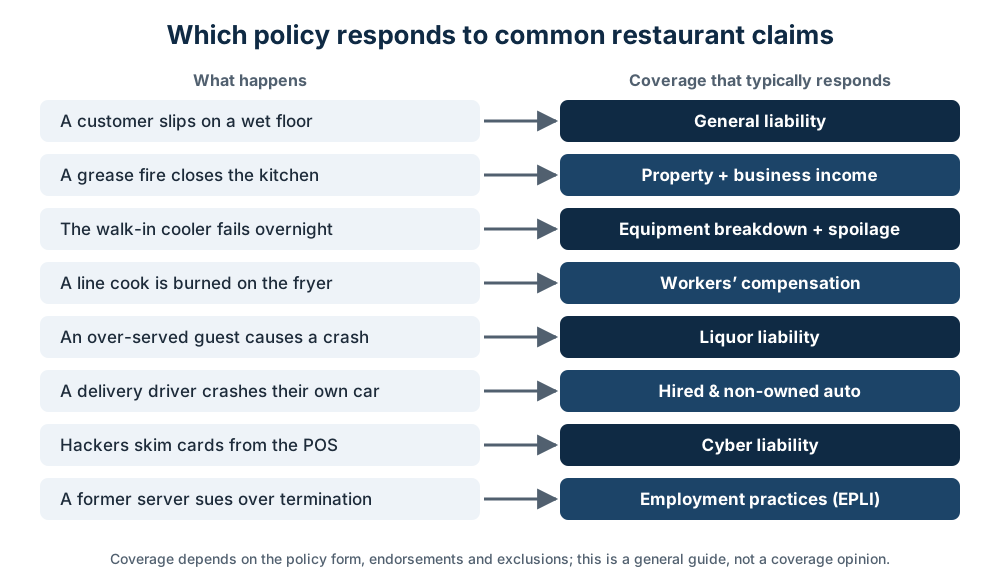
- A hurricane evacuation order closes the strip for days in peak season. Whether business income responds depends on the cause of loss and your wording, so review it before June.
- Sandy flip-flops meet a wet deck stair and a vacationer breaks an ankle.
- A seasonal bartender, three weeks into the job, serves a visibly intoxicated guest who later injures someone.
- Salt air corrodes an outdoor patio cooler and it fails mid-July, taking a weekend of seafood with it.
- A shift runner uses his own truck to pick up extra ice and causes a fender-bender on a crowded boulevard.
Myrtle Beach restaurant coverage checklist
- General liability — decks, stairs and patios bring slip-and-fall exposure.
- Commercial property — building or tenant improvements, kitchen equipment and inventory.
- Wind and hail coverage — often a separate policy through the coastal wind pool.
- Flood insurance — the only coverage that responds to rising water.
- Business income and extra expense — protects peak-season revenue after a covered loss.
- Liquor liability — required for most evening on-premises sellers.
- Workers’ compensation — required at four employees, including seasonal staff.
- Hired and non-owned auto — errands and deliveries in employees’ own vehicles.
What drives pricing for a Grand Strand restaurant
Distance to the water and flood zone, building age and construction, wind mitigation features, alcohol share of sales, hours, entertainment, deck or pier seating, seasonal payroll and loss history all feed the rate. Owners improve their options by documenting storm shutters, keeping electrical and hood maintenance current, formalizing server training and ID checks, and giving carriers accurate seasonal payroll up front.
How we quote it
Coastal restaurant insurance often means stitching several policies together. Provident Financial Group is an independent agency, so one application lets us compare multiple carriers quoted through our agency side by side, plus wind and flood options, and show you where the gaps are. We issue certificates for landlords, SCDOR and event partners on request. Call (866) 964-6660.
Frequently asked questions
Does my regular property policy cover hurricane damage in Myrtle Beach?
On the coast it often excludes wind, and it almost never covers flood. Many owners need a separate wind and hail policy and a separate flood policy.
We only open March through October. Do we still need workers’ comp?
If you regularly employ four or more people during your season, yes. Part-time and seasonal staff count toward the threshold.
Our servers are mostly seasonal. Do they all need alcohol server training?
Anyone serving alcohol on premises at least 10 hours a week, and their managers, must complete SCDOR-approved training within 30 days of hire.
When should I review coverage before hurricane season?
Early in the year. Carriers commonly restrict new wind coverage once a storm is forecast, so waiting can leave you unable to add or increase limits.
Ready for peak season? Get Multiple Quotes within minutes.
Official South Carolina sources
- S.C. Code Title 61, Chapter 2 (alcohol general provisions; liquor liability insurance)
- South Carolina Workers' Compensation Commission: employer FAQ
- SC Department of Agriculture: retail food safety
- SC Department of Agriculture: certified food protection manager guidance (2024)
- S.C. Code Title 38, Chapter 75 (incl. SC Wind and Hail Underwriting Association)
State facts on this page are drawn from the statutes and agency pages above. Laws and agency rules change, so confirm current requirements with the agency before relying on them. This page is general information, not legal advice or a coverage opinion.