
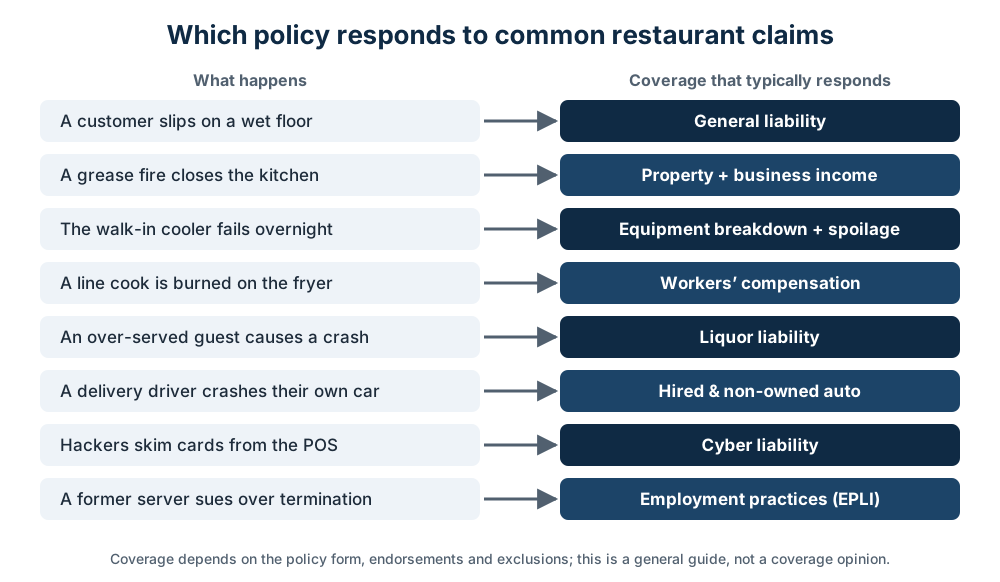
Fast casual restaurants in South Carolina usually need a business owner’s policy or package that covers general liability and property, workers’ compensation once four or more people are employed, employment practices liability for a large hourly crew, cyber coverage for app and kiosk ordering, and liquor liability if they sell beer or wine on-premises after 5 p.m. Hired and non-owned auto matters if staff drop off catering orders.
This is aimed at counter-service concepts: bowl and salad builders, burrito and taco lines, poke, Mediterranean, better-burger and chicken concepts, often in strip centers along Woodruff Road, Harbison Boulevard or Highway 17. The format is simple, but high volume and a young workforce create their own insurance needs.
South Carolina requirements behind the counter
Your food permit comes from the South Carolina Department of Agriculture’s Retail Food Safety program under Regulation 61-25, and at least one employee with authority over preparation and service must be a certified food protection manager. In an assembly-line concept with a dozen toppings and sauces, that manager’s allergen and cross-contact controls are exactly what an underwriter wants to understand.
Workers’ comp is required once you regularly employ four or more people, and part-time staff count. Nearly every fast casual unit crosses that line on day one. The South Carolina restaurant workers’ comp page covers the penalties for going without and how premium is built.
Many fast casual brands add a few beers and a canned wine. If that sale is for on-premises consumption and happens after 5 p.m., South Carolina requires liquor liability with an annual aggregate of at least $1,000,000, per-occurrence of at least half the total, and SCDOR as certificate holder, unless your operation qualifies for a reduction under the risk mitigation program that started January 1, 2026. Alcohol under 40 percent of sales and closing by midnight are both factors, which fits most counter-service concepts. Employees who serve alcohol at least 10 hours a week and their managers must complete SCDOR-approved server training. Details are on our South Carolina liquor liability page.
Counter-service claims that show up most
The drink station is a slip generator. Ice spills, a leaking soda nozzle, and customers carrying full cups across tile add up to falls near the self-serve area, and in a strip center your lease probably makes you responsible for that space. A dropped tray at the pickup shelf can be the same claim.
Assembly lines blur allergens. A guest orders a bowl with no sesame, but the same spoon that portions the sesame-ginger dressing touches the next scoop. Online ordering adds a twist: the allergy note is typed in the app, the label printer cuts it off, and the line never sees it. That becomes a products-completed operations claim with your app vendor also in the picture.
Employment claims are the sleeper risk. A fast casual unit might employ thirty hourly workers across two shifts, and a scheduling dispute, termination or harassment complaint can turn into a claim that general liability does not touch. Then there are strip-center property issues: a fire in an adjacent tenant’s space causes smoke damage and a three-week closure, and your business income coverage decides whether payroll gets met.
Fast casual coverage checklist
- Business owner’s policy or package — bundles general liability, property and business income for a single-location unit.
- Products-completed operations — responds to allergen and illness claims tied to build-your-own menus.
- Workers’ compensation — mandatory at four or more employees; covers line burns, cuts and slips.
- Employment practices liability — defends wrongful termination, discrimination and harassment claims from hourly staff.
- Cyber liability — protects card and customer data moving through kiosks, apps and loyalty programs.
- Liquor liability — required for on-premises beer and wine sales after 5 p.m., with SCDOR as certificate holder.
- Hired and non-owned auto — covers the business when managers drop off catering in personal cars.
- Equipment breakdown — pays for a failed walk-in, ice machine or rice cooker bank.
Levers that shape a fast casual premium
Sales volume and square footage are the base. Carriers then look at cooking methods (open grills and fryers versus cold assembly), hood suppression, seating count, patio use, alcohol share of sales, hours, payroll by class, employee count and turnover, online ordering volume, and loss history. For multi-unit operators, consistent controls across locations help significantly.
Concrete improvements: floor mats and a mopping log at the drink station, dedicated allergen utensils with color coding, printed allergy flags on every ticket, a written handbook and complaint procedure for EPLI, and multifactor authentication on ordering and payroll systems. If you sell beer, get every server trained before their first shift and keep certificates on site.
How Provident Financial Group quotes fast casual concepts
You complete one application and we compare multiple carriers quoted through our agency side by side, including package pricing and optional EPLI and cyber. Certificates for your landlord and shopping-center manager are issued once you bind, and we can handle multiple locations on one program. Call (866) 964-6660 to talk through your lease requirements.
Frequently asked questions
Does a fast casual restaurant that sells two beers need the full liquor limit?
If you sell for on-premises consumption after 5 p.m., the liquor liability requirement applies, but low alcohol sales and early closing may qualify you for a reduced limit under the 2026 risk mitigation program.
Is EPLI worth it for a single fast casual location?
With a large hourly team and frequent turnover, employment claims are one of the more common exposures, and general liability excludes them.
Will a BOP satisfy a strip-center lease?
Often, if limits and additional insured wording match the lease. We review the insurance section before you sign.
Does restaurant insurance cover an allergy note the app failed to print?
Products-completed operations generally responds to the customer’s injury claim, subject to policy terms; the vendor’s role may affect recovery later.
Opening or adding a unit? Get Multiple Quotes within minutes.