
Bars and taverns in South Carolina that hold an on-premises license and sell alcohol after 5 p.m. must carry liquor liability insurance with at least a $1,000,000 annual aggregate, with SCDOR listed as certificate holder. Beyond that legal minimum, most bars also need general liability with assault and battery coverage, property and business interruption, and workers’ comp once they regularly employ four or more people.
This page is for owners of neighborhood taverns, sports bars, cocktail lounges and late-night music venues from Greenville to Myrtle Beach. South Carolina rewrote its rules for alcohol licensees for 2026, so even a long-insured bar should check its policy against the new requirements before renewal. For the statewide picture, see our South Carolina restaurant insurance guide.
South Carolina’s liquor liability mandate for bars open past 5 p.m.
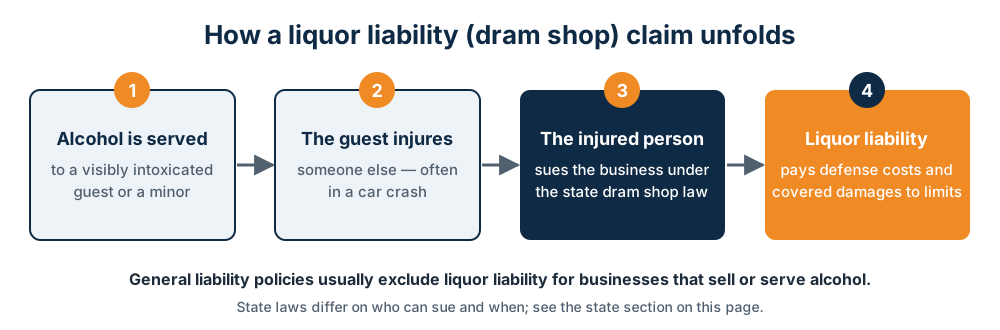
Under S.C. Code 61-2-145, any business licensed for on-premises consumption that sells alcohol after 5 p.m. must carry liquor liability coverage, either as a standalone policy or as a liquor liability endorsement on general liability. The annual aggregate must be at least $1,000,000, the per-occurrence limit must be at least 50% of that total, and the South Carolina Department of Revenue (SCDOR) must appear as certificate holder. A lapse is grounds for suspension or revocation. Our South Carolina liquor liability page covers the filing details.
Act 42 of 2025 (H.3430), effective January 1, 2026, added a risk mitigation program that can reduce the required limit down to a $300,000 floor. Qualifying steps include closing by midnight, having all servers trained, keeping alcohol under 40% of sales, using forensic ID scanning, or holding 501(c)(3) status. A late-night bar that sells mostly drinks will rarely qualify for much of a reduction, and a lower floor is not the same as enough protection. The law allows fault to be apportioned among tortfeasors in alcohol cases (15-38-15), but when a DUI defendant is also found liable, the licensee becomes jointly and severally liable for 50% of actual damages (61-2-147).
Server training is now mandatory. Since January 1, 2026, anyone who serves alcohol for on-premises consumption at least 10 hours a week, plus their managers and supervisors, must complete an SCDOR-approved server training program (S.C. Code 61-3-110 to 61-3-140). New hires have 30 days, and certificates must be kept on premises. Knowingly selling to an intoxicated person (61-6-2220) brings escalating penalties: a $2,500 fine, then a suspension of up to 14 days, then revocation (61-4-580).
Where bar claims come from on a Friday night
A patron who was cut off at 11:30 gets into a pickup in your lot and sideswipes another car on the way home; the injured driver sues both the DUI driver and the bar. A doorman walks an unruly guest out the side exit and the guest breaks a wrist on the steps, then claims excessive force. A spilled pitcher near the pool tables sits for twenty minutes and a league player tears a knee ligament. A cooler compressor quits on a holiday weekend and a full keg order goes warm. Each lands under a different part of the program, which is why bar coverage is built in layers.
Many general liability forms written for bars exclude or sublimit assault and battery, so read that language before you assume a parking lot fight is covered. Live bands and televised fight nights raise crowd size and change how underwriters view the account.
Coverage checklist for a South Carolina tavern
- Liquor liability — required by 61-2-145 for late-hour sellers; limits must meet the aggregate and per-occurrence rules with SCDOR on the certificate.
- General liability — slip-and-fall, customer injury and property damage claims that have nothing to do with alcohol.
- Assault and battery coverage — fills the gap many bar forms leave for fights, doorman incidents and security claims.
- Commercial property — bar fixtures, POS terminals, sound systems and the improvements you made to a leased space.
- Business interruption — lost income while you rebuild after a kitchen fire or a coastal storm.
- Equipment breakdown and spoilage — draft systems, walk-in coolers and ice machines.
- Workers’ compensation — required once you regularly employ four or more people, part-timers included; see our South Carolina restaurant workers’ comp page.
- Umbrella or excess liability — extra limits above liquor liability and GL for a severe injury case.
- Employment practices liability — tip disputes, harassment and wrongful termination claims.
What moves a bar’s premium up or down
Carriers price bars mostly on alcohol exposure: liquor sales as a share of revenue, closing time, occupancy, and whether you have dancing, live entertainment or a history of police calls. Location matters too. A bar near the coast may need wind coverage placed separately; the South Carolina Wind and Hail Underwriting Association is the statutory residual market for wind and hail in the coastal area, including Horry, Georgetown, Charleston, Beaufort and Colleton counties.
The steps that satisfy the state’s risk mitigation program also make an account more attractive to underwriters: documented server training for the whole staff, ID scanners at the door, cameras covering the entrance and lot, a written cut-off policy and a clean incident log. A real food menu helps too, because it lowers the alcohol share of sales.
Quoting a bar through an independent agency
Provident Financial Group is an independent agency, so one application goes to multiple carriers that write bars and taverns, and you see the quotes side by side. We confirm the liquor liability limits line up with 61-2-145, list SCDOR as certificate holder, and issue live certificates of insurance you can send to a landlord or promoter. Call (866) 964-6660 if you would rather talk it through. Coverage is always subject to underwriting and policy terms.
Frequently asked questions
Does a South Carolina bar that closes at 4 p.m. need liquor liability?
The mandate in 61-2-145 applies to on-premises licensees that sell after 5 p.m. A daytime-only bar falls outside that rule, but landlords often require liquor liability anyway, and the lawsuit exposure exists at any hour.
Can the risk mitigation program lower my required limit?
Possibly. Steps such as closing by midnight, training all servers, keeping alcohol under 40% of sales or using forensic ID scanning can reduce the requirement, but never below the $300,000 floor.
Who needs the new server training certificate?
Anyone serving alcohol for on-premises consumption at least 10 hours a week, plus their managers and supervisors. New hires have 30 days to finish an SCDOR-approved program.
Is a bar fight covered by my liability policy?
Only if your program includes assault and battery coverage. Many bar forms exclude or cap these claims, so ask for the specific wording before you bind.
South Carolina bar owners can compare liquor liability, GL and property options from several carriers in one pass. Get Multiple Quotes within minutes.