
Restaurants in Columbia, SC typically need general liability, commercial property, workers’ compensation once they regularly employ four or more people, and liquor liability if they pour for on-premises consumption after 5 p.m. That last one is a South Carolina licensing requirement, not a suggestion: the policy has to meet the state minimum and list the SC Department of Revenue as certificate holder.
This page is for Columbia restaurants, cafes and sports bars, from lunch spots feeding the downtown government workforce to kitchens that live and die by college weekends.
South Carolina rules that shape a Columbia policy
Liquor liability is mandatory for many licensees. Under S.C. Code 61-2-145, on-premises licensees that sell after 5 p.m. must carry liquor liability (or general liability with a liquor endorsement) with an annual aggregate of at least one million dollars, a per-occurrence limit of at least half the total, and SCDOR named as certificate holder. Since January 1, 2026, a risk mitigation program can reduce that to a 300,000-dollar floor for steps like closing by midnight, training every server, keeping alcohol under 40% of sales or using forensic ID scanning. A lapse is grounds for suspension or revocation. See our South Carolina liquor liability guide.
Server training is now required. Employees who serve alcohol on premises at least 10 hours a week, plus their managers, must complete an SCDOR-approved program; new hires have 30 days. Under Act 42 of 2025, where a drunk-driving defendant is also found liable, the licensee can be jointly and severally liable for 50% of actual damages.
Workers’ comp starts at four employees. Part-timers and family members count. Fines run per employee per day, willful refusal is a misdemeanor, and an uninsured employer loses standard defenses if a worker sues.
Food safety and vehicles. Retail food permits run through the SC Department of Agriculture under Regulation 61-25, and at least one employee directing food prep must be a certified food protection manager. Vehicles used for catering or deliveries need at least 25/50/25 liability (in thousands of dollars), plus uninsured motorist coverage at the same limits.
Where Columbia restaurants actually get hurt
Columbia is a state capital and a big university town at once. Weekday lunch is steady; home-game weekends can double the crowd in a few hours.
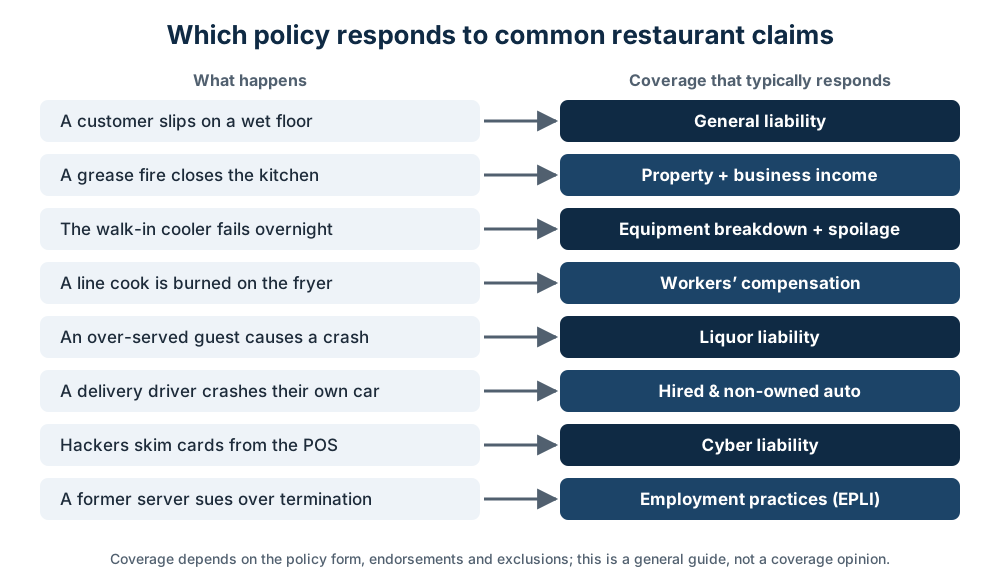
- A fake ID gets past a new bartender on a packed Saturday, and the patron later causes a crash. Training records, ID procedures and your liquor limits all matter at once.
- A guest slips on a spilled drink near a crowded bar rail and fractures a wrist.
- A server drives her own car to drop off a catering order for a state office and rear-ends another vehicle. Without hired and non-owned auto coverage, that claim can land on your business.
- A walk-in cooler compressor fails on a hot summer weekend and inventory spoils before a tech arrives.
- A line cook suffers a deep fryer burn during the dinner rush and misses weeks of work.
Coverage checklist for a Columbia restaurant
- General liability — guest injuries and property damage from a busy dining room or patio.
- Liquor liability — required for many licensees; certificate must name SCDOR and meet the per-occurrence rule.
- Commercial property — your build-out, kitchen equipment, furniture and stock.
- Business income — lost income and payroll support if a covered loss closes you.
- Equipment breakdown and spoilage — compressor, hood and cooler failures.
- Workers’ compensation — required at four or more employees, including part-timers.
- Hired and non-owned auto — staff running deliveries in their own cars.
- Employment practices liability — wrongful termination or harassment claims in a high-turnover workforce.
What moves your premium in Columbia
Carriers weigh alcohol as a share of revenue, closing time, live entertainment, square footage, building age, fire suppression over the cooking line, payroll by job class and prior claims. A kitchen-driven restaurant that closes at 10 p.m. rates very differently from a late-night bar near campus. To improve pricing, document server training, use ID scanning, keep hood and suppression service records current, and ask whether the new risk mitigation options fit your operation. Clean loss runs help most of all.
How quoting works with Provident Financial Group
US Restaurant Insure is a service of Provident Financial Group, an independent agency. One application lets us compare multiple carriers quoted through our agency side by side, so you weigh limits and exclusions, not just price. Once bound, we issue certificates for your landlord, SCDOR and any venue that asks. Prefer to talk? Call (866) 964-6660.
Frequently asked questions
Does my Columbia cafe need liquor liability if we only sell beer and wine at lunch?
The state mandate applies to on-premises licensees that sell after 5 p.m. If you truly stop before then it may not apply, but your lease or lender may still require the coverage.
We have three full-time cooks and two part-time servers. Do we need workers’ comp?
Yes. South Carolina counts part-time workers, so five regular employees puts you over the four-employee threshold.
Can training our servers lower our required liquor liability limit?
It can. Full server training is one of the 2026 risk mitigation factors that may allow a reduced limit. Ask us how the factors apply to your license.
What do I need to show my landlord before I open?
Most Columbia leases ask for a certificate showing general liability and property limits, with the landlord named as additional insured. We can issue it the day your policy binds.
Opening, renewing or shopping your current policy? Get Multiple Quotes within minutes.
Official South Carolina sources
- S.C. Code Title 61, Chapter 2 (alcohol general provisions; liquor liability insurance)
- South Carolina Workers' Compensation Commission: employer FAQ
- SC Department of Agriculture: retail food safety
- SC Department of Agriculture: certified food protection manager guidance (2024)
- S.C. Code Title 38, Chapter 75 (incl. SC Wind and Hail Underwriting Association)
State facts on this page are drawn from the statutes and agency pages above. Laws and agency rules change, so confirm current requirements with the agency before relying on them. This page is general information, not legal advice or a coverage opinion.