
Breweries and taprooms in Connecticut typically need product liability, liquor liability, property with equipment breakdown and workers’ compensation. A brewery is two businesses in one building: a manufacturer whose cans and kegs leave the premises, and a bar exposed to Connecticut’s Dram Shop Act. Every employer in the state must carry workers’ comp, regardless of how few people work the brewhouse.
This guide is for production breweries, brewpubs and taproom-first operations across Connecticut, from converted mill buildings in the Naugatuck Valley to shoreline spots that draw summer crowds. It covers the state rules that touch your policy, the brewhouse risks carriers ask about, and how to get several quotes from one application.
Connecticut liquor rules that shape taproom coverage
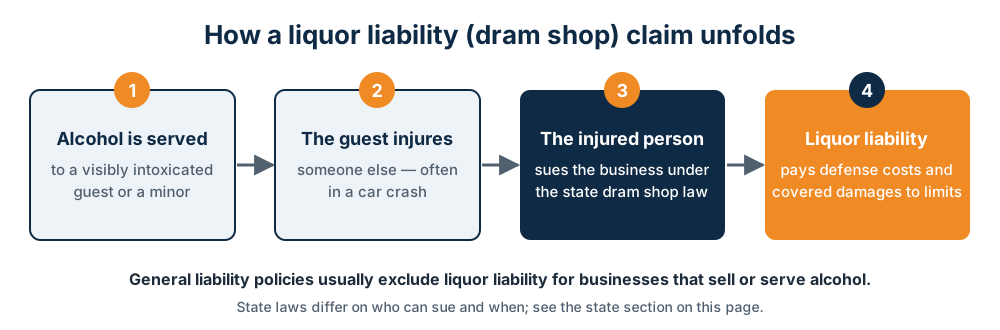
Taproom pours are subject to the Dram Shop Act, Conn. Gen. Stat. § 30-102. If you sell to an intoxicated guest who then injures someone, you can be liable up to a statutory cap of $250,000 per injured person and $250,000 in the aggregate, with written notice due within 120 days (180 for death or incapacity) and a one-year window to sue. Claims alleging wanton or reckless service are not bound by that cap. The state does not mandate liquor liability insurance, yet distributors, landlords and festival organizers routinely ask for it.
The Department of Consumer Protection’s Liquor Control Division oversees permits. Since January 1, 2026, owners on new permit applications and transfers must finish DCP’s free Liquor Law Education Program before the permit issues, and DCP-approved server training under § 30-47(b) remains voluntary but valuable for underwriting. Workers’ comp is required for every employer under § 31-284(b).
Brewhouse and taproom exposures that turn into claims
Production creates risks a typical bar never sees. A batch with a secondary fermentation problem leaves the building in cans; a few swell and one bursts in a retailer’s cooler, cutting a stocker’s hand. That is a products claim, and it may be followed by a recall of every can from that run. A glass carboy or a pressurized keg coupler failure can injure a brewer, and hot-side work around the kettle and CIP chemicals produces burns that show up on the workers’ comp loss run.
The taproom side has its own scenarios. A Saturday release draws a line down the block, a guest trips on a hose running to a food truck parked on your lot, and the truck operator’s certificate turns out to be expired. A tour group member slips on a wet brewhouse floor. On the property side, a power loss during a Long Island Sound storm can spoil fermenting batches, and a freeze-up in an older building can crack glycol lines. Coastal flooding is a real concern for waterfront locations and is not covered under a standard property form.
What a Connecticut brewery policy should include
- Product liability — covers injury or damage from beer that leaves your building in cans, bottles or kegs.
- Product recall or contamination — pays to pull and replace a bad batch from shelves and taps.
- Liquor liability — responds to over-service claims from taproom and event pours under the Dram Shop Act.
- General liability — premises injuries during tours, releases and trivia nights.
- Property with equipment breakdown — fermenters, brite tanks, boilers, glycol chillers and the canning line.
- Spoilage and business income — beer in process lost to a power outage or refrigeration failure, plus lost sales while you rebuild.
- Workers’ compensation — brewers, cellar staff and beertenders; mandatory in Connecticut.
- Commercial and hired auto — self-distribution vans and employees running kegs in personal cars.
- Inland marine — mobile bars, kegs and jockey boxes taken to festivals.
How carriers set the price for a brewery
Underwriters look at annual barrel production, the share of beer distributed versus poured on site, whether you self-distribute, taproom hours and capacity, the building’s construction and sprinkler status, and your loss history. A brewpub with a full kitchen adds cooking exposure; a taproom that hosts outside food trucks adds contractual exposure.
Ways to improve your pricing include written quality-control and batch-tracking procedures, pressure-vessel maintenance records, a requirement that every visiting food truck provide a certificate naming you as additional insured, server training for taproom staff, and a flood plan if you are near the water.
One application, several brewery quotes
Provident Financial Group is an independent agency. You complete one application, and we compare multiple carriers side by side, including markets that understand craft beverage manufacturing. After you bind, we can issue live certificates of insurance for distributors, landlords and beer festivals. Call (866) 964-6660 to talk through your setup.
Frequently asked questions
Does a taproom-only brewery still need product liability?
If any beer leaves in growlers, crowlers, cans or kegs, yes. Product claims can follow a container long after it leaves your door.
Are food trucks at my brewery covered under my policy?
Generally no. Require each truck to carry its own liability and name your brewery as additional insured, and keep the certificates on file.
Is flood damage part of a standard brewery property policy?
Usually not. Shoreline breweries should price separate flood coverage, since coastal flooding along Long Island Sound is a known Connecticut exposure.
Can one policy cover both brewing and the taproom?
Often, yes, through a package built for craft beverage businesses, though liquor liability and product recall may be written as separate forms.
Want to see what your brewery qualifies for? Get Multiple Quotes within minutes.