
Food vendors and farmers market sellers in Delaware typically need general liability with products coverage, a certificate that names each market or event as additional insured, equipment or inland marine coverage for tents, coolers and cooking gear, and the right auto coverage for the vehicle hauling everything to the market. Once you hire help, even for one weekend, Delaware workers’ compensation applies.
This page is for tent and table vendors: market bakers, jam and salsa makers, kettle corn and lemonade stands, prepared-food booths at county fairs and street festivals, and small producers selling at markets from Wilmington to Milton. Most vendors need a lean, portable policy rather than a full restaurant package.
Market permits, event rules and the 2026 mobile food order
Delaware’s Division of Public Health, through its Office of Food Protection, permits food establishments statewide under the State of Delaware Food Code, including mobile units and many event operations. What you need depends on what you sell and how it is prepared, so check with DPH before your first market day rather than relying on another vendor’s setup. Permitted establishments generally must have a Certified Food Protection Manager, with variances available for some lower-risk operations.
If you are moving from a tent to a truck, note Executive Order 21 (Governor Meyer, 2026), which directs DPH to clarify that a food truck can meet sanitation requirements with onboard equipment alone, without a separate commissary, if it meets Food Code standards. Confirm current implementation with DPH, and see our Delaware food truck insurance page for what changes on the insurance side.
Markets and festivals set their own insurance terms, usually requiring general liability at a stated limit and naming the organizer, and sometimes the town or property owner, as additional insured. Keep a copy of each vendor agreement; we can match your certificate to it.
Tents, generators and the drive to the market
The vehicle you use to haul product matters. Delaware requires 25/50/10 liability (in thousands of dollars) and Personal Injury Protection on every registered vehicle. If a business-owned van or truck carries your goods, it needs a commercial auto policy. If you use a personal vehicle, ask whether your personal carrier allows regular business use; some policies limit it.
- A gust off the Delaware Bay lifts an unweighted canopy at a Lewes market and it strikes a shopper and a neighboring vendor’s display.
- A customer trips over the power cord running from your generator to a warming table.
- Homemade salsa sold in jars is linked to illness, and the buyer’s attorney asks for your insurance information.
- A cooler of cut fruit loses temperature on a hot afternoon and the whole batch is thrown out.
- A helper you pay cash for the day burns a hand on a kettle corn popper.
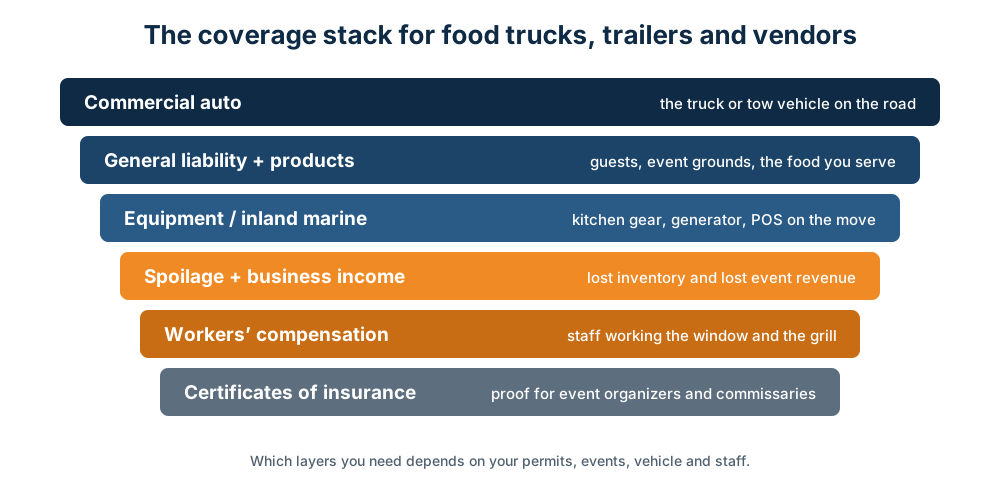
A vendor’s short list of coverages
- General liability — covers shopper injuries and damage to the market’s or another vendor’s property.
- Products-completed operations — responds when food you sold causes illness or injury after the sale.
- Additional insured endorsements — let you name markets, festivals and property owners as their contracts require.
- Inland marine or business equipment — protects tents, coolers, cookers and generators on the road and at the booth.
- Commercial auto — for business-owned vehicles, with Delaware’s required PIP.
- Workers’ compensation — required from the first employee, including paid day helpers.
- Spoilage — optional for vendors carrying significant refrigerated inventory.
What vendor premiums hinge on
Carriers rate on annual sales, product type (shelf-stable baked goods versus cooked or acidified foods), open flame or fryer use, number of events, whether you also sell wholesale and prior claims. Vendors can improve their standing with weighted tents, cord covers, fire extinguishers at cooking stations, clear ingredient labels, batch records for jarred products and a simple temperature log for coolers.
How a market vendor gets covered and certified
Provident Financial Group is an independent agency. One application goes to multiple carriers and we compare options side by side, including annual policies that cover every market you attend. After binding we can issue certificates to each organizer quickly. Call (866) 964-6660. Coverage is subject to underwriting and policy terms.
Frequently asked questions
Do I need a separate policy for every Delaware farmers market?
Usually not. An annual vendor liability policy covers your ongoing operations, and we issue a certificate naming each market that requires one.
Is a tent blown over by wind covered?
Damage to your own tent is covered only if you carry equipment or inland marine coverage. Injury to a shopper or damage to another vendor’s booth is a general liability claim.
Does my homeowners policy cover products I make at home and sell at markets?
Homeowners policies commonly exclude business activity, so a separate commercial policy is typically needed.
I pay my cousin to help on Saturdays. Do I need workers’ comp?
If your cousin is an employee, Delaware requires coverage from the first employee. Talk with us about how the relationship is set up.
Heading to market this season? Get Multiple Quotes within minutes.