
Kansas liquor liability insurance covers alcohol-related injury claims and their defense, even though Kansas has no dram shop statute. In Ling v. Jan’s Liquors (1985) and Bland v. Scott (2005), the Kansas Supreme Court declined to create civil liability for suppliers who serve intoxicated people or minors, leaving the question to the legislature. No statute requires the coverage, but landlords, lenders and venues often do.
This page is for Kansas bar owners, brewery taprooms, restaurants with a bar program, BYOB restaurants and caterers, from Wichita’s Old Town to Lawrence and Johnson County. In Kansas the buying decision is driven by contracts and on-premises risk rather than dram shop law. For your broader program, see restaurant insurance in Kansas.
Does Kansas have a dram shop law?
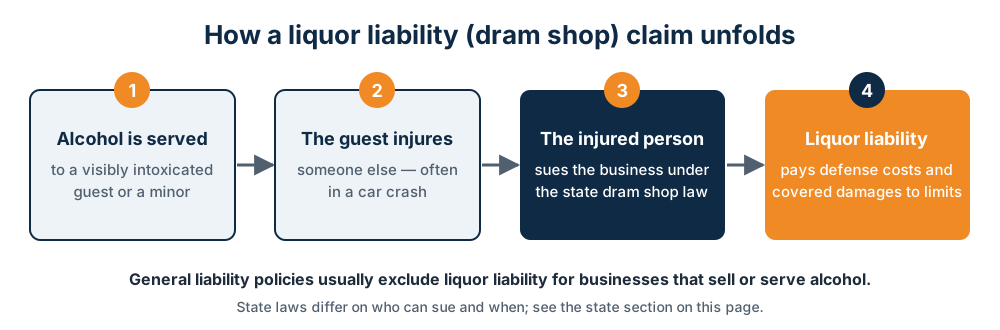
No. Kansas has no dram shop statute. The legislature repealed an earlier dram shop act in 1949, and in Ling v. Jan’s Liquors, 237 Kan. 629 (1985), the Kansas Supreme Court refused to create vendor liability for serving minors or intoxicated persons, saying the question belongs to the legislature. The practical result: when a guest leaves your bar, drives and injures someone, Kansas courts have not recognized a civil claim against the seller for the act of serving.
That is not the same as no exposure. Licensees still face administrative penalties from the Kansas Department of Revenue, Division of Alcoholic Beverage Control (ABC). Alcohol-related premises claims, such as fights and falls involving intoxicated guests, can still be filed on ordinary negligence grounds. Plaintiffs can file suits that test the rule, and defense costs accrue even when those suits fail. And because the courts have repeatedly deferred to the legislature, the position could change if lawmakers act, so review it at each renewal.
| Kansas situation | Civil claim against the seller? | What still matters |
|---|---|---|
| Adult served past intoxication, later injures someone off premises | Not recognized (Ling v. Jan’s Liquors) | Defense costs if a plaintiff tests the rule |
| Minor served, later injures someone | Not recognized against suppliers (Ling; Bland v. Scott) | Criminal exposure and ABC administrative penalties |
| Fight, fall or security failure on premises | Can be filed as a premises claim | Assault and battery terms, staffing |
| BYOB guest at an unlicensed business | Premises claims remain possible | Following every KDOR ABC BYOB condition |
Social hosts and the Bland v. Scott decision
Kansas has no civil social host liability. In Bland v. Scott (Kan. 2005), the Kansas Supreme Court again declined to create a third-party cause of action against suppliers of alcohol, including social hosts who served a minor, calling it “a matter of public policy which the legislature is best equipped to handle.” Furnishing alcohol to minors is still a crime. For restaurants renting private rooms and caterers pouring at client events, the distinction between a liquor policy and host liquor liability still decides which policy answers a premises claim.
Is liquor liability insurance required for a Kansas license?
Not by statute. The KDOR on-premise licensing page lists only a Liquor Drink Tax bond of at least $1,000 (cash, escrow or surety) for on-premise licensees and no liability insurance requirement. That bond relates to drink tax obligations; it is not insurance and does not pay injury claims. The coverage requirement comes from contracts: commercial landlords, lenders, event venues and franchisors often write liquor liability into their agreements with named per-occurrence and aggregate limits and additional insured status.
Server training in Kansas is voluntary
We found no mandatory server-training law in Kansas. The KDOR ABC offers optional licensee education visits on request, covering ID checks, compliance and underage drinking laws. Training still pays off: it reduces ABC administrative problems, supports your defense in a premises claim, and gives underwriters something concrete to credit. Keep a roster of who was trained and when.
Kansas BYOB rules for unlicensed businesses
Kansas is unusually specific here. The KDOR ABC allows BYOB at unlicensed businesses only if the liquor stays in the patron’s personal possession and is not sold, offered or given away by the owner; no charge of any kind is made, so a corkage or setup fee conflicts with that condition; there is no possession or consumption between midnight and 9 a.m.; and the business has never had a liquor license revoked. Local rules may be stricter. A BYOB restaurant still has premises exposure, and our BYOB liquor liability guide covers the coverage options.
Claim scenarios typical for Kansas venues
A Wichita Old Town bar ejects a patron at closing, a fight follows on the sidewalk, and the injured bystander sues for negligent security. A Lawrence bar near campus has a guest fall down a stairwell after several drinks. A Kansas City, Kansas brewery taproom hosts a release party where a patron slips on a wet floor by the tap wall. A Topeka BYOB restaurant charges a small setup fee, breaking a KDOR condition, just before a guest is injured. A caterer pouring at an Overland Park wedding is named with the venue after a dance-floor injury.
Why assault and battery terms matter most in Kansas
With over-service claims largely off the table, the claims Kansas bars actually see tend to be fights, ejections and security failures. Your general liability policy excludes injury arising from selling or serving alcohol once you are in that business, and many liquor and GL policies exclude assault and battery or cap it with a small sublimit. Read that wording first; see does liquor liability cover assault claims.
Per-occurrence and aggregate limits
The per-occurrence limit caps what is paid for one incident; the aggregate caps the policy year. Kansas leases usually specify both, often matching your general liability limits. Confirm whether defense costs erode the limit and whether your umbrella sits over the liquor policy. Our explainer on per-occurrence vs aggregate limits goes deeper.
How liquor receipts shape Kansas pricing
Carriers rate primarily on liquor receipts: annual alcohol sales and the share they represent of total revenue. A steakhouse selling wine with dinner is priced very differently from a late-night bar where drinks are most of the sales. Hours, live music, drink specials, security staffing, training, claims history and any ABC violations adjust the rate. Clean POS splits between food and alcohol and an incident log help you see what you qualify for.
Which Kansas businesses face which issues
- Bars and taverns — ejections, fights and crowd control; A&B limits come first.
- Breweries and taprooms — release parties and festival pours alongside manufacturing risks.
- Fine dining and restaurants with bars — lower receipts, but lease requirements still apply.
- Caterers — venue certificate demands at events you do not control.
- Employers with more than $20,000 in gross annual payroll — workers’ comp is required, and smaller employers are exempt unless they are subcontractors; see Kansas restaurant workers’ comp.
Coverage checklist for Kansas licensees and BYOB venues
- Liquor liability — defense and alcohol-related claims your GL excludes.
- Assault and battery — a full limit, not a token sublimit.
- General liability — slips, falls and food claims.
- Umbrella — scheduled over the liquor policy.
- Property — wind and hail; rising-water flood needs separate NFIP coverage.
- Commercial auto — Kansas requires PIP and UM/UIM on top of 25/50/25 (in thousands of dollars) liability.
Quoting Kansas liquor coverage with an independent agency
Provident Financial Group takes one application to multiple carriers and compares the quotes side by side, including A&B wording and umbrella fit. Have your license type, liquor receipts, hours, BYOB practices and loss runs ready. After binding, live certificates of insurance for landlords and venues are issued quickly. Call (866) 964-6660 or start online.
Frequently asked questions
Can a Kansas bar be sued if a patron drives drunk after leaving?
Kansas courts have not recognized a dram shop claim against the seller, per Ling v. Jan’s Liquors. A suit can still be filed and must be defended, and premises claims remain.
Why buy liquor liability if Kansas has no dram shop law?
Leases and lenders often require it, on-premises alcohol-related injuries and fights can still produce claims, and defense costs are real even when a claim fails.
Is the Liquor Drink Tax bond the same as liquor liability insurance?
No. The bond is a licensing condition tied to drink tax; it does not pay injury claims.
Can a Kansas restaurant charge corkage for BYOB?
Not at an unlicensed business under the KDOR ABC conditions, which require that no charge of any kind is made. Check local rules too.
Serving alcohol or allowing BYOB in Kansas? Compare liquor liability and A&B options from multiple carriers. Get Multiple Quotes within minutes.
Official Kansas sources
- Kansas Department of Revenue ABC: on-premise licensing
- Kansas Department of Revenue ABC: reference guide
- Kansas Department of Revenue ABC: licensee education
State facts on this page are drawn from the statutes and agency pages above. Laws and agency rules change, so confirm current requirements with the agency before relying on them. This page is general information, not legal advice or a coverage opinion.
Related pages
- Bar insurance in Kansas
- Brewery insurance in Kansas
- Catering insurance in Kansas
- Fine dining insurance in Kansas
- Restaurant insurance in Kansas
- Liquor liability laws by state