
Kentucky bars, restaurants, breweries and caterers that sell or serve alcohol need liquor liability insurance because a standard general liability policy excludes alcohol-related claims. Kentucky’s dram shop statute, KRS 413.241, treats drinking rather than serving as the main cause of an injury, but a licensee can still be held liable when a reasonable person should have known the patron was already intoxicated.
This page is for Kentucky permit holders: a bourbon bar in Louisville, a taproom near campus in Lexington, or a caterer pouring at barn weddings. It explains what the statute actually exposes you to, where policies commonly fall short, and how carriers price the coverage. It is general information, not legal advice.
What does KRS 413.241 actually say?
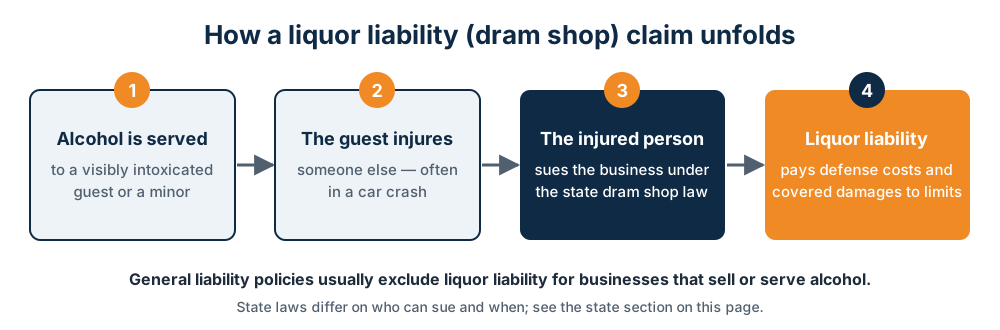
Kentucky’s dram shop law starts from a position that favors sellers. The General Assembly declared that consuming alcohol, not serving it, is the proximate cause of injuries an intoxicated person causes, and it makes that intoxicated person primarily liable to anyone they hurt. A permit holder and its employees who serve a person of legal age are not liable for injuries that happen off premises unless a reasonable person in the same circumstances should have known the patron was already intoxicated when served.
That exception is where Kentucky claims live. An injured driver, passenger or pedestrian, or the family of someone killed, sues both the drinker and the bar, and argues that slurred speech, stumbling or a run of rapid rounds should have been obvious to any reasonable bartender. The protection disappears entirely for anyone who forces drinks on a person or falsely says a drink has no alcohol in it. Kentucky sets no statutory cap on damages, so one serious crash can produce a demand far beyond a modest policy limit.
Notice what the statute is written around: service to people of legal age. Serving a minor sits outside that framing and is also a licensing violation the Kentucky Department of Alcoholic Beverage Control (ABC) enforces, so carriers treat ID discipline as a core underwriting question.
Social hosts, BYOB and the questions Kentucky law leaves open
KRS 413.241 speaks to permit holders and their employees. It does not clearly answer whether a private host can be sued for over-serving a guest, and we have not verified Kentucky case law on that point. Kentucky’s position on BYOB at unlicensed restaurants is also something to confirm with the Kentucky ABC and your local administrator before you allow it. If you host private parties, know that the host liquor coverage inside a general liability policy and a true liquor liability policy respond very differently (see liquor liability vs. host liquor liability).
Is liquor liability insurance required in Kentucky?
We have not identified a Kentucky statute that requires permit holders to carry liquor liability insurance. In practice, most operators carry it because someone else demands it: commercial landlords write it into the lease, lenders ask for it, and wedding sites and festivals will not let a caterer or mobile bar pour without a certificate naming them as additional insured. Without it, a KRS 413.241 suit is defended and paid out of the business itself.
STAR server training and why it helps your defense
The Kentucky ABC runs STAR server training, a three-hour course whose certificate is valid for three years, designed to help sellers and servers protect themselves from third-party liability. Whether training is mandated statewide is something we have not verified, and we are not aware of a formal safe harbor tied to it. It still pays off twice. Because the legal test is what a reasonable person should have known, documented training, written cut-off policies and incident logs are evidence your staff acted reasonably, and many underwriters look favorably on trained staff when pricing the account.
Claim scenarios Kentucky venues should plan for
| Scenario | The legal question | Policy that should respond |
|---|---|---|
| A regular leaves a bourbon bar after a long tasting flight and rear-ends a car on the interstate | Should a reasonable server have known he was already intoxicated? | Liquor liability |
| Two guests fight on the patio during a Derby watch party | Did staff respond reasonably to a visible threat? | Liquor liability with assault and battery coverage |
| A 20-year-old with a borrowed ID is served near campus and crashes | Falls outside the legal-age protection of the statute | Liquor liability; separate ABC license exposure |
| A wedding guest served by your catering staff drives off and hits a cyclist | Same reasonable-person test applied to your servers | Caterer’s liquor liability; venue expects additional insured status |
| A doorman is hurt removing an intoxicated patron | Employee injury, not a third-party claim | Workers’ compensation |
That last row matters more in Kentucky than in some neighboring states: workers’ comp is required from the first employee, and family members and part-time staff count. See restaurant workers’ compensation in Kentucky.
Assault and battery, and the liquor exclusion in your GL
A standard general liability form excludes injury arising from causing or contributing to someone’s intoxication when you are in the business of selling or serving alcohol. That is why liquor liability is a separate policy. The next trap is assault and battery: some forms exclude fights outright, some cover them only up to a small sublimit, and some exclude injuries caused by your own security staff. For a late-night bar, that wording can matter more than the headline limit. See does liquor liability cover assault claims?
Per-occurrence vs. aggregate limits
Liquor liability carries a per-occurrence limit, the most the carrier pays for one incident, and an aggregate, the most it pays for all incidents in the policy year. A multi-car crash with several injured people is one occurrence, so the per-occurrence number is what gets tested. Ask whether defense costs sit inside the limit, which erodes it, or outside it. Because Kentucky has no damage cap, many operators add an umbrella and confirm it follows form over liquor. More on per-occurrence vs. aggregate.
Coverage checklist for a Kentucky permit holder
- Liquor liability — responds to KRS 413.241 suits that general liability excludes
- Assault and battery coverage at full limits — patio fights and ejections at late-night venues
- Defense outside the limit where available — alcohol suits are expensive to defend even when you win
- Employees as insureds — bartenders and servers are often named personally
- Additional insured endorsements — landlords, venues and festivals ask for them on the certificate
- Umbrella that follows form over liquor — no statutory cap means no ceiling on a verdict
- Workers’ compensation — required from the first employee in Kentucky
How liquor receipts drive the price
Most carriers rate liquor liability on annual alcohol receipts, so the exposure grows with every pour. The ratio of alcohol to food sales matters just as much: a steakhouse where wine is a small share of revenue is viewed very differently from a bar where drinks are most of the business. Underwriters also weigh closing time, live music, security staffing, drink specials, prior claims and ABC violations. Documented STAR training, ID scanners, a written cut-off policy and incident reports all help.
Which Kentucky businesses face which issues
Bars and taverns carry the heaviest dram shop and assault exposure because of late hours and high alcohol share. Breweries and taprooms add product liability and tour guests to the picture. Fine dining restaurants usually have a lower alcohol ratio but still face over-service claims from long pairing dinners. Caterers face the reasonable-person test at someone else’s venue, often under contracts that shift liability to them.
How quoting works with Provident Financial Group
Provident Financial Group is an independent agency, so you complete one application and we compare liquor liability from multiple carriers side by side, including assault and battery terms and defense treatment. Once you bind, we issue certificates of insurance you can send to landlords and venues. Call (866) 964-6660 or start online. For the full package, see restaurant insurance in Kentucky.
Frequently asked questions
Can a Kentucky bar be sued if a customer drives drunk after leaving?
Yes, but the injured party has to get past KRS 413.241, which makes the drinker primarily liable. The bar is exposed when a reasonable person should have known the patron was already intoxicated when served.
Does Kentucky cap dram shop damages?
No statutory damage cap applies. That is why limits, defense terms and an umbrella that follows form deserve attention.
Is STAR training required for every Kentucky server?
We have not verified a statewide mandate. STAR certificates are valid for three years and help show your staff acted reasonably, which is the test the statute uses.
Can one liquor policy cover my bar and my catering jobs?
Often, if the carrier knows about off-site service and it is scheduled on the policy. Tell us about catering before you bind so events are not an uncovered surprise.
Ready to see what Kentucky carriers will offer your business? Get Multiple Quotes within minutes.
Official Kentucky sources
- Kentucky Revised Statutes § 413.241 (dram shop liability)
- Kentucky Department of Alcoholic Beverage Control
- Kentucky ABC: education and STAR server training
State facts on this page are drawn from the statutes and agency pages above. Laws and agency rules change, so confirm current requirements with the agency before relying on them. This page is general information, not legal advice or a coverage opinion.
Related pages
- Restaurant insurance in Kentucky
- Bar insurance in Kentucky
- Brewery insurance in Kentucky
- Catering insurance in Kentucky
- Fine dining insurance in Kentucky
- Liquor liability laws by state
- Do caterers need liquor liability insurance?