
Food trucks in California typically need commercial auto insurance at or above the state’s 30/60/15 minimum (in thousands of dollars), general liability for the people lined up at the window, workers’ compensation for anyone on the payroll, and coverage for the kitchen equipment built into the truck. County environmental health agencies, commissaries and event organizers routinely ask for evidence of insurance before you serve.
This page is for owner-operators running a truck anywhere from San Diego to Sacramento, whether the week is office-park lunches, private catering or weekend festivals. For the national overview, see our food truck insurance guide.
How does California permit a mobile food facility?
California calls a food truck a mobile food facility, and the county environmental health agency permits and inspects it before it can operate. Under the California Retail Food Code (Health & Safety Code §§114295 and 114326), the unit must operate from an approved commissary and report there at least once each operating day for cleaning and servicing. Some counties add conditions; Sonoma County, for example, summarizes a requirement for a restroom agreement within 200 feet when you stop for more than an hour. Construction must meet NSF/ANSI Standard 59, and procedures differ by county, so a truck working both Los Angeles and Orange County events should expect two sets of paperwork.
At least one owner or employee must pass a state-approved food safety certification exam, and food handlers need a California Food Handler Card within 30 days of hire, valid for three years. Inspection history and certification records are exactly what underwriters ask about.
Commissary, venue and festival paperwork: who asks for what
The county permit makes you legal; the certificate of insurance gets you through the gate. Each party below tends to want something slightly different on the certificate.
| Who is asking | What they commonly request | What to check first |
|---|---|---|
| Commissary operator | General liability naming the commissary as additional insured | Whether the agreement also asks for a waiver of subrogation |
| Festival or street-fair organizer | Certificate naming the organizer, sponsors and sometimes the city | Exact legal names and the certificate deadline in the vendor packet |
| Winery, brewery or office campus | Liability, auto for the vehicle on site, liquor liability if you pour | Whether they want primary and non-contributory wording |
| Truck lender or lessor | Loss payee on physical damage coverage | That the stated value includes the full build-out |
Our guide to certificates for food truck events explains the wording, and blanket additional insured endorsements save time when you book a dozen events a season.
What California’s higher auto minimums mean for a rolling kitchen
California raised its minimum auto liability limits on January 1, 2025 under SB 1107, from 15/30/5 to 30/60/15 (in thousands of dollars), according to the California Department of Insurance. That is a legal floor, not a recommendation. A loaded truck carrying propane and hot oil that rear-ends a sedan on the 405 can generate claims well beyond it, and many venues ask for higher limits before letting a vehicle on site.
Personal auto policies do not respond when the vehicle is the business, so the truck needs commercial auto. Declare the value of the kitchen build-out so physical damage coverage reflects replacement cost, and cover supply runs in personal cars with hired and non-owned auto.
Workers’ comp when your crew is two cooks and a cousin
California requires workers’ compensation for every employer with one or more employees (Labor Code §3700), family members included. A sole proprietor with no employees may cover themselves by endorsement, and corporate officers must be covered unless they wholly own the corporation. The State Compensation Insurance Fund is the insurer of last resort.
For policies incepting on or after September 1, 2024, the WCIRB split the old restaurant code into separate classes, including 9083 for fast food or fast casual, 9081(1) for restaurants not otherwise classified and 9082 for caterers that are not restaurants. The class that fits your truck depends on how you operate, so describe your menu and catering share accurately. Going uninsured is a misdemeanor, triggers a stop order barring use of employee labor, and carries penalties based on at least twice the premium you would have paid. See California restaurant workers’ comp.
Earthquake, wildfire and power loss exposures
The California Department of Insurance warns that commercial property insurance usually does not cover earthquake damage; separate earthquake insurance is needed. That matters most for what stays put: a leased prep space, stored supplies, or equipment kept at the commissary. If you own a fixed kitchen in a wildfire area and the regular market declines it, the California FAIR Plan is the property insurer of last resort, and because its policies are limited fire policies, owners often add Difference in Conditions coverage. Power shutoffs and heat waves can also knock out commissary refrigeration, which is where spoilage coverage helps.
Claim scenarios we see from California trucks
- A guest at a Silicon Valley campus lunch reports food poisoning and files a claim against the truck.
- A child trips over a generator cord at a street fair and breaks a wrist.
- A fryer shifts during a hard stop on the way to a Sacramento event, burning a cook and damaging the line.
- Beer poured from your truck at a winery event reaches an obviously intoxicated guest under 21, the main dram shop exposure under Business & Professions Code §25602.1.
California food truck coverage checklist
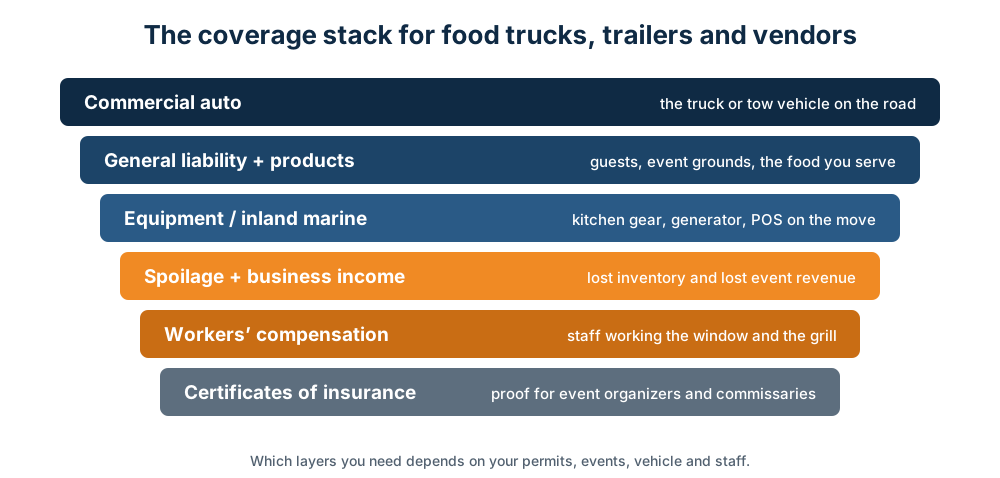
- Commercial auto liability — the minimum is 30/60/15 (in thousands of dollars); venues often expect more.
- Auto physical damage with the build-out declared — replaces the kitchen, not just the chassis.
- General liability with products coverage — injuries and illness tied to what you serve.
- Blanket additional insured and waiver of subrogation — faster certificates for commissaries and festivals.
- Workers’ compensation — mandatory with one employee, family included.
- Equipment coverage — generators, POS gear and tents used off the truck.
- Liquor liability — if you ever pour; see California liquor liability.
- Umbrella — higher limits for large events and corporate contracts.
What pushes a California food truck premium up or down?
Carriers blend auto and restaurant factors: vehicle and build-out value, where the truck garages, route traffic density, driver records, cooking method (open flame and deep fryers rate differently from coffee or shaved ice), payroll and your WCIRB class. What helps: a serviced fire suppression system, a K-class extinguisher on board, documented commissary check-ins, secure overnight parking and clean inspection reports. A higher physical damage deductible can also help if you could fund one out of pocket.
How quoting works with an independent agency
Provident Financial Group is an independent agency, so you complete one application and we compare multiple carriers side by side. Once you bind, we issue live certificates of insurance you can send to a commissary, county or festival organizer. Call (866) 964-6660 or start online.
Frequently asked questions
Does my California commissary need to be named on my insurance?
Many commissary agreements require it, usually as an additional insured on general liability. Send us the agreement so the certificate matches its wording.
Do I need workers’ comp if my only helper is my brother on weekends?
If he is paid, very likely yes. California requires coverage with one or more employees, and family members count.
Did the 2025 auto limit increase change what my truck should carry?
It raised the legal floor to 30/60/15 (in thousands of dollars), but most trucks carry more because event and venue contracts ask for it.
Do my servers need RBS certification to pour beer at a festival?
Servers and managers at ABC on-premises licensed businesses must be certified within 60 days of hire, and certification lasts three years. Confirm the event’s license arrangement with the organizer and ABC before you pour.
Can one policy cover my truck in several counties?
Yes, the insurance travels with the truck statewide. Permits are separate, and each county’s environmental health agency sets its own process.
Ready to see what you qualify for? Get Multiple Quotes within minutes. Prefer to talk it through? Call Provident Financial Group at (866) 964-6660.
Official California sources
- San Diego County Environmental Health: food handler card
- Sonoma County Environmental Health: food handler card
- Sonoma County Environmental Health: summary of mobile food facility regulations
- California Department of Insurance: 2025 insurance changes (auto minimums, SB 1107)
- California ABC: licensee laws and liability
State facts on this page are drawn from the statutes and agency pages above. Laws and agency rules change, so confirm current requirements with the agency before relying on them. This page is general information, not legal advice or a coverage opinion.