
Restaurants in Los Angeles typically need general liability, property and business income, workers’ compensation from the first employee, liquor liability if they pour alcohol, and hired and non-owned auto for delivery. The California rules that matter most are Responsible Beverage Service (RBS) certification for every server and manager within 60 days of hire, and WCIRB’s 2024 split of restaurant class codes, which changes how your workers’ comp is rated.
This guide is for LA owners running strip-center noodle shops, Hollywood cocktail lounges, taco trucks, event caterers and multi-unit fast casual concepts.
Why Los Angeles is its own insurance market
Los Angeles is sprawling and car-dependent. Many restaurants sit in strip centers with shared parking lots, and much of their revenue moves through delivery, takeout and catering drops across a huge metro area. That means more miles driven by staff, more parking-lot injuries and more certificates of insurance demanded by landlords and corporate clients. LA is also famous for its food truck culture, so plenty of operators run a kitchen, a truck and an off-site catering book at once. Each operation must be described accurately on the application or a claim can be disputed.
Catastrophe exposure is the other big difference. The California Department of Insurance warns that commercial property insurance usually does not cover earthquake damage, so a separate earthquake policy or a Difference in Conditions (DIC) policy is needed. In wildfire-exposed parts of the region, some owners can only place property with the California FAIR Plan, the state’s insurer of last resort, whose limited fire policies are often paired with DIC.
California requirements, applied to an LA kitchen
Workers’ comp: Labor Code §3700 requires coverage for every employer with one or more employees, including family members. Being uninsured is a misdemeanor, and the Labor Commissioner must issue a stop order barring employee labor. For policies incepting on or after September 1, 2024, the WCIRB split the old restaurant code into 9080 (full service), 9081(1) (N.O.C.), 9083 (fast food or fast casual), 9084 (bars, not restaurants), 9082 (caterers) and 9058 (hotel food and beverage staff). A taqueria counter and a sit-down steakhouse may now rate very differently. See our California restaurant workers’ comp guide.
Alcohol: California’s dram shop exposure is narrow. Under Business and Professions Code §25602.1, a licensee can be sued for serving an obviously intoxicated person under 21 whose intoxication causes injury or death, and licensees still owe patrons a common-law duty of reasonable care, which drives security and premises claims. RBS certification is mandatory for servers and managers, lasts 3 years, and uncertified staff can trigger ABC administrative action.
Food safety and vehicles: Local environmental health agencies inspect under the California Retail Food Code. At least one owner or employee must hold a state-approved food safety certification, and food handlers need a California Food Handler Card within 30 days of hire. Minimum auto limits rose to 30/60/15 (in thousands of dollars) on January 1, 2025, which matters for owned delivery or catering vehicles.
The claims that hit LA restaurants
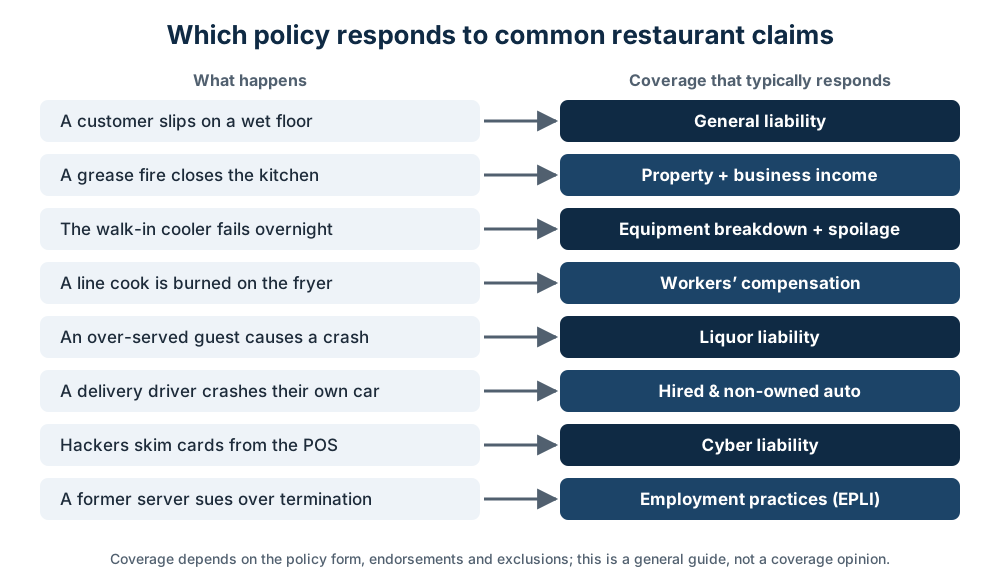
- An employee delivering in their own car rear-ends another driver; without hired and non-owned auto, the restaurant can be named with no coverage.
- A guest trips over a wheel stop in the shared strip-center lot and the landlord tenders the claim to you under the lease.
- A grease fire reaches the ductwork and closes the kitchen for weeks, a property and business income loss.
- An earthquake cracks a masonry wall and the building is red-tagged; that loss is covered only if you bought earthquake or DIC coverage.
Los Angeles restaurant coverage checklist
- General liability — guest injuries in dining rooms, patios and shared lots.
- Liquor liability — defends §25602.1 and service-related suits that general liability excludes.
- Commercial property and business income — fire, theft and vandalism, plus lost income during repairs.
- Earthquake or DIC — fills the earthquake gap in standard property forms.
- Workers’ compensation — mandatory from the first hire, rated under the new WCIRB codes.
- Hired and non-owned auto — staff who deliver or cater in personal vehicles.
- Employment practices liability — harassment and wrongful termination claims; most forms limit wage-and-hour coverage.
- Cyber liability — online ordering and card data breaches.
Rating factors behind an LA quote
Price depends on your WCIRB class and payroll, experience mod, alcohol share of sales, closing time, security staffing, delivery volume, building age and construction, wildfire and earthquake exposure at the address, and loss history. Current RBS certificates, written ID policies, documented hood cleaning, a driver roster with checked motor vehicle records and a return-to-work program all help carriers see a better-run risk.
Getting quoted through an independent agency
One application goes to multiple carriers, and Provident Financial Group presents the results side by side so you can weigh limits, exclusions and deductibles. After you bind, you get live certificates of insurance to send to landlords or event producers the same day. Call (866) 964-6660 to walk through options with an agent.
Frequently asked questions
Which WCIRB code applies to my Los Angeles restaurant?
It depends on your service model: full service is 9080, fast food or fast casual is 9083, and a bar that is not a restaurant is 9084. We review your operation so the class matches what you do.
Does my LA restaurant need earthquake coverage?
It is not legally required, but commercial property usually excludes earthquake. Many landlords and lenders ask for it, and it can be bought separately or through DIC.
Do my bartenders need RBS certification?
Yes. Anyone who checks ID, takes alcohol orders, pours or delivers alcohol must be RBS certified within 60 days of hire, along with their managers.
Is my food truck covered under my restaurant policy?
Usually not. A truck needs its own commercial auto policy; see our California food truck insurance page.
Want to compare carriers for your LA location? Get Multiple Quotes within minutes.
Official California sources
- California ABC: licensee laws and liability
- California Division of Workers' Compensation: FAQ
- San Diego County Environmental Health: food handler card
- Sonoma County Environmental Health: food handler card
- California Department of Insurance: California FAIR Plan
State facts on this page are drawn from the statutes and agency pages above. Laws and agency rules change, so confirm current requirements with the agency before relying on them. This page is general information, not legal advice or a coverage opinion.