
Equipment breakdown insurance pays to repair or replace restaurant equipment damaged by sudden mechanical or electrical failure, such as a burned-out compressor or a shorted control board, which standard property policies exclude. Spoilage coverage pays for the food lost when that equipment fails or the power goes out. Both are usually endorsements, and each has its own triggers, limits, and waiting periods.
This page is for owners and kitchen managers who want to know, before something fails, exactly which policy responds. Compressors, hood fans, dish machines, POS terminals, and HVAC units run long hours in a restaurant, and the failure rarely arrives at a convenient time. It tends to come on a holiday weekend, during a heat wave, or the night after the biggest produce and protein delivery of the week.
Why doesn’t property insurance cover a broken compressor?
Commercial property policies are built around perils: fire, lightning, windstorm, theft, vandalism, water from a burst pipe, and similar outside events. The widely used special causes of loss form then excludes several things that matter in a kitchen: mechanical breakdown, electrical damage from artificially generated current (a short circuit, arcing, or a surge that did not come from lightning), and wear and tear. The reasoning is that these failures start inside the machine rather than coming from an outside event.
Equipment breakdown coverage fills that gap. It responds to an “accident,” usually defined as sudden and accidental physical damage from mechanical breakdown, electrical failure, pressure-vessel explosion, or a similar cause. Some carriers build it into a restaurant BOP and others sell it by endorsement; see equipment breakdown vs commercial property for a side-by-side comparison.
Which restaurant equipment is at stake?
- Walk-in coolers and freezers — compressor burnout, a failed condenser fan motor, a stuck defrost timer, or a fractured refrigerant line. The insulated box is property; the refrigeration system is where most breakdown claims start.
- Reach-ins, prep tables, and ice machines — smaller units, but a restaurant has many of them, and a control board failure can take one out mid-service.
- Hood exhaust and make-up air fans — if the exhaust fan motor fails, fire codes generally will not let you run the cooking line, so a fan failure can close the kitchen as surely as a fire. A grease fire in the hood, by contrast, is a fire claim under property; see grease fires in the hood system.
- Cooking equipment — combi ovens, fryers with electronic controls, conveyor pizza ovens, and induction ranges all carry expensive boards and sensors.
- Dish machines and water heaters — booster heater failures, tank ruptures, and other pressure-vessel accidents.
- POS terminals, servers, and network gear — electrical surge or component failure. Reprogramming menus and restoring data may fall under a separate data restoration sublimit.
- HVAC — a failed compressor on the exterior condensing unit in July leaves you with an unbearable dining room and an unsafe kitchen.
- Electrical service — panels, switchgear, and transformers owned by you or, under your lease, maintained by you.
What equipment breakdown coverage typically includes
An equipment breakdown endorsement is more than a repair bill. Most forms bundle several coverage parts, each with its own limit or sublimit:
- Property damage — repair or replacement of the damaged equipment, often with an option to upgrade to more energy-efficient models.
- Expediting expenses — overtime labor and express freight to get a replacement compressor or board installed faster.
- Spoilage — perishable stock lost because of the breakdown, frequently a sublimit that may be smaller than your peak inventory.
- Business income and extra expense — lost income and extra costs while equipment is down, after a waiting period.
- Refrigerant costs — contamination by leaking refrigerant, and the cost of replacing older refrigerants that are expensive or restricted.
- Data restoration, hazardous substance cleanup, and code upgrades — usually modest sublimits.
Spoilage from a breakdown vs. spoilage from a power outage
Food spoilage can come from two directions, and policies treat them differently.
Breakdown spoilage happens when your own equipment fails: the compressor burns out, a thermostat sticks, or refrigerant leaks. It is paid by the spoilage sublimit inside the equipment breakdown endorsement, or by a standalone spoilage endorsement that lists breakdown or contamination as a covered cause.
Power outage spoilage happens when your equipment is fine but the electricity stops. If the outage comes from damage to utility lines, substations, or transformers away from your premises, the loss usually falls under utility service interruption coverage or the power-outage option on a spoilage endorsement. Some forms exclude overhead transmission lines unless you select them, and some exclude outages the utility plans or schedules in advance. More in does restaurant insurance cover power outages.
The practical takeaway: a restaurant needs both triggers. Breakdown coverage alone will not pay when a storm knocks out the neighborhood grid for two days, and utility coverage alone will not pay when your own compressor dies. Also note that spoilage forms commonly exclude disconnection of equipment from its power source, so an employee who unplugs a freezer to run a floor buffer is usually not a covered event.
The time element: lost income while equipment is down
The food and the repair invoice are often the smaller part of a breakdown loss. Lost sales while the kitchen is limited or closed can exceed both. Equipment breakdown endorsements often include business income and extra expense, but they usually apply only after a waiting period measured in hours, and some carriers express the deductible as a number of hours of downtime rather than a flat amount. A failure fixed overnight may never reach the income coverage at all.
Extra expense is where many restaurant breakdown claims are won: renting a refrigerated trailer, buying dry ice, moving product to a sister location, or paying a technician’s emergency rate to get the line running before dinner. See business interruption vs extra expense for how the two differ, and our business interruption guide for waiting periods and restoration in detail.
Why maintenance records matter
Equipment breakdown covers sudden accidents, not the slow deterioration behind them. Wear and tear, corrosion, and neglect are excluded, though a sudden breakdown that results from them is often still covered. That line is where adjusters focus, and records are how you stay on the right side of it:
- Service contracts and invoices for refrigeration, HVAC, and exhaust systems, including coil cleaning and filter changes.
- Temperature logs for walk-ins and reach-ins. The same logs the health department expects also show when a unit started drifting.
- Hood cleaning and suppression system inspection reports.
- Equipment ages, model numbers, and purchase records, which help at claim time and when setting values.
Some spoilage endorsements include a refrigeration maintenance agreement condition. If you told the carrier you have a service contract and let it lapse, coverage can be affected, so tell your agent before you drop one.
How restaurant breakdown and spoilage claims are adjusted
Breakdown claims often go to adjusters and engineers who specialize in mechanical and electrical losses. What to expect, and what helps:
- Report fast and protect the product — move food to working units or a rental reefer. The policy expects you to limit the loss, and reasonable costs to do so are often covered.
- Keep the failed part — do not let the technician haul away the compressor, board, or motor. The adjuster may want to inspect it to confirm the cause.
- Get the cause in writing — a service ticket that says “compressor seized” or “control board failed after electrical surge” shapes which coverage responds.
- Document the discarded food — photos, a written inventory with quantities, supplier invoices, and any health department instruction to discard.
- Valuation — spoilage is usually paid at the replacement cost of the food, with some forms offering a selling-price option for finished goods.
- Repair or replace — insurers typically pay to repair when repair is practical and to replace with like kind and quality when it is not.
Our restaurant claim guide walks through reporting, the sworn statement of loss, and timelines in order.
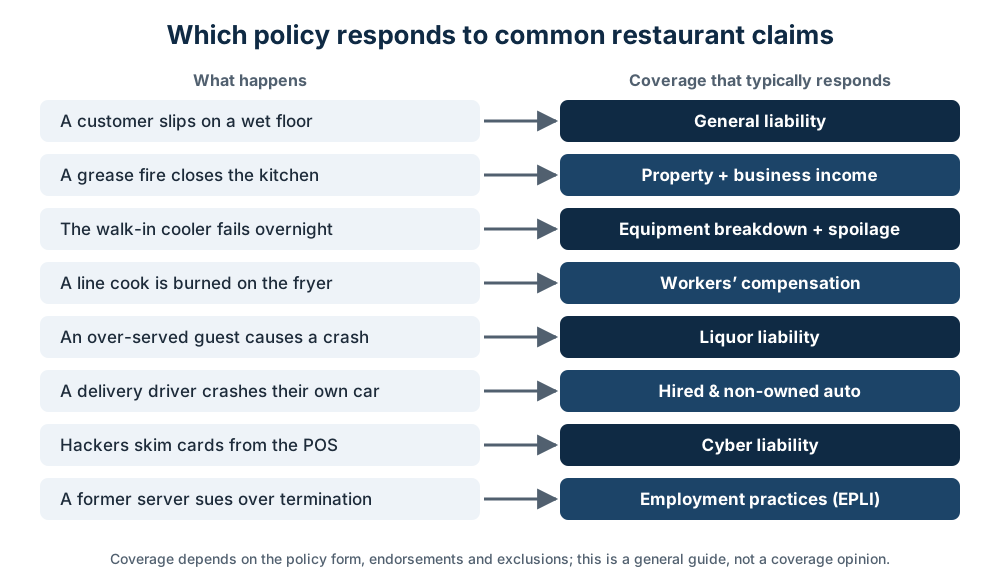
Which coverage responds? Common restaurant scenarios
| Scenario | Coverage that usually responds | Watch for |
|---|---|---|
| Walk-in compressor burns out overnight; product spoils | Equipment breakdown for the repair plus breakdown spoilage | Spoilage sublimit smaller than peak inventory |
| Storm damages utility lines; the block loses power for two days | Utility service interruption and power-outage spoilage | Overhead line and planned-outage exclusions |
| Kitchen fire damages the walk-in and the food inside | Commercial property, since fire is a covered peril | Business personal property limit and valuation |
| Lightning surge destroys POS terminals | Commercial property, since lightning is a covered peril | Electronic equipment and data restoration sublimits |
| Internal short destroys the hood exhaust fan motor; line cannot run | Equipment breakdown, with business income after the waiting period | Hours-based waiting period |
| Compressor fails after years of dirty coils and no service | Possibly breakdown for the sudden failure; wear and tear itself excluded | Maintenance documentation |
| Employee unplugs a freezer by mistake | Usually none; disconnection is commonly excluded | Spoilage causes of loss wording |
| Burst pipe floods the kitchen and shorts the dish machine | Property for the water damage; breakdown may address electrical damage | How the two policies coordinate |
For the water scenario specifically, see does restaurant insurance cover a burst pipe.
Setting limits that match your kitchen
Spoilage limits should reflect peak inventory, not the average. Count what is in every walk-in, reach-in, and freezer on your heaviest delivery day, including high-value proteins, seafood, and specialty items, and remember holiday stock-ups and catering prep. Equipment values should be at current replacement cost for the whole kitchen, updated when you add a combi oven or a second walk-in. Review both every renewal and after any menu or volume change; a limit set years ago rarely matches today’s walk-in.
What affects the price of breakdown and spoilage coverage
Carriers look at the number and age of refrigeration units, the type of cooking and electrical equipment, maintenance practices, loss history, the limits and deductibles you choose, and whether the location has backup protection. Remote temperature monitors that alert a manager’s phone, a generator or generator hookup, surge protection on electronics, and a current refrigeration service contract all make the risk easier to underwrite. More ideas in how to lower restaurant insurance premiums.
How quoting works with an independent agency
Provident Financial Group submits one application to multiple carriers quoted through our agency and lays the proposals side by side, including whether equipment breakdown is built in, the spoilage sublimit, the power-outage option, and the waiting period, so you are comparing coverage and not only premium. Certificates of insurance for your landlord or franchisor are available as soon as coverage is bound. Call (866) 964-6660 or start online.
Frequently asked questions
Does equipment breakdown cover a walk-in that failed because it was old?
Age alone is not excluded, but gradual wear and tear is. If an older compressor fails suddenly, the resulting breakdown is often covered; maintenance records help show it was a sudden accident rather than neglect.
Is food spoilage covered if the utility cuts power during a heat wave?
It depends on why the power went out and how your spoilage or utility service coverage is worded. Outages caused by damage to utility equipment are commonly covered when you carry the power-outage option, while planned or scheduled outages are often excluded.
Do I need equipment breakdown if my equipment is leased?
Usually, yes. Most equipment leases make the restaurant responsible for loss or damage, and the lost income from a breakdown is yours either way. Schedule leased items on your policy and check the lease’s insurance clause.
Will the policy pay for a rental refrigerated trailer?
Often, yes, as a cost to reduce the loss or as extra expense, because it keeps product from spoiling and keeps you open. Keep the rental invoice and note why it was needed.
Does equipment breakdown cover a POS system?
An internal electrical failure or non-lightning surge that damages POS hardware is a typical breakdown claim, with data restoration subject to its own sublimit. Card data theft is a different exposure handled by cyber insurance.
Make sure the next walk-in failure is covered before it happens. Get Multiple Quotes within minutes.