
Restaurants in San Diego typically need general liability, property and business income, workers’ compensation for every employee, liquor liability if they serve beer, wine or cocktails, and auto coverage for delivery or catering. The California requirement that matters most is RBS certification for servers and managers within 60 days of hire, and San Diego County adds its own food handler card program.
This page is for San Diego owners of beach-area taco shops, brewery taprooms with kitchens, harbor seafood restaurants, brunch spots and food trucks. It walks through what makes the region different and which policies fit.
San Diego’s dining scene and the risks it creates
San Diego combines a large tourism trade, a major military presence and a well-known craft brewing scene. Mild weather keeps patios open almost all year, which means more outdoor seating, heaters, umbrellas and foot traffic on uneven surfaces. Beach and bayfront locations see wet floors, sand tracked inside and seasonal staffing swings, while salt air shortens the life of outdoor equipment and signage. Proximity to the border shapes the cuisine and a lot of small, family-run kitchens.
Two catastrophe exposures stand out. Earthquake damage is usually excluded from commercial property, according to the California Department of Insurance, so it needs a separate policy or DIC. In wildfire-prone inland and backcountry areas, some owners can only place property with the California FAIR Plan, a limited fire policy that is often paired with DIC to fill gaps.
Legal requirements for San Diego restaurants
Food safety: Local environmental health agencies inspect under the California Retail Food Code. At least one owner or employee must pass a state-approved food safety certification exam. Food handlers need a card within 30 days of hire, and San Diego County runs its own food handler card program under the county code, so use the county’s approved process.
Alcohol: RBS certification is required for anyone who checks ID, takes alcohol orders, pours or delivers drinks at an on-premises licensee, and for their managers. It lasts 3 years. Dram shop liability is narrow, but Business and Professions Code §25602.1 allows claims against a licensee that serves an obviously intoxicated person under 21 who then causes injury or death. A beer-and-wine licensee should not let guests bring in spirits.
Workers’ comp and vehicles: Coverage is mandatory from the first employee (Labor Code §3700). WCIRB now separates 9080 full service, 9083 fast food or fast casual, 9084 bars or taverns and 9082 caterers, so a brewery taproom with a limited menu needs careful classification. Minimum auto liability is 30/60/15 (in thousands of dollars), and food trucks must operate from an approved commissary.
San Diego loss examples
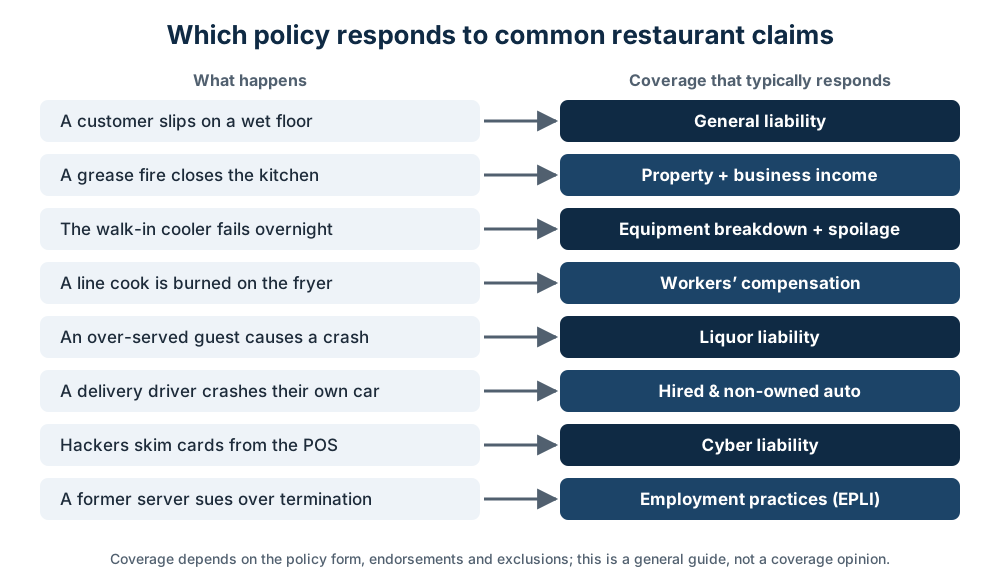
- A guest slips on sand and water near the patio entrance of a beachside cafe, a general liability claim.
- A bottomless brunch runs long and an under-21 guest who was visibly intoxicated causes a crash, a §25602.1 claim.
- A fryer fire during a Friday fish taco rush damages the hood and closes the kitchen, a property and business income loss.
- A food truck’s generator fails at an event and ruins product, an equipment and spoilage loss.
- A server strains her back carrying bus tubs up patio stairs, a workers’ comp claim.
Recommended coverage for San Diego operators
- General liability — patio, beach-traffic and slip-and-fall exposures.
- Liquor liability — brunch, taproom and cocktail service claims.
- Commercial property — outdoor heaters, furniture and signage exposed to salt air, plus the build-out.
- Business income — lost profit after a covered fire or other shutdown.
- Earthquake or DIC — earthquake damage excluded from standard property.
- Workers’ compensation — required, rated under the WCIRB restaurant or bar codes.
- Commercial auto or hired and non-owned auto — trucks, catering vans and staff delivery.
- Equipment breakdown and spoilage — walk-ins, generators and refrigeration.
How carriers set San Diego restaurant pricing
Underwriters weigh your WCIRB class and payroll, alcohol share of sales, patio size, hours, entertainment, building construction, wildfire and earthquake exposure at the address, vehicle use and claims history. Current RBS and food handler records, a written ID policy, non-slip mats at patio entries, hood cleaning logs and a maintained generator all help.
Comparing quotes with Provident Financial Group
Complete one application and we take it to multiple carriers, then show you the options side by side. Once you bind, we issue live certificates of insurance for landlords, event organizers and brewery partners. Call (866) 964-6660 to speak with an agent.
Frequently asked questions
Does San Diego County have its own food handler card?
Yes. San Diego County runs its own food handler card program under the county code, and staff should use the county-approved process.
Is my brewery taproom a restaurant for workers’ comp purposes?
It depends on the operation. WCIRB distinguishes full-service restaurants, fast casual and bars that are not restaurants, so we review your menu and service model.
Can I cover wildfire at a backcountry location?
Often yes, through standard carriers or the California FAIR Plan, which is frequently paired with a DIC policy.
Do bottomless brunch specials affect my liquor coverage?
They can. Carriers ask about drink promotions, and strong ID and service-limit procedures help your terms.
See what you qualify for. Get Multiple Quotes within minutes.
Official California sources
- California ABC: licensee laws and liability
- California Division of Workers' Compensation: FAQ
- San Diego County Environmental Health: food handler card
- Sonoma County Environmental Health: food handler card
- California Department of Insurance: California FAIR Plan
State facts on this page are drawn from the statutes and agency pages above. Laws and agency rules change, so confirm current requirements with the agency before relying on them. This page is general information, not legal advice or a coverage opinion.