
A restaurant business owner’s policy (BOP) bundles commercial property, business income, and general liability into one policy built for smaller, lower-hazard food-service operations. It fits many cafés, delis, and neighborhood restaurants, but carriers cap eligibility by size, sales, and alcohol share, and a BOP never includes liquor liability, workers’ comp, or auto. Those gaps are filled with endorsements or separate policies.
This guide is for owners comparing how to structure a restaurant’s insurance: first-time operators opening a single location, owners whose renewal came back with a non-renewal notice because the concept outgrew the program, and anyone who wants to know exactly what the policy they already carry will and won’t pay for. For an overview of every line a restaurant buys, see our restaurant coverages guide.
What does a restaurant BOP bundle?
A BOP is a pre-packaged policy form. Instead of building property and liability coverage part by part, the carrier issues one contract with standard coverage parts and a menu of optional endorsements. For a restaurant, the core pieces are:
- Building — if you own the building, the structure and permanently installed fixtures. Tenants usually skip this and insure their buildout instead; see tenant improvements and betterments coverage.
- Business personal property — ranges, fryers, walk-in and reach-in units, furniture, smallwares, POS hardware, food and beverage inventory, and paper goods.
- Business income and extra expense — lost net income and continuing expenses while a covered property loss keeps you closed, plus the added cost of reopening faster. Many BOP forms write this on an actual-loss-sustained basis for a set number of months instead of a fixed limit; our business interruption guide explains how that works.
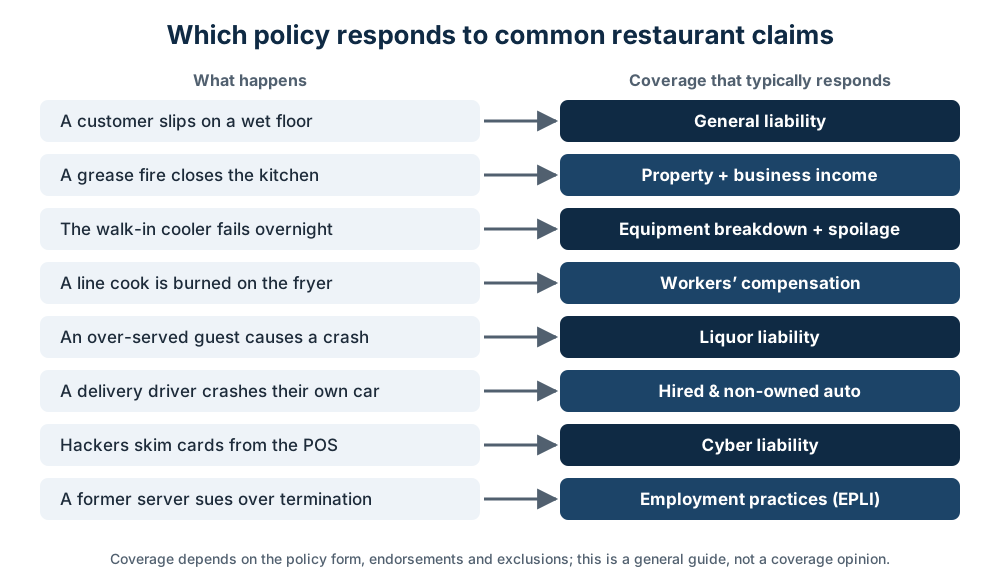
- General liability — bodily injury and property damage to third parties, such as a guest who slips on a wet floor by the dish station or a server who drops a tray of drinks onto a customer’s laptop.
- Products-completed operations — the part of liability that responds when a guest says your food made them sick; see does general liability cover food poisoning.
- Personal and advertising injury — claims such as defamation, or a false-detention allegation after a manager accuses a guest of walking out on a check.
- Medical payments — small, no-fault payments for a guest’s injury, which often resolve a minor incident before it turns into a lawsuit.
Most BOP forms also include built-in extensions with modest sublimits, such as outdoor signs, accounts receivable, and debris removal. A restaurant with an expensive illuminated sign or a large catering receivable should check whether the built-in amount is enough.
Who qualifies? Eligibility limits that push a restaurant out of a BOP
BOP programs are priced for predictable risks, so every carrier writes eligibility rules into its underwriting guidelines. The exact thresholds differ by carrier and state, which is why the same restaurant can be BOP-eligible with one company and declined by the next. These are the factors that most often move a restaurant into a package policy:
- Building size and insured values — carriers cap square footage and total insured values per location. Owner-occupied buildings with large footprints often exceed the cap.
- Annual gross sales — restaurant BOP classes usually carry a sales ceiling per location, so a high-volume spot can outgrow the program even if it is physically small.
- Alcohol share of receipts — the most common reason restaurants lose BOP eligibility. Programs set a maximum percentage of total sales that can come from beer, wine, and spirits. A busy bar program, happy-hour growth, or a wine list that sells briskly can push you over it without anyone noticing.
- Hours and entertainment — operations that stay open late, run dance floors or DJs, charge a cover, or employ door security are usually treated as bar or nightclub exposures and written elsewhere.
- Cooking and fire protection — heavy frying, solid-fuel cooking such as wood-fired ovens and charcoal grills, or a hood suppression system that is not current and regularly serviced can make a location ineligible until the fire protection is brought up to standard.
- Locations and operations mix — multi-unit groups, commissaries, catering-heavy operations, and restaurants with their own delivery vehicles often fit better on a package.
- Loss history — a recent large fire or liability loss can keep a risk out of BOP programs for a few renewals.
If you are close to a threshold, the answer is accurate reporting, not shading numbers. Understating alcohol sales on an application can give a carrier grounds to rescind a policy or contest a liquor-related claim. The better move is to have your agent market the account to BOP programs and package carriers at the same time and compare the results. Revisit the numbers at every renewal, too: a menu change that grows beverage sales can quietly take you outside the program.
What does a restaurant BOP not cover?
Owners are most often surprised by what a BOP leaves out. These exposures need their own policy or a specific endorsement:
- Liquor liability — BOP liability forms exclude injury arising from selling, serving, or furnishing alcohol when you are in that business. If you pour, you need liquor liability, either as an endorsement where the program allows it or as a standalone policy. State dram shop rules are summarized on our liquor liability laws by state page.
- Workers’ compensation — never part of a BOP. It is a separate statutory policy that states require once you have employees; see what happens if a restaurant has no workers’ comp.
- Autos — vehicles titled to the business need commercial auto, and employees driving their own cars on business need hired and non-owned auto (HNOA).
- Professional and employment practices liability — harassment, discrimination, and wrongful-termination claims from employees are excluded from general liability.
- Flood and earthquake — standard property forms exclude both; they are bought separately where the location warrants it.
- Mechanical breakdown and spoilage — unless the form or an endorsement adds them, a seized compressor or a walk-in full of spoiled product is not a covered property loss.
- Communicable disease — most property forms exclude losses and closures caused by a virus or bacteria.
The table shows where each gap is normally filled.
| Exposure | Excluded from a standard BOP? | Usual fix |
|---|---|---|
| Liquor liability | Yes, for businesses that sell or serve alcohol | Liquor liability endorsement where allowed, or standalone policy |
| Employee injuries | Yes | Workers’ compensation policy |
| Staff delivering in personal cars | Yes | Hired and non-owned auto endorsement |
| Company-owned vehicles | Yes | Commercial auto policy |
| Harassment or wrongful termination claims | Yes | EPLI endorsement or standalone EPLI |
| Flood | Yes | Separate flood policy |
| Earthquake | Yes | Earthquake endorsement or separate policy |
| Card data breach or ransomware | Largely | Cyber endorsement or standalone cyber policy |
Which BOP endorsements matter most for a restaurant?
The base form is generic. What makes a BOP fit a restaurant is the endorsement schedule. These are the ones that earn their place in food service:
- Equipment breakdown — adds sudden mechanical and electrical failure of compressors, hood fans, dish machines, HVAC units, and POS hardware. Some carriers build it in; others sell it as an endorsement. Details in does a BOP cover equipment breakdown.
- Spoilage — pays for perishable stock lost to refrigeration breakdown, refrigerant contamination, or a power outage. Check that the limit matches what is in your walk-in on a Friday afternoon, not on a slow Monday.
- Utility service interruption — covers property damage and lost income when an off-premises outage of power, water, or communications, caused by damage to utility equipment, shuts you down. Some versions exclude overhead transmission lines unless you select them.
- Employment practices liability (EPLI) — high turnover and large hourly and tipped staffs make harassment, discrimination, and retaliation claims a real exposure. See EPLI vs general liability; wage-and-hour claims are usually excluded even under EPLI.
- Cyber and data breach — card fraud from a compromised terminal, a hijacked online-ordering account, or ransomware on the back-office computer. BOP cyber endorsements tend to carry small sublimits, so read restaurant cyber insurance to judge whether standalone coverage makes sense.
- Hired and non-owned auto — liability when an employee crashes while running to the supplier or dropping off a catering order in their own car. Third-party delivery platforms handle their own drivers, but your staff are a separate exposure.
- Additional insured wording — landlords, franchisors, and event hosts will ask to be named; blanket additional insured wording avoids issuing a new endorsement each time.
- Food contamination — pays cleanup, product disposal, lost income, and sometimes reputation advertising after a health-department closure tied to a contamination incident.
BOP vs. package policy vs. separate GL and property
There are three common ways to structure a restaurant’s core property and liability coverage. The right choice depends mostly on size, alcohol share, and how customized the coverage needs to be.
| Feature | Restaurant BOP | Commercial package policy | Separate GL and property policies |
|---|---|---|---|
| Typical fit | Single-location cafés, delis, bakeries, and family restaurants within program limits | Larger, higher-volume, or alcohol-heavy restaurants and multi-unit groups | Unusual risks, or when one line must go to a specialty market |
| Eligibility | Strict caps on size, sales, and alcohol share | Broad; each account underwritten individually | Each line underwritten separately |
| Flexibility | Fixed form plus an endorsement menu | Modular; limits, deductibles, and forms chosen line by line | Fully custom, but gaps can open between policies |
| Liquor liability | Endorsement only where the program allows | Can be added as its own coverage part | Standalone policy |
| Business income | Often actual loss sustained for a set period | Written with a chosen limit and options such as extended indemnity | Attached to the property policy |
| Pricing | Usually efficient for small, lower-hazard risks | Priced on the account’s specific exposures | Can run higher because each policy has its own minimum premium |
| Administration | One policy, one renewal date | One policy, several coverage parts | Several policies, possibly several carriers and dates |
In practice, most small restaurants start on a BOP, move to a package when alcohol sales or volume grow, and use separate policies only when one exposure, often liquor liability for a bar-forward concept, needs a specialty market. For deeper comparisons, see what is a restaurant package policy and BOP vs general liability.
What affects the price of a restaurant BOP?
BOP premium is driven by exposure. Carriers weigh the building’s construction and square footage, the value of equipment and inventory, annual sales (the usual base for liability rating), cooking type, the condition of the hood and suppression system, the location’s fire protection class, crime and weather exposure in the area, prior claims, and the endorsements selected. Several of these are in your control: keep suppression inspections and hood-cleaning records current, install monitored fire and burglar alarms, report sales accurately so underwriters are not forced to assume the worst, update equipment values so claims are not shortchanged, and choose deductibles you can comfortably absorb. Our page on restaurant insurance cost factors goes further.
How quoting a BOP works with an independent agency
Provident Financial Group is an independent agency, so one application goes to multiple carriers quoted through our agency, and the proposals come back side by side: base form, endorsements, sublimits, and deductibles, not just the premium. If your restaurant sits near a BOP eligibility line, we quote BOP programs and package carriers in the same round so you can see both structures. Once coverage is bound, you receive certificates of insurance you can share with your landlord, franchisor, or event venues. Call (866) 964-6660 or start online.
Frequently asked questions
Can a restaurant that serves alcohol get a BOP?
Often, yes, as long as alcohol stays under the program’s maximum share of sales and the operation looks like a restaurant rather than a bar. Liquor liability still has to be added by endorsement or bought as a separate policy.
Does a BOP include business interruption coverage?
Yes. Business income and extra expense are standard parts of most BOP forms, frequently written on an actual-loss-sustained basis for a set number of months, with a waiting period before lost income is paid.
Is a BOP more cost-effective than separate policies?
For small, lower-hazard restaurants it is usually the most cost-effective structure, because the carrier prices the bundle as a whole. Larger or alcohol-heavy operations sometimes price better on a package policy, so compare both.
Does a BOP cover my employees’ injuries?
No. Employee injuries fall under workers’ compensation, which is always a separate policy. The BOP’s liability coverage is for customers and other third parties.
What if my restaurant outgrows the BOP mid-term?
Tell your agent when sales, alcohol share, hours, or square footage change materially. The carrier may endorse the policy, adjust premium, or require a move to a package at renewal; an unreported change can create problems at claim time.
Does a restaurant BOP cover a walk-in cooler that breaks down?
Only if equipment breakdown is built into the form or added by endorsement, and the food inside needs spoilage coverage as well. Our equipment breakdown and spoilage guide covers both.
Want to know whether your restaurant fits a BOP or needs a package? Get Multiple Quotes within minutes.