
Restaurant liability insurance usually means commercial general liability: the policy that pays defense costs and damages when a guest, vendor or passerby says your restaurant hurt them or damaged their property. It covers slip-and-fall injuries on your premises and illness or allergic reactions caused by food you served, but it excludes liquor claims, employee injuries and most employment disputes, which need their own coverage.
This guide is for owners and managers of full-service restaurants, cafes, counter-service spots and franchise units who want to know what their liability policy does before a claim tests it. It is written by Provident Financial Group, the independent agency behind US Restaurant Insure, and covers how the policy is built, where restaurant policies leave gaps, and how to choose limits.
What does restaurant general liability cover?
A commercial general liability (CGL) policy is built from coverage parts that each respond to a different kind of claim. For a restaurant, two do most of the work.
Premises and operations: what happens inside your four walls
This part responds when your space or your staff’s work injures someone who isn’t your employee or damages their property: a guest catching a foot on a high-chair leg left in the aisle, a server tipping a sizzling fajita skillet onto a diner’s forearm, a produce driver slipping on ice at your back door. The policy pays for your legal defense and any settlement or judgment, up to the limits. Standard forms usually pay defense in addition to the limit, but some restaurant and bar programs use defense-within-limits wording, so confirm which you have.
Products-completed operations: your food after it leaves your hands
To a liability policy, a restaurant is a food manufacturer. Once a plate is served, a take-out bag handed over or a catering tray set down, claims about that food fall under the products-completed operations hazard: a guest who cracks a molar on a cherry pit in a cobbler, a customer who finds glass in a smoothie, a family sickened by leftover chicken. This hazard usually has its own aggregate, separate from premises claims. See general liability vs product liability for restaurants.
Smaller pieces round out the policy. Personal and advertising injury covers offenses like a manager detaining a guest over a disputed check. Medical payments cover modest bills for an injured guest regardless of fault, which often settles a minor fall. Damage to premises rented to you covers the landlord’s building if a fire you cause spreads, though its default sublimit is often lower than a lease demands.
Foodborne illness and allergen claims: how GL responds
Food illness is bodily injury, so it falls within general liability unless the policy carries a specific exclusion. Picture a caterer whose chicken salad sickens dozens of guests at a corporate lunch after a cooling failure. Claims arrive from many separate people, and how the policy groups them matters: some wording treats related injuries as one occurrence, which affects the per-occurrence limit and how many deductibles apply. Does general liability cover food poisoning? walks through the details.
Allergen claims tend to be single, severe events. A server tells a guest the pesto is nut-free, the kitchen used cashews that week, and the guest ends up hospitalized. GL is built to respond, subject to policy terms. Your best defense is paperwork: an allergen matrix the front of house actually uses, ticket modifiers that print in the kitchen, and a written protocol for dedicated prep surfaces.
What GL will not pay is your own loss. Revenue lost while closed after an outbreak, discarded inventory and the deep-clean are first-party costs that belong to food contamination coverage and business interruption.
Slip-and-fall claims: the scenario every restaurant should plan for
Restaurants combine wet floors, grease, ice and rushed staff with guests looking at menu boards instead of their feet. The usual setups: mopping during service without a sign, ice melt tracked in on a winter night, a leaking restroom supply line nobody reported, patio pavers lifted by tree roots. Whether the claim is yours or the landlord’s often depends on where the guest fell and who the lease makes responsible for shared lots and sidewalks. These claims are won with records: timed floor-inspection logs, same-day incident reports, witness names, and security footage saved before it records over.
Assault and battery exclusions and sublimits
This is the gap that surprises owners most. Many restaurant and bar GL policies exclude assault and battery or cap it with a sublimit well below the main limit. A door host pushes an aggressive guest, who falls down the front steps; two patrons fight on the patio and the injured one sues for inadequate security. Both arise from a physical altercation, which is exactly what A&B wording addresses. It comes in three broad forms:
- Absolute exclusion — no coverage for any claim arising from an assault, including negligent-security and negligent-hiring allegations.
- Exclusion with a carve-back — coverage restored for employees acting to protect people or property.
- Sublimit — reduced coverage, sometimes with defense costs counted inside the smaller limit.
Late hours, live music, sports broadcasts and a strong bar trade push carriers toward the restrictive end, and liquor policies can carry their own A&B limits. See does liquor liability cover assault claims.
Why general liability excludes liquor claims
Standard CGL forms exclude liquor liability for any insured in the business of manufacturing, distributing, selling, serving or furnishing alcoholic beverages. If you hold a license and pour, GL will not respond to claims that you caused or contributed to someone’s intoxication, served a minor or a visibly intoxicated person, or broke an alcohol law. The classic dram shop claim is an over-served guest who drives away and injures another motorist, who then sues the restaurant. You need a separate liquor liability policy or coverage part, and that applies to a beer-and-wine license as much as a full bar.
BYOB restaurants sit in a gray area, because whether you are in the business of furnishing alcohol depends on facts like corkage fees and whether staff pour. Get the carrier’s position in writing. State dram shop rules differ widely; see liquor liability laws by state.
Per-occurrence vs aggregate: how restaurant liability limits work
A GL policy lists several limits, each capping something different. Using a common lease-driven structure of 1 million per occurrence and 2 million aggregate, one slip-and-fall can never pay more than the per-occurrence limit, while every premises claim in the policy year draws down the same general aggregate. Food claims usually draw from a separate products-completed operations aggregate. Aggregates reset at renewal, not when a claim closes.
| Limit | What it caps | Restaurant example |
|---|---|---|
| Each occurrence | Total for one incident, however many people are hurt | A tray of hot soup burns two guests at one table |
| General aggregate | All premises and operations claims in the policy year | Three separate falls at the entrance in one year |
| Products-completed operations aggregate | All food and product claims in the policy year | Unrelated illness claims tied to delivery orders |
| Damage to premises rented to you | Fire damage to the landlord’s building | A fryer fire spreads into the unit next door |
With more than one location, ask for a per-location aggregate endorsement so a bad year at one unit cannot drain the limit protecting the others.
Who needs to be an additional insured on your policy?
Landlords, property managers, lenders, franchisors, catering venues and some delivery platforms will ask to be additional insureds, which gives them a direct right to coverage for claims arising from your operations. A blanket endorsement covering anyone you agree in writing to add is easier to manage than naming each party, and many leases also require primary and non-contributory wording and a waiver of subrogation. The most common mistake we see is a certificate listing an additional insured when the policy has no endorsement behind it. The certificate is only evidence; the endorsement is the coverage. Read what an additional insured endorsement does.
How much liability insurance does a restaurant need?
Start with your contracts, then look at real exposure. Nearly every commercial lease requires general liability with the landlord as additional insured, and franchise agreements, venue contracts and liquor license rules may add minimums. Beyond that floor, these factors push toward higher limits:
- Seating capacity and weekend volume, which raise the number of people exposed to one incident
- Alcohol sales, late-night hours and entertainment
- Large off-site catering events, where one contaminated dish can reach hundreds of guests
- Owned real estate, equipment and other assets a large judgment could reach
Higher limits are usually bought as an umbrella or excess policy above GL, liquor, employer’s liability and auto. Confirm your liquor policy is scheduled as underlying coverage, because some umbrellas exclude liquor claims unless it is. See how much liability insurance a restaurant needs.
GL vs liquor liability vs EPLI vs workers’ comp
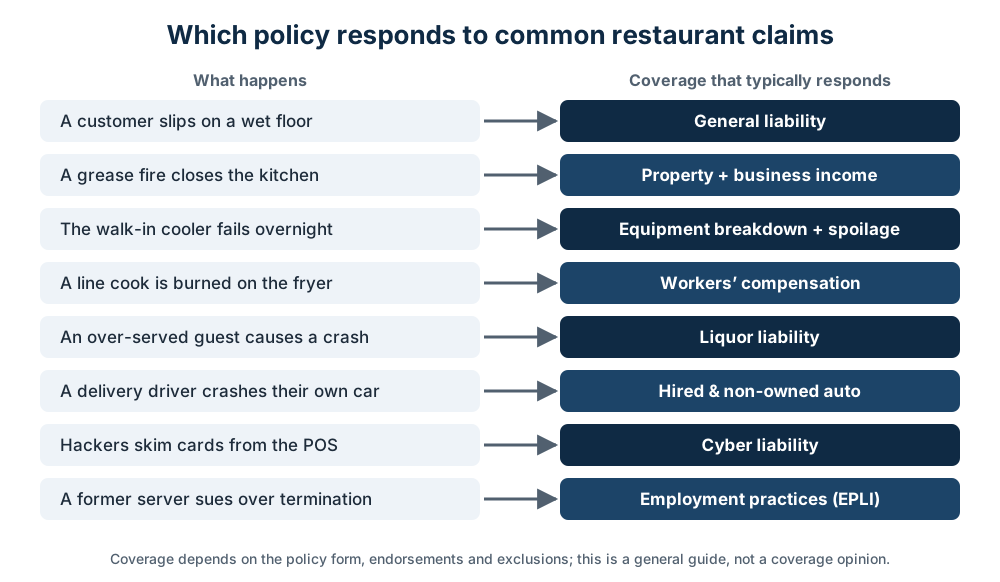
Restaurant liability is split across several policies because each is built for a different claimant.
| Coverage | Who makes the claim | Typical restaurant claim | Without it |
|---|---|---|---|
| General liability | Guests, vendors, the public | Slip on a wet floor; illness from a served dish | Defense and damages come out of the business |
| Liquor liability | People hurt by an intoxicated patron | Over-served guest causes a crash after leaving | GL excludes it for businesses that serve alcohol |
| EPLI | Employees, former employees, applicants | Harassment or wrongful termination suit | GL excludes employment claims |
| Workers’ compensation | Your own employees | Line cook burned at the fryer | GL excludes employee injury; state penalties may apply |
| Commercial or hired and non-owned auto | Other drivers and the public | Delivery driver rear-ends another car | GL excludes most auto accidents |
Wage-and-hour disputes over tips and overtime are often excluded even from EPLI; see EPLI vs general liability. If staff deliver in their own cars, hired and non-owned auto fills the gap GL leaves.
What affects the price of restaurant liability coverage?
Restaurant GL is usually rated on annual sales within a restaurant classification, so a fast-casual counter and a full-service room with a bar land in different rate groups. Underwriters then adjust for hours, entertainment, catering and delivery volume, patio seating, the assault and battery option you pick, your deductible and your loss history. Many small restaurants can package GL with property in a business owners policy, often a cost-effective option when you qualify. For every rating factor across all lines, see restaurant insurance cost factors.
How quoting liability works with an independent agency
With Provident Financial Group you fill out one application, and we compare multiple carriers side by side on the terms that matter for restaurants: assault and battery wording, defense inside or outside the limit, the products aggregate, liquor treatment, and blanket versus scheduled additional insured endorsements. Coverage is always subject to underwriting and policy terms. Once you bind, we issue certificates of insurance you can send to landlords, venues and franchisors. Prefer to talk it through? Call (866) 964-6660.
Frequently asked questions
Does restaurant general liability cover food poisoning claims?
Usually yes. Illness caused by food you served is bodily injury under the products-completed operations hazard, subject to policy terms. It does not cover your own lost income or discarded inventory.
Is my restaurant covered if a staff member injures a guest during a scuffle?
It depends on the assault and battery wording: some policies exclude it entirely, some restore coverage for employees protecting people or property, and some pay only up to a reduced sublimit.
Do we need liquor liability if we only serve beer and wine?
Yes. The GL liquor exclusion applies to any business that sells or serves alcohol, regardless of license type or menu size.
Does general liability cover an employee who slips in the kitchen?
No. Employee injuries are excluded from GL and handled by workers’ compensation, which includes employer’s liability for related lawsuits.
Does my liability coverage follow food we deliver or cater?
Products coverage follows the food, so illness from a delivered meal is generally treated like one from the dining room. The vehicle is different: GL excludes most auto accidents.
Want to see how carriers would treat your menu, bar and hours? Get Multiple Quotes within minutes. Or call (866) 964-6660 to talk with a restaurant specialist.