
Breweries and taprooms in Delaware generally need product liability for the beer they package, liquor liability for the pints they pour, equipment breakdown for the brewhouse, and workers’ compensation from the first employee. Delaware has no dram shop cause of action, but a taproom still faces on-site incident claims and defense costs, and most general liability policies exclude alcohol-related claims for businesses that serve drinks.
A brewery is two businesses under one lease: a small manufacturer with tanks, glycol lines, CO2 and a canning or kegging operation, and a hospitality venue with trivia nights, food trucks in the lot and weekend crowds. This page covers both halves for production breweries and brewpubs from Wilmington to Milton and the beach corridor. For the national picture, read our brewery and taproom insurance overview, and see the Delaware restaurant insurance hub for other food-service types.
Delaware rules that shape a taproom’s insurance
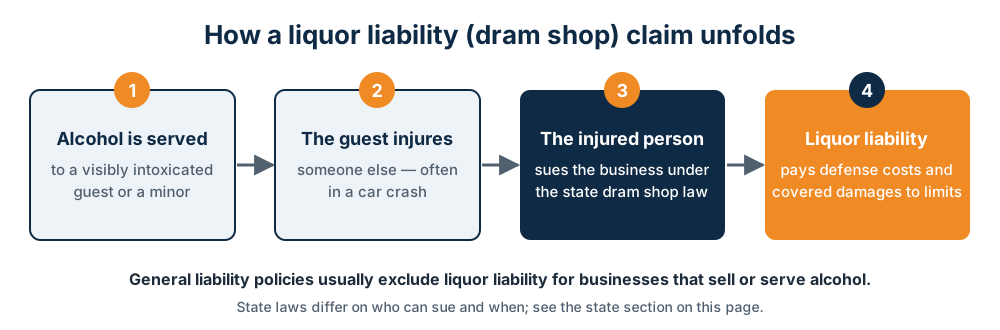
In McCall v. Villa Pizza, Inc. (1994), the Delaware Supreme Court found no statutory or common-law cause of action against a licensed establishment by someone injured off the premises by an intoxicated patron, and left the issue to the General Assembly. For a taproom, that lowers but does not erase the liquor exposure: incidents on your property, a guest who falls on the mezzanine stairs, or a lawsuit that simply has to be defended all still cost money. Landlords commonly require liquor coverage in the lease, and the Delaware liquor liability page explains how that coverage is written.
Anyone who sells, serves or dispenses alcohol, plus their managers, must complete state-approved Responsible Alcoholic Beverage Server Training under 4 Del. C. § 1203, and certification lasts two years. Your specific manufacturing and retail license questions belong with the Office of the Delaware Alcoholic Beverage Control Commissioner. Workers’ compensation is mandatory with one employee, and any vehicle you use to self-distribute kegs must carry at least 25/50/10 liability (in thousands of dollars) plus mandatory Personal Injury Protection of 15/30 (in thousands).
Brewhouse and taproom losses to plan for
On the production floor, a brewer opening a fermenter hatch during active fermentation can be exposed to CO2, and a cellar worker can be scalded by hot caustic during a clean-in-place cycle. Hauling grain sacks up a platform, dropping a full keg on a foot and slipping on a wet brewhouse floor are the everyday injuries that make up much of a brewery’s comp history.
On the product side, a batch of cans that referments in distribution can bulge or burst on a retailer’s shelf, and a glass bottle fragment or a mislabeled allergen (think lactose in a milkshake IPA) can trigger a recall and a customer claim. In the taproom, a guest trips on a hose line crossing the floor during a Saturday brew day, or a patron who stayed for four hours argues with another at a crowded release party.
Then there is property. A glycol chiller failure in August can ruin every tank in the cellar, and a coastal storm or flooding in a low-lying Sussex or Kent County building can knock out power long enough to spoil finished beer.
Policies a Delaware brewery should line up
- Products and completed operations liability — packaged beer sold at retail and restaurants carries your name when something goes wrong.
- Liquor liability — taproom pours, tastings and festival pours; confirm off-site events are included.
- General liability — tours, trivia nights and customer slips in the taproom.
- Equipment breakdown — boilers, glycol chillers, compressors and the canning line.
- Spoilage and contamination — beer lost to temperature failure or a contaminated batch.
- Product recall expense — pulling a problem batch from distributors and shelves.
- Commercial auto or hired and non-owned auto — keg runs and festival trips in owned or employee vehicles.
- Workers’ compensation — CO2, caustic, lifting and slip injuries on the brewhouse floor.
- Business interruption — lost taproom and wholesale income after a covered shutdown.
Pricing factors when you make and pour beer
Underwriters look at annual barrels produced, the split between wholesale and taproom sales, whether you distribute out of state, packaging type, the age and pressure rating of vessels, sprinkler protection, food service, events and hours. Loss history and quality-control documentation weigh heavily.
To tighten pricing, keep batch records and lot codes, maintain CO2 monitors and confined-space procedures, schedule boiler and pressure-vessel inspections, write down your cleaning chemical handling, track server certifications, and keep hoses and pallets out of guest walkways.
How one application reaches several carriers
As an independent agency, Provident Financial Group sends one set of brewery details to multiple carriers quoted through our agency and lays the results out side by side, including recall options and liquor wording. You can download live certificates for distributors, festivals and your landlord once coverage is in force. Call (866) 964-6660 to talk it through.
Frequently asked questions
Does a Delaware brewery need liquor liability if it only pours samples?
If you sell or serve alcohol on site, your general liability policy will likely exclude liquor-related claims, so a liquor liability policy fills that gap. Many landlords require it too.
Is a contaminated batch covered by my property policy?
Often not by default. Spoilage, contamination and recall coverages are usually separate endorsements or policies, so ask for them by name.
Do taproom staff need Delaware server training?
Yes. Employees who serve alcohol and their managers must complete state-approved training, renewed every two years.
What auto coverage do I need to self-distribute kegs?
An owned van needs commercial auto meeting Delaware’s 25/50/10 minimum plus PIP; if staff use their own cars, hired and non-owned auto coverage protects the brewery.
Ready to compare brewery programs? Get Multiple Quotes within minutes.