
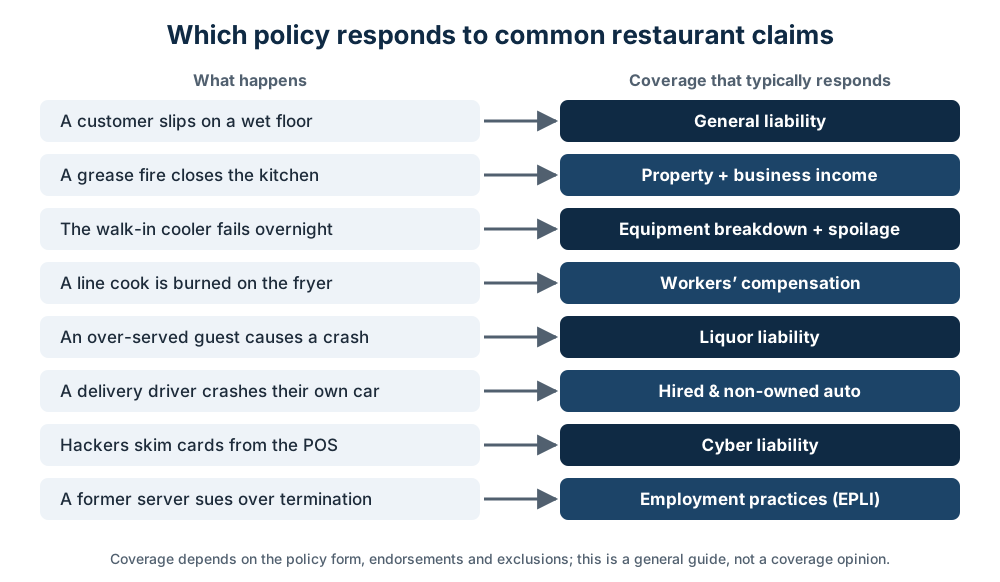
Ice cream shops typically need general liability with products coverage, a business owners policy that adds equipment breakdown and food spoilage for freezers and dipping cabinets, workers’ compensation for scoopers and counter staff, and hired and non-owned auto if anyone drives for the business. Shops that cater, run carts or sell pints wholesale also need event certificates and product liability that follows the product off the premises.
This page is for owners of scoop shops, frozen yogurt stores, gelato counters and soft-serve stands, from a seasonal walk-up near the beach to a year-round franchise unit in a strip center. The risks concentrate in four places: refrigeration, allergens, wet floors and a young workforce. If you also sell cakes and pastries, see our dessert shop insurance guide.
How seasonality changes the way a scoop shop is insured
For many shops, most of the year’s sales land in a few warm months. That matters for income protection: a shutdown in July costs far more than one in January, so business interruption coverage should be sized to peak-season earnings, with a restoration period long enough to replace a back-ordered dipping cabinet. It matters for payroll: headcount can multiply in summer, and workers’ comp is rated on payroll, so pay-as-you-go billing based on actual wages keeps you from overpaying in winter or facing a large audit bill later.
It also matters in the off-season. Shops that close for winter should tell their carrier, because many property forms limit certain coverages once a building has been vacant for an extended stretch, and a closed shop with the heat turned down is a prime candidate for frozen pipes. Read the vacancy condition and keep minimum heat on.
What happens when a dipping cabinet fails overnight?
Picture a compressor giving out on your main dipping cabinet on a holiday weekend. By morning the tubs have softened past safe refreezing, the replacement unit is days away and the line is already forming. That creates three losses: the repair, the discarded product and missed sales. Standard property policies generally exclude mechanical and electrical breakdown, which is why equipment breakdown and spoilage coverage is the core of an ice cream program rather than an add-on.
A grid outage is a different trigger. If a storm cuts utility power rather than your own equipment failing, spoilage is usually paid only if the policy includes utility interruption or off-premises power coverage, often after a waiting period. Temperature alarms and maintenance records help prevent the loss and support the claim.
| Freezer-related loss | Coverage that typically responds | What to check |
|---|---|---|
| Compressor burns out on a dipping cabinet | Equipment breakdown | Deductible; like-kind replacement terms |
| Tubs melt after that failure | Food spoilage endorsement | Spoilage sublimit; inventory records |
| Storm knocks out utility power | Utility interruption or off-premises power spoilage | Waiting period before coverage begins |
| Sales lost while the unit is replaced | Business income tied to the covered loss | Peak-season income; waiting period |
Dairy, nuts and cross-contact: the product liability side
Few menus are as allergen-dense as an ice cream case. Milk is in nearly everything, peanuts and tree nuts show up in mix-ins, custard bases use eggs, and cones contain wheat. Shared scoops, dipping wells and toppings bars make cross-contact easy. A typical claim: a parent asks whether the mint chip is nut-free, the scoop was just used in butter pecan, and the child needs emergency care that night. The medical bills and any lawsuit fall under the products-completed operations part of general liability, subject to policy terms; see how allergic reaction claims are handled.
Shops that make their own base face contamination risk too: a soft-serve machine not broken down and sanitized on schedule, or a dairy supplier recall that forces you to pull every pint. Recall and disposal costs are not bodily injury, so they need separate food contamination coverage. Dedicated scoops for allergen flavors and a staff script that tells guests plainly when cross-contact is possible reduce these claims.
Teen staff, sore wrists and workers’ comp
Many shops run on high school and college workers, and the injuries follow a pattern: wrist and shoulder strain from scooping hard product, cuts from opening tubs, burns from waffle cone irons and hot fudge warmers, and slips behind the counter. Workers’ compensation pays medical bills and lost wages and is required in most states once you have employees, though thresholds vary. Federal and state youth-employment rules also limit minors’ hours and the equipment they may operate, and violations bring penalties insurance does not pay. For state comp rules, see our sister site USA Workers Comp.
A young crew also creates employment claims. A harassment complaint by a teenage employee against a shift supervisor is what employment practices liability is built for; general liability does not cover it. Our EPLI versus general liability comparison explains the gap.
Melt, drips and slip-and-fall claims
A cone drips on the tile, a child drops a sundae by the napkin station, and minutes later an older customer slips and breaks a wrist. General liability covers the injury subject to policy terms. Anti-slip mats at the pickup counter and a logged mop schedule during rushes help. Strip-center landlords usually require additional insured status and a waiver of subrogation, so confirm those endorsements before signing the lease.
Carts, trucks, catering and festival booths
Wedding carts and summer festivals move your risk off the premises. Confirm that your liability coverage is not limited to the shop address, and expect each organizer to want a certificate of insurance naming them as additional insured. A cart hauled in an employee’s car calls for hired and non-owned auto; a business-owned vehicle or truck needs commercial auto plus coverage for the freezer and generator on board. The food truck insurance page covers mobile units in depth.
Franchise versus independent ice cream shops
Franchise agreements set the floor: minimum limits, often an umbrella, the franchisor as additional insured, specific certificate wording and deadlines. Review the FDD insurance requirements checklist with your agent. Independent shops have more freedom, though the lease usually sets much of the program.
Ice cream shop coverage checklist
- General liability with products-completed operations — slips on melt and allergen or illness claims tied to what you serve.
- Business owners policy — build-out, freezers, point-of-sale gear and income during a covered shutdown.
- Equipment breakdown — compressors, batch freezers and soft-serve machines that property forms exclude.
- Spoilage and utility interruption — melted inventory after a breakdown or grid outage.
- Workers’ compensation — scooping strains, cone-iron burns and back-of-counter slips.
- Hired and non-owned or commercial auto — carts, catering runs and wholesale deliveries.
- Employment practices liability — harassment and termination claims from a young, high-turnover crew.
- Food contamination and recall — supplier recalls and sanitation lapses that force you to discard product.
What affects the price of ice cream shop insurance?
Carriers weigh annual sales and payroll, seasonal versus year-round operation, the number and value of freezers, whether you make your own base, wholesale distribution, off-site events, your building and location, limits and deductibles, and claims history. Temperature alarms, maintenance contracts, documented machine cleaning, written allergen procedures and a mop log all help, as does bundling property and liability. More ideas: how to lower restaurant insurance premiums.
How quoting works with an independent agency
US Restaurant Insure is the restaurant site of Provident Financial Group, an independent agency. You complete one application, and we compare multiple carriers side by side so you can weigh coverage, deductibles and price together. Once you bind, you get live certificates of insurance to share with landlords and event organizers. Call (866) 964-6660 with questions. Coverage is subject to underwriting and policy terms.
Frequently asked questions
Does a business owners policy cover melted ice cream after a freezer breaks?
Only if equipment breakdown and food spoilage are added. A basic property form usually excludes mechanical failure, so the repair and the lost product can go unpaid without them.
Do I need separate insurance for an ice cream cart at a private event?
Usually not a separate policy, but your liability coverage must extend off-premises and the host will want a certificate naming them as additional insured. If the cart travels in a vehicle, auto coverage has to be addressed too.
Are frozen yogurt and gelato shops insured the same way as scoop shops?
The structure is the same, but self-serve froyo shops tend to have more floor-spill exposure, while gelato makers producing on site have more equipment and contamination exposure.
What happens if a customer reacts to a nut mix-in?
The products-completed operations part of general liability typically responds, subject to policy terms. Written allergen procedures and separate scoops help prevent the claim and support your defense.
Ready to see what your shop qualifies for? Get Multiple Quotes within minutes. Prefer to talk it through? Call (866) 964-6660.
Related pages
- Dessert shop insurance
- Equipment breakdown and spoilage insurance
- Power outage coverage
- Franchise restaurant insurance
- Restaurant business owners policy
- Slip-and-fall claims
Ice Cream Shop Insurance by state
- Ice Cream Shop Insurance in New Jersey
- Ice Cream Shop Insurance in New York
- Ice Cream Shop Insurance in Connecticut
- Ice Cream Shop Insurance in Vermont
- Ice Cream Shop Insurance in Ohio
- Ice Cream Shop Insurance in Michigan
- Ice Cream Shop Insurance in Virginia
- Ice Cream Shop Insurance in Pennsylvania
- Ice Cream Shop Insurance in Delaware
- Ice Cream Shop Insurance in Maryland
- Ice Cream Shop Insurance in North Carolina
- Ice Cream Shop Insurance in South Carolina
- Ice Cream Shop Insurance in Georgia
- Ice Cream Shop Insurance in Florida
- Ice Cream Shop Insurance in Texas
- Ice Cream Shop Insurance in Kentucky
- Ice Cream Shop Insurance in Kansas
- Ice Cream Shop Insurance in California
- Ice Cream Shop Insurance in Indiana
- Ice Cream Shop Insurance in Arizona
- Ice Cream Shop Insurance in Washington, DC
- Ice Cream Shop Insurance in Massachusetts
- Ice Cream Shop Insurance in Nevada