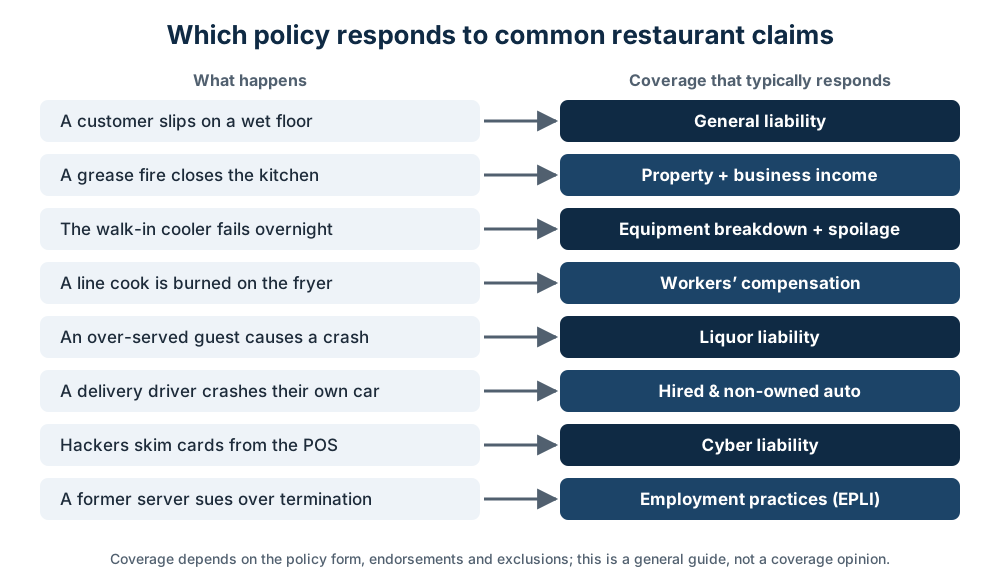
It is a Saturday afternoon, the dining room is filling up, and someone notices the walk-in cooler is warm. By the time a technician arrives, hundreds of dollars in product may already be unsafe to serve. For many restaurant owners, this is the moment they learn that a standard property policy does not always respond the way they assumed.
Spoilage and mechanical failure are two of the most common sources of unexpected loss in a restaurant, and the coverage that addresses them is often optional. Here is how these exposures typically work, and what to ask before you need to file a claim.
Why a basic property policy may not cover a mechanical failure
Property policies are generally built to respond to named causes of loss such as fire, certain types of water damage, theft, and storm. A compressor that burns out from age or electrical wear is often treated as a mechanical breakdown rather than a covered peril, and many policies exclude it by default.
That gap matters because refrigeration, hoods, fryers, ovens, and HVAC systems carry most of a restaurant’s operating equipment value. When one of them fails, the cost is the repair or replacement plus the lost product plus the lost sales while you are limited in what you can serve.
What equipment breakdown coverage typically addresses
Equipment breakdown coverage, sometimes called boiler and machinery coverage, is designed to respond to sudden and accidental mechanical or electrical failure of covered equipment. Depending on the form, it may help with repair or replacement costs, expediting charges to speed up repairs, and certain related expenses.
Coverage can differ significantly between carriers, so it is worth asking exactly which equipment is included, whether there is a separate deductible, and whether wear and tear or gradual deterioration is excluded.
Spoilage coverage and the details that matter
Spoilage coverage, sometimes offered as an add-on to equipment breakdown or as a stand-alone endorsement, may help reimburse perishable stock that is lost when temperature control fails. It may also be triggered by a power interruption, depending on how the endorsement is written.
Ask about the spoilage limit, whether it applies to both refrigerated and frozen goods, and whether there is a waiting period before coverage begins. Some policies also require that you keep temperature logs or have a maintenance program in place, so documentation habits can affect how a claim is handled.
Power outages and off-premises utility failures
Many owners are surprised to learn that a loss caused by a utility outage away from the premises, such as a downed power line or a grid failure, may not be covered unless the policy includes a utility service interruption endorsement. This is a separate question from equipment breakdown, and it is worth raising with your agent.
If your restaurant relies on heavy refrigeration or has a history of outages in the area, it may be worth asking whether a generator, and how it is insured, changes your coverage conversation.
Business income when the kitchen cannot operate
Even when equipment is repaired quickly, a closure or a reduced menu can mean lost revenue. Business income coverage often depends on a covered cause of loss, so if equipment breakdown is excluded, the related income loss may not be paid either. Some policies extend business income to equipment breakdown claims when that coverage is added.
Reviewing how these coverages work together is more useful than looking at any one of them alone.
Practical steps to reduce the risk
Insurance responds after a loss, but maintenance can prevent many of them. Scheduling regular service on refrigeration and ventilation, keeping simple temperature logs, and knowing where your emergency repair contacts are can reduce both the likelihood of a failure and the friction of a claim.
Many restaurants also keep a short written plan for what to move, where to move it, and who to call if a cooler goes down.
Talk with an independent agent before the next failure
Whether equipment breakdown and spoilage coverage make sense depends on your menu, equipment age, location, and budget. An independent agent can compare options across carriers and explain what your current policy does and does not include. If you would like a second look at your restaurant coverage, we would be glad to help.