
Delis and sandwich shops in Connecticut typically need general liability with products coverage for foodborne illness claims, workers’ compensation (required for every employer, with no minimum headcount), property coverage with equipment breakdown and spoilage for coolers and slicers, and hired and non-owned auto if staff deliver lunch orders. Most owners bundle the first three in a business owner’s policy.
This page is for owners of neighborhood delis, Italian grinder shops, bagel-and-sandwich counters and corporate lunch spots from Greenwich to Norwich. It applies Connecticut rules to the way a deli actually runs: a lot of sliced ready-to-eat meat, a morning rush, catering trays going out the door and a small crew doing everything. For the broader picture, see our deli and sandwich shop insurance overview and the Connecticut restaurant insurance hub.
Connecticut health code rules that shape deli coverage
Your food establishment permit comes from your local health director, whether that is a city health department or a regional health district. Inspections follow the Connecticut Food Code, which is based on the FDA Food Code and has been fully in effect statewide since February 17, 2023. Under Conn. Gen. Stat. § 19a-36i, Class 2, 3 and 4 food establishments must employ a certified food protection manager and designate an alternate person in charge when that manager is not on site. A deli slicing meats and building sandwiches to order will usually fall into one of those classes, so confirm your classification with your health director.
Why does this matter for insurance? Underwriters ask about inspection history, and a documented food safety program is one of the few things a small deli can point to that directly improves how a carrier views a contamination risk. A closure order after a failed inspection is also a common gap: many policies do not pay lost income from a health department shutdown unless a specific endorsement is added.
On the employment side, Connecticut requires every employer to insure its workers’ compensation liability, even a two-person shop. Covered employers must also handle CT Paid Leave payroll deductions. If you are thinking about adding beer to the cooler, that requires a state liquor permit through the Department of Consumer Protection and a separate conversation about Connecticut liquor liability.
Slicers, sliced meats and catering trays: deli claim scenarios
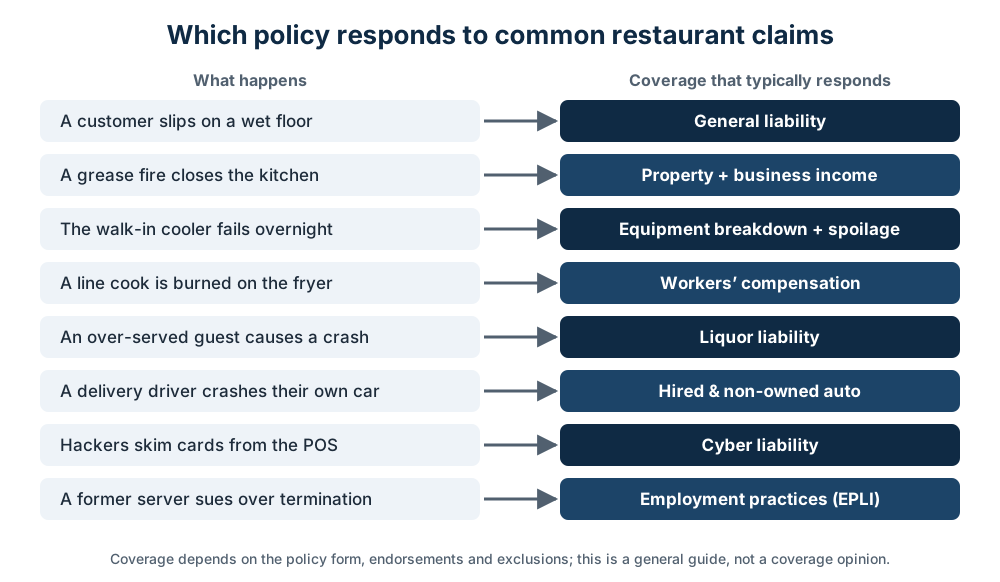
Deli losses tend to be ordinary events with outsized consequences. A few we see underwriters focus on:
- A new hire cleans the meat slicer without locking out the blade and loses the tip of a finger. That is a workers’ comp claim with surgery, lost time and possibly a permanent impairment rating.
- A tray of turkey wraps sits on a warm conference room table for three hours after your driver drops it off. Several attendees get sick, and the office manager’s lawyer names your deli because you prepared the food.
- The compressor on your walk-in fails on a Saturday night before a long weekend. By Tuesday morning you are discarding cured meats, cheeses and prepared salads, and you cannot open until the unit is replaced.
- A customer asks if the chicken salad has nuts, a counter employee guesses wrong, and an allergic reaction sends the customer to the emergency room.
- Your delivery driver, using his own sedan, rear-ends another car on the Berlin Turnpike. His personal policy responds first, but the injured driver sues your business too.
Deli & sandwich shop coverage checklist
- General liability with products-completed operations — responds to customer injuries and illness claims tied to food that has already left your counter, including catering orders.
- Commercial property — protects slicers, display cases, POS equipment and tenant improvements from fire, theft and storm damage.
- Equipment breakdown and spoilage — pays for a failed walk-in or reach-in and the inventory lost with it, which a basic property form often excludes.
- Business income — replaces lost profit and ongoing expenses while a covered loss keeps you closed; ask about adding a food contamination or health-order extension.
- Workers’ compensation — required in Connecticut for any employee; covers slicer lacerations, knife cuts, burns from the grill and strains from unloading deliveries.
- Hired and non-owned auto — covers the business when employees deliver in their own cars; step up to commercial auto if you own a van.
- Employment practices liability — useful for high-turnover counter crews where scheduling and termination disputes come up.
- Umbrella — adds limits on top of general liability and auto when a landlord or corporate catering client asks for more than a primary policy provides.
What moves a deli’s premium up or down
Carriers rate a deli mainly on annual sales, payroll, square footage, location and claims history. The mix matters too: a deli that runs a hot line with fryers or flat-tops looks different from a cold-sandwich counter, and heavy catering or delivery volume adds exposure. Building age, sprinkler and hood suppression systems, and whether you own or lease also affect the property side.
Practical ways to improve how you are priced: keep blade guards and cut-resistant gloves at every slicer and document training; log cooler temperatures and install an alarm that texts you when a unit warms up; write down allergen procedures and post them at the counter; require drivers to show a valid license and their own auto coverage; and keep three to five years of loss runs ready so a new carrier can see a clean record. The comp side is covered in more depth on our Connecticut restaurant workers’ compensation page.
One application, several Connecticut carriers
As an independent agency, Provident Financial Group takes one application for your deli and compares options from multiple carriers quoted through our agency, side by side, so you can see limits, deductibles and exclusions rather than just price. Once you bind, we issue certificates of insurance you can send to your landlord, a corporate catering client or a building manager the same day. Call (866) 964-6660 or start online. All coverage is subject to underwriting and policy terms.
Frequently asked questions
Does my deli need a certified food protection manager in Connecticut?
If your local health director classifies the deli as a Class 2, 3 or 4 food establishment, yes. State law requires a certified food protection manager plus a designated alternate person in charge when the manager is away.
Is a customer who gets sick from cold cuts covered?
A foodborne illness claim is generally handled under the products-completed operations part of general liability, subject to policy terms. Confirm that coverage is not excluded or sublimited before you bind.
My deli delivers lunch orders to offices. What coverage applies?
If employees drive their own cars, hired and non-owned auto protects the business when it gets pulled into a claim. If the deli owns the vehicle, you need a commercial auto policy meeting at least Connecticut’s 25/50/25 minimums (in thousands of dollars).
If our walk-in fails over a holiday weekend, is the meat covered?
Only if your policy includes spoilage coverage, often paired with equipment breakdown. Many base property forms exclude mechanical failure, so ask for it by name.
Want to see what your deli qualifies for? Get Multiple Quotes within minutes.