
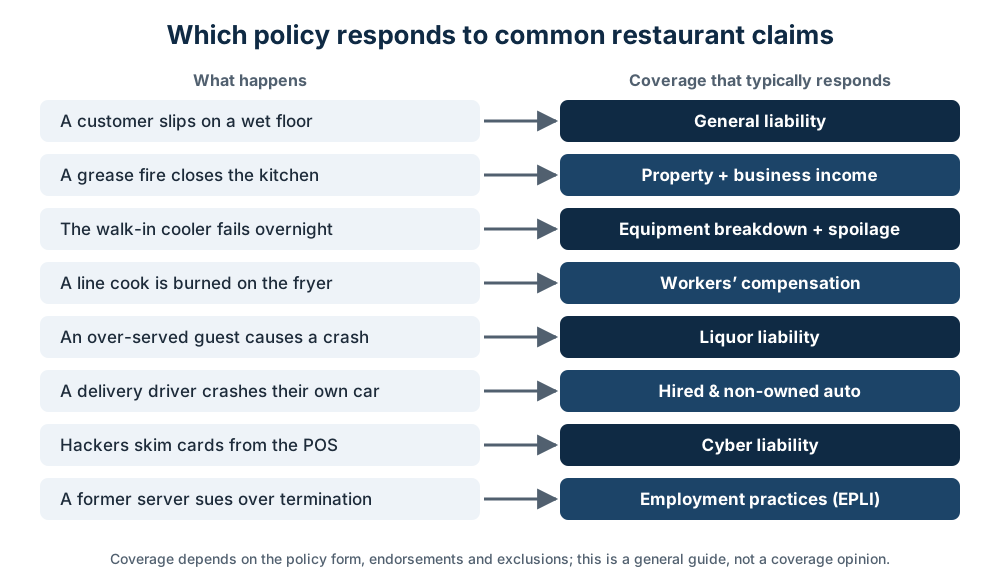
Charleston restaurants typically need liquor liability, general liability, property with wind and flood protection, business income, workers’ compensation and auto coverage. The South Carolina rule that matters most is the liquor liability mandate: on-premises licensees that sell alcohol after 5 p.m. must carry liquor liability meeting statutory minimums, with the South Carolina Department of Revenue named as certificate holder.
This guide is for peninsula dining rooms, seafood and barbecue restaurants, bars, cafes and caterers across Charleston and the surrounding Lowcountry communities.
Why Charleston is a demanding market
Charleston is one of the country’s best-known food destinations, and its restaurants serve a year-round flow of tourists, wedding parties, conventioneers and a large hospitality workforce. Many dining rooms occupy historic buildings on the peninsula, where repairs are slow and costly, while newer locations spread across the islands and suburbs. Weddings and private events keep caterers busy, often at venues that require certificates and specific limits.
Coastal weather sets the property picture. Charleston County is inside the area served by the South Carolina Wind and Hail Underwriting Association, the statutory residual market for wind and hail coverage, and commercial property at fixed locations there is eligible. Low-lying peninsula streets also flood during heavy rain and high tides, and standard property policies exclude flood.
South Carolina requirements for Charleston licensees
Mandatory liquor liability. Under S.C. Code 61-2-145, businesses licensed for on-premises consumption that sell after 5 p.m. must carry liquor liability, or general liability with a liquor endorsement, with an annual aggregate of at least one million dollars and a per-occurrence limit of at least half the total, listing SCDOR as certificate holder. Since January 1, 2026 a risk mitigation program allows reduced minimums for practices such as closing by midnight, training all servers, keeping alcohol under 40 percent of sales or using forensic ID scanning. A lapse is grounds for suspension or revocation.
Server training. Since January 1, 2026, employees who serve alcohol for on-premises consumption at least 10 hours a week, plus their managers, must complete an SCDOR-approved server training program; new hires have 30 days, and certificates must be kept on premises.
Fault and penalties. Act 42 of 2025 lets fault be apportioned among defendants in alcohol cases and, where a DUI defendant is also found liable, makes the licensee jointly and severally liable for 50 percent of actual damages. Knowingly selling to intoxicated persons brings escalating penalties: a fine, then a suspension, then revocation (61-4-580).
Comp, food safety and vehicles. Workers’ comp is required for employers regularly employing four or more people, counting part-time and family workers (S.C. Code 42-1-360). The South Carolina Department of Agriculture permits restaurants, caterers and mobile food units, and at least one employee must be a certified food protection manager. Business vehicles need 25/50/25 liability (in thousands of dollars) plus matching uninsured motorist coverage.
Charleston claim scenarios
- A tropical storm tears signage and awnings loose and wind-driven rain soaks a historic dining room, triggering a wind claim and weeks of closure.
- A king tide floods the kitchen of a peninsula restaurant that never bought separate flood coverage.
- A wedding guest served by a caterer’s bar staff causes a crash, and the new fault rules put the licensee’s share squarely in play.
- A liquor policy lapses at renewal, and SCDOR notice threatens the alcohol license.
Coverage checklist for Charleston restaurants
- Liquor liability — required for after-5 p.m. on-premises licensees, with SCDOR as certificate holder.
- Commercial property with wind and hail — through the standard market or the wind pool where needed.
- Flood insurance — separate policy for peninsula and low-lying locations.
- Business income — sized for long repair timelines in historic buildings.
- General liability — for guests at your restaurant and at off-site events.
- Workers’ compensation — mandatory at four regular employees.
- Commercial or hired and non-owned auto — for catering vans and deliveries, including uninsured motorist.
What affects Charleston restaurant pricing
Carriers look at wind and flood zone, building age and construction, alcohol share of sales, closing time, event and catering volume, payroll under NCCI codes 9082 or 9083, and loss history. Many of the state’s risk mitigation steps, such as trained servers, ID scanning and earlier closing, also make your liquor submission more attractive, and storm shutters or other wind mitigation can help on the property side.
How we build your quote
Provident Financial Group is an independent agency. One application lets us compare multiple carriers side by side, and we file certificates naming SCDOR as required and issue live certificates for landlords and wedding venues. Call (866) 964-6660. Coverage is subject to underwriting and policy terms.
Frequently asked questions
Do I have to name SCDOR on my liquor liability certificate?
Yes. South Carolina requires SCDOR as certificate holder for licensees subject to the liquor liability mandate.
Can I qualify for lower liquor liability minimums?
Possibly. The risk mitigation program lets qualifying licensees reduce the required limit, down to a statutory floor.
When is server training due for new hires?
Within 30 days of hire, and certificates must be kept on premises.
How many employees trigger workers’ comp in South Carolina?
Four or more regularly employed workers, with part-time and family members counted.
Get your Charleston restaurant compliant and covered. Get Multiple Quotes within minutes.
Official South Carolina sources
- S.C. Code Title 61, Chapter 2 (alcohol general provisions; liquor liability insurance)
- South Carolina Workers' Compensation Commission: employer FAQ
- SC Department of Agriculture: retail food safety
- SC Department of Agriculture: certified food protection manager guidance (2024)
- S.C. Code Title 38, Chapter 75 (incl. SC Wind and Hail Underwriting Association)
State facts on this page are drawn from the statutes and agency pages above. Laws and agency rules change, so confirm current requirements with the agency before relying on them. This page is general information, not legal advice or a coverage opinion.