
Coffee shops and cafes in South Carolina typically need a business owner’s policy that pairs general liability with property coverage, equipment breakdown for espresso machines and refrigeration, workers’ compensation once they regularly employ four or more people (part-timers count), and, anywhere near the coast, a clear plan for wind and hail. Cafes that add beer or wine in the evening also pick up the state’s liquor liability rules.
This page is written for independent cafes, drive-thru coffee kiosks, roasters with a retail counter and bakery-cafes across the state, from Greenville and Rock Hill to Columbia, Charleston and Bluffton. It walks through what South Carolina law actually touches, where cafe claims come from, and how to put a policy together that a landlord will accept and that still fits a coffee-shop margin.
South Carolina rules a cafe owner should know
Food permitting now sits with the South Carolina Department of Agriculture’s Retail Food Safety program, which took over from the former DHEC and enforces Regulation 61-25 for retail food establishments. At least one employee with authority to direct food preparation and service must be a certified food protection manager from an accredited program. That certificate is not an insurance requirement, but underwriters like seeing it, along with clean inspection history, when they rate a cafe that handles dairy, eggs and prepared sandwiches.
Workers’ compensation is required once you regularly employ four or more employees in South Carolina. Employers with fewer than four, or with annual payroll under $3,000 in the prior calendar year, are exempt. The detail that trips up coffee shops: part-time workers and family members count as employees. Two full-time baristas plus three weekend part-timers puts you over the line. Sole proprietors and partners may elect coverage for themselves. Our South Carolina restaurant workers’ comp guide covers penalties and how the market works.
If you add wine or local beer for on-premises consumption and sell after 5 p.m., state law requires liquor liability coverage filed with the South Carolina Department of Revenue as certificate holder, and since January 1, 2026 staff who serve alcohol at least 10 hours a week must complete SCDOR-approved server training. See our South Carolina liquor liability page before you apply for that license.
Along the coast, the South Carolina Wind and Hail Underwriting Association is the statutory residual market for wind and hail in areas including Horry, Georgetown, Charleston, Beaufort and Colleton counties. A cafe on Kiawah or in Myrtle Beach may end up with property from one carrier and wind from another, and the two need to line up.
Where coffee shop claims actually come from
Hot liquids are the signature exposure. A lid pops off at the drive-thru window and a customer takes a lap burn on the way to work; that is a bodily injury claim under general liability, and how you train staff on lids and carriers matters when it gets defended. Inside, laptop customers run charger cords across walkways, and a trip over one is a classic premises claim.
Equipment is the second driver. A boiler element fails on a dual-group espresso machine during the Saturday rush, or a reach-in cooler compressor quits overnight in July and a full delivery of milk and cold brew spoils. Standard property coverage often excludes mechanical breakdown, which is why equipment breakdown and spoilage coverage belong on a cafe policy.
Allergens are growing fast. A barista steams almond milk in the same pitcher used for oat, and a customer with a tree-nut allergy has a reaction. Staff injuries round it out: steam-wand burns, grinder cuts, and wrist and shoulder strain from tamping hundreds of shots a day. And on the coast, a hurricane evacuation order can close you for days even when the building is fine, so the business income wording matters.
Coverage checklist for a South Carolina cafe
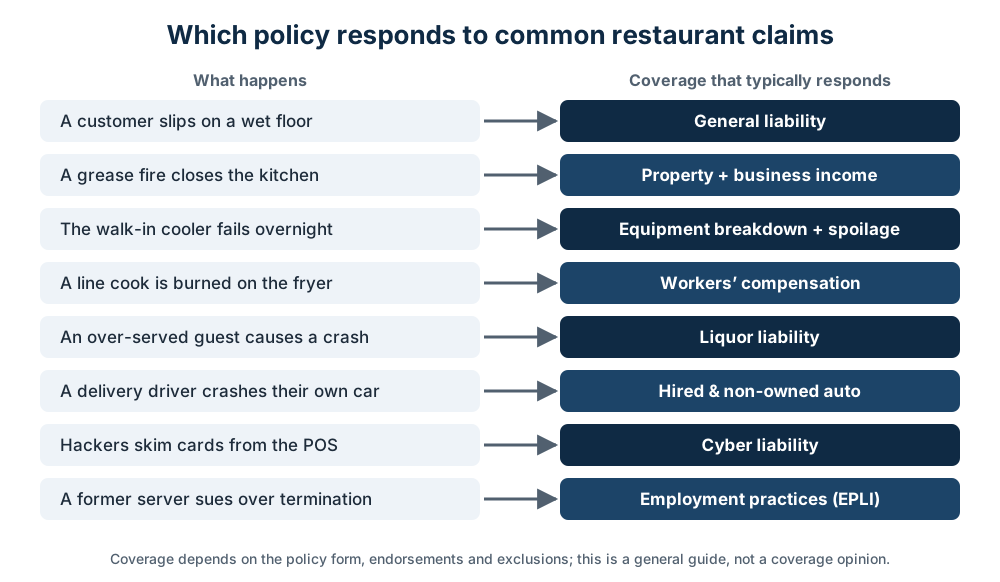
- General liability — defends slip, trip and hot-beverage burn claims from customers.
- Products-completed operations — responds when a pastry, sandwich or drink you sold makes someone sick or triggers an allergy.
- Commercial property — covers build-out, espresso machines, grinders, furniture and inventory; confirm how wind is handled at coastal locations.
- Equipment breakdown — pays to repair a failed boiler, compressor or electrical panel that standard property may exclude.
- Spoilage — replaces milk, dairy alternatives and cold brew lost to a power outage or cooler failure.
- Business income and extra expense — replaces lost profit and pays to reopen faster after a covered loss.
- Workers’ compensation — required at four or more employees in South Carolina, part-timers included.
- Cyber liability — protects card data flowing through your POS, loyalty app and online ordering.
- Liquor liability — needed if you sell beer or wine for on-premises consumption, and mandatory after 5 p.m.
What moves a coffee shop’s premium
Carriers price a cafe mostly on gross sales, square footage, building construction and age, distance to the coast, and payroll by workers’ comp class. Cooking method matters: a shop that only warms pastries rates differently than one running a flat-top grill under a hood. Hours, drive-thru volume, any alcohol sales and your prior claims history all feed in. Coastal locations also see percentage wind deductibles, which can be a large number on a building you own.
Owners who get better terms usually show a clean inspection record, documented lid and carrier procedures, cord management in seating areas, labeled allergen pitchers, service records on refrigeration and espresso equipment, and a monitored alarm. On the coast, choosing a wind deductible you can actually fund, and documenting shutters or impact glass, often improves options.
How a cafe quote works with Provident Financial Group
You fill out one application and we take it to multiple carriers quoted through our agency, then show the options side by side so you can compare limits, deductibles and exclusions, not just price. Once you choose, we issue certificates of insurance you can send to your landlord or a farmers-market organizer the same day. Prefer to talk it through? Call (866) 964-6660.
Frequently asked questions
Do part-time baristas count toward South Carolina’s workers’ comp threshold?
Yes. Part-time workers and family members count as employees, so a cafe that regularly employs four or more people in total generally must carry workers’ compensation.
Is a coffee shop in Charleston or Myrtle Beach covered for hurricane wind?
Only if wind is included on your property policy or placed separately. In coastal counties it may come from the South Carolina Wind and Hail Underwriting Association, with its own deductible, so review both pieces together.
Does my cafe need liquor liability if we only pour wine at evening events?
If you hold an on-premises license and sell after 5 p.m., South Carolina requires liquor liability with SCDOR as certificate holder. Occasional hosted events without sales raise different questions, so ask us before the first event.
Will my landlord accept a business owner’s policy?
Usually, as long as the limits match the lease and the landlord is added as additional insured. We can review the lease insurance section and issue a matching certificate.
Ready to see what your cafe qualifies for? Get Multiple Quotes within minutes.