A restaurant makes money only when the doors are open. If a kitchen fire, burst pipe, or storm damage forces you to close for weeks, the repair bill is only part of the problem. Rent, loan payments, insurance premiums, and often payroll keep coming due while sales drop to zero. Business interruption coverage is designed to address that gap, and it is one of the most misunderstood parts of a restaurant insurance program.
What Business Interruption Coverage Typically Does
Business interruption insurance, sometimes called business income coverage, generally replaces lost net income and continuing operating expenses when a covered physical loss forces your restaurant to suspend operations. The key phrase is “covered physical loss.” In most policies, the interruption must be caused by direct physical damage from a covered cause of loss, such as fire, wind, or certain types of water damage, to the property described in your policy.
That means the coverage is usually tied to your property policy. If the underlying damage is excluded, the income loss that follows is often excluded too. Flood and earthquake, for example, are commonly excluded from standard commercial property forms and may require separate coverage. It is worth asking your agent exactly which causes of loss trigger your income protection.
Net Income, Continuing Expenses, and Payroll
Most policies pay based on two buckets: the net income your restaurant would have earned, and the normal operating expenses that continue during the shutdown. Rent, utilities that still run, loan payments, and insurance premiums often fall into the second bucket. Payroll is where policies differ. Some include ordinary payroll for a limited period, some cover only key employees, and some exclude it unless you select an option. If keeping your kitchen team together during a closure matters to you, this is a conversation to have before a loss rather than after.
The Waiting Period and the Period of Restoration
Business interruption coverage typically does not start the moment the fire is out. Many policies include a waiting period, often measured in hours or days, before income coverage begins. After that, coverage generally runs for the “period of restoration,” which is the time it reasonably takes to repair or replace the damaged property and resume operations. It usually does not extend until your sales fully recover. Restaurants that lose regulars during a long closure may want to ask about extended business income, which can continue coverage for a set time after reopening.
Limits That Match Reality
A common problem is choosing a limit based on last year’s tax return rather than a realistic projection. Business income limits are often tied to your anticipated revenue and expenses over a 12-month period, and some policies include a coinsurance clause that may reduce a claim payment if the limit is too low. Seasonal restaurants, newly opened locations, and fast-growing concepts should review their worksheets carefully, since a figure that was accurate at renewal may not reflect a busy season or a recent expansion.
Related Coverages Worth Asking About
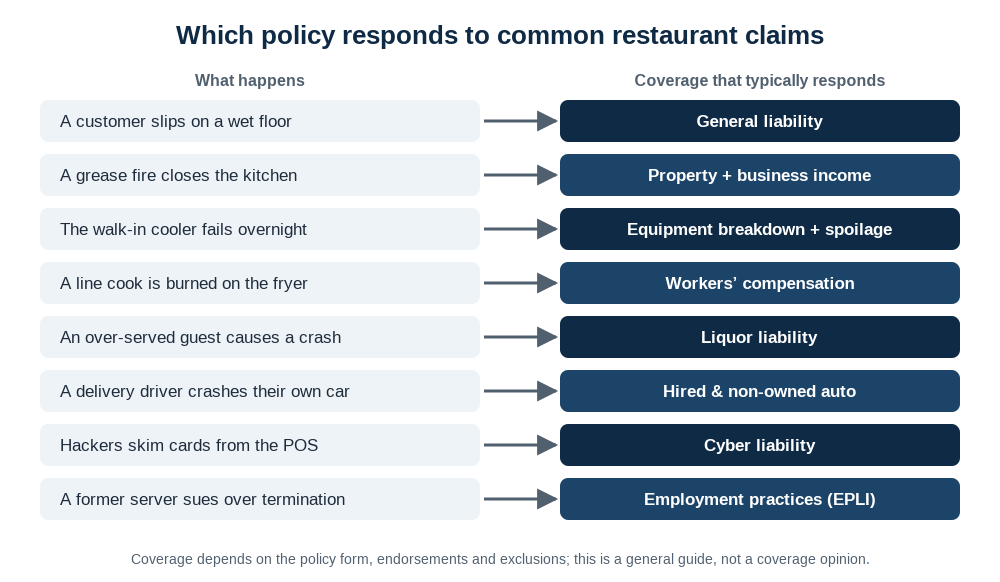
Several add-ons can change how well your restaurant is protected during a closure. Civil authority coverage may apply when a government order prevents access to your premises after a nearby covered loss. Utility service interruption coverage may respond when an off-premises power outage, rather than damage at your building, shuts you down. Extra expense coverage can help pay for temporary measures that keep you operating, such as renting equipment or a temporary location. Spoilage and equipment breakdown coverage are often separate lines and may not be included automatically.
How to Prepare Before You Need It
Documentation makes claims smoother. Keep recent profit-and-loss statements, sales reports, payroll records, and lease documents organized and easy to retrieve. Review your policy’s waiting period and payroll treatment, and ask whether your limit reflects your current revenue. After any loss, notify your carrier promptly and keep records of every expense related to the closure.
Every policy is different, and coverage depends on the specific terms, exclusions, and conditions in your contract. If you would like to understand how your own restaurant’s income would be protected after a closure, an independent agent can walk through your policy with you and compare options across carriers.