
Restaurants in Hartford, CT typically need general liability, property and business interruption, workers’ compensation, and liquor liability if they sell alcohol. The Connecticut rule that matters most is the Dram Shop Act, Conn. Gen. Stat. § 30-102, which makes a seller liable when an intoxicated customer injures someone, with damages capped at $250,000 per injured person and $250,000 in the aggregate.
Hartford is Connecticut’s capital and a long-time insurance industry hub, so many restaurants depend on weekday office crowds, government workers and events downtown, alongside neighborhood spots and college-area cafes. Provident Financial Group is an independent agency licensed in Connecticut, and we compare multiple carriers for Hartford restaurant owners.
Hartford’s dining patterns and the risks they bring
Weekday lunch and happy hour carry many downtown restaurants, while arena concerts, games and convention events create evening surges. That combination means short, crowded service windows, after-work drinking and guests driving home on the highways that ring the city. Neighborhood restaurants in older mixed-use buildings face different issues: aging electrical systems, apartments overhead and tight parking.
Connecticut’s weather adds nor’easters, heavy snow and freeze-ups statewide. Snow load on older buildings, burst pipes during cold snaps and icy sidewalks are the losses Hartford owners should plan for each winter.
How Connecticut law applies to a Hartford restaurant
Dram shop details that matter. The $250,000 cap applies to claims under § 30-102. The injured party must give the seller written notice within 120 days (180 days in cases of death or incapacity) and sue within one year, so report any alcohol-related incident to your carrier right away. Separate common-law claims for wanton or reckless service fall outside the cap, which is one reason many owners carry higher limits and an umbrella. Our Connecticut liquor liability page goes deeper.
Liquor permits. The Department of Consumer Protection’s Liquor Control Division issues permits. Since January 1, 2026, applicants, permittees and backer owners on new permit applications, transfers and substitute-permittee applications must complete DCP’s free Liquor Law Education Program. Server training remains voluntary, but DCP recognizes approved seller/server programs that cover minors, over-service and liability.
Workers’ comp. Every employer must insure its full liability with an authorized carrier or qualify to self-insure (Conn. Gen. Stat. § 31-284); there is no employee minimum and no state fund. Penalties for going uninsured include per-employee and daily civil penalties, and a knowing, willful failure is a class D felony for owners and officers. Employers also withhold CT Paid Leave contributions (0.5% of wages in 2026). See Connecticut restaurant workers’ comp.
Food safety and vehicles. Local health directors permit and inspect under Connecticut’s FDA-based Food Code, and Class 2, 3 and 4 establishments must employ a certified food protection manager and name an alternate person in charge. Delivery and catering vehicles need at least 25/50/25 liability (in thousands of dollars) plus uninsured/underinsured motorist coverage of at least 25/50.
Hartford scenarios that lead to claims
- After a downtown concert, a patron served past visible intoxication injures a pedestrian; the family sends written notice within the 120-day window.
- A worker in an older building’s basement kitchen is burned when a steam kettle valve fails.
- A nor’easter drops heavy snow, a gutter tears loose, and water pours into the dining room.
- A catering driver backs into a parked car outside an office building while unloading lunch.
Coverage checklist for Hartford restaurants
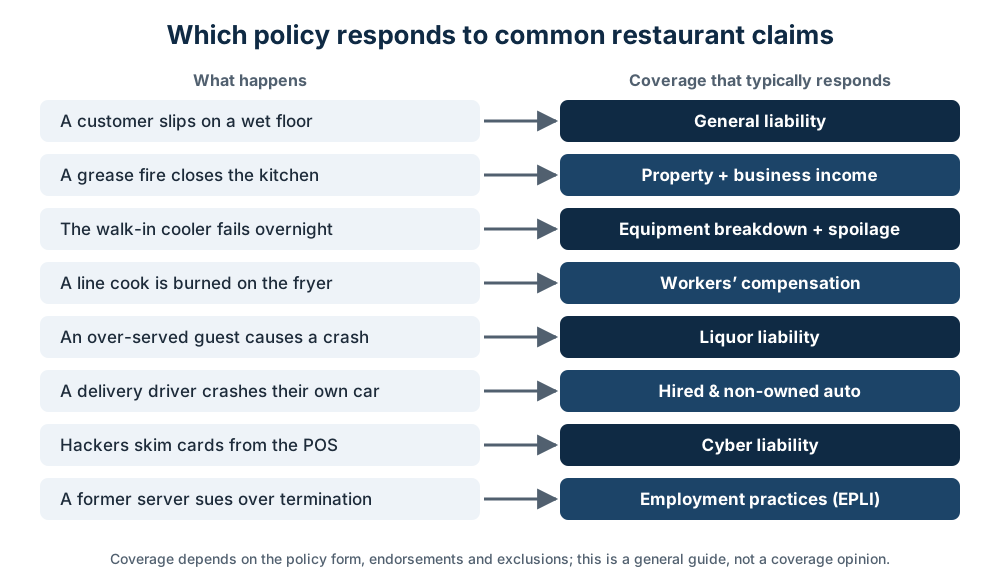
- Liquor liability — responds to § 30-102 claims and defense costs.
- Umbrella — covers exposure above primary limits, including claims outside the statutory cap.
- General liability — busy lunch rooms, happy hours and event crowds.
- Workers’ compensation — required from the first employee.
- Property and business interruption — winter storm and fire losses.
- Equipment breakdown and spoilage — boilers, compressors and walk-ins.
- Commercial or hired and non-owned auto — catering and delivery.
- Cyber liability — online ordering and card payments.
Rating factors for a Hartford policy
Carriers review alcohol share of sales, closing time, event traffic, payroll by class, building age and sprinklers, and claims history. Completed DCP education, approved server training, incident logs, well-maintained heating and hood systems, and snow-removal contracts all support better pricing.
Quoting through Provident Financial Group
Complete one application and we compare multiple carriers quoted through our agency side by side, then send certificates to landlords and event partners once you bind. Call (866) 964-6660.
Frequently asked questions
Does the dram shop cap mean I only need that much liquor coverage?
Not necessarily. The cap covers § 30-102 claims, but defense costs and common-law claims for reckless service can go beyond it.
Do I have to finish the Liquor Law Education Program for a new permit?
Yes, since January 1, 2026 it is required for new applications, transfers and substitute permittees before the permit is issued.
Is there a minimum number of employees before comp applies in Connecticut?
No. The statute sets no employee threshold, so one employee is enough.
What should I do after an alcohol-related incident?
Document what happened, save video and receipts, and notify your carrier promptly, even before any formal notice arrives.
See what your Hartford restaurant qualifies for, subject to underwriting and policy terms. Get Multiple Quotes within minutes.
Official Connecticut sources
- Connecticut General Statutes § 30-102 (Dram Shop Act)
- Connecticut General Statutes § 31-284 (employer duty to insure)
- State of Connecticut adoption of the FDA Model Food Code (via Ledge Light Health District)
State facts on this page are drawn from the statutes and agency pages above. Laws and agency rules change, so confirm current requirements with the agency before relying on them. This page is general information, not legal advice or a coverage opinion.