
Asheville restaurants typically need property and business income coverage with a close look at flood, general liability, liquor liability, workers’ compensation and auto coverage for catering or trucks. The North Carolina rule that matters most for small Asheville kitchens is the workers’ comp threshold: coverage becomes mandatory once three or more employees are regularly employed, and willful failure to insure is a felony.
We wrote this for independent restaurants, taprooms with kitchens, bakeries, cafes and food trucks in Asheville and the surrounding Buncombe County mountain communities.
Mountain tourism, craft beer and river valleys
Asheville is a tourism-driven mountain city with a nationally known food and craft beer scene. Visitor traffic peaks in summer and during the fall leaf season, then thins out in winter, so cash flow is seasonal and a closure in October hurts far more than one in February. Many businesses are small and owner-operated, and food trucks frequently park at breweries rather than running their own dining rooms.
Flooding is the exposure owners here understand best. Steep terrain and river valleys channel heavy rain quickly, and the remnants of Hurricane Helene in 2024 showed how far inland a tropical system can do damage. Standard commercial property policies exclude flood, so separate flood coverage and a clear business income plan matter as much here as on the coast.
Rules that shape an Asheville restaurant program
Workers’ comp. North Carolina requires coverage when three or more employees are regularly employed in the same business (G.S. 97-2). Sole proprietors, partners and LLC members actively engaged in the business may elect coverage. Negligent failure to insure is a Class 1 misdemeanor, willful failure is a Class H felony, and daily civil penalties apply per employee (G.S. 97-94). Restaurants are commonly rated under NCRB codes 9082 and 9083.
Alcohol. The NC ABC Commission issues permits and requires documented seller/server training first; its RASP course is free. The Dram Shop Act makes a permittee liable for negligent sales to underage guests whose impaired driving causes injury, and knowingly selling to an intoxicated person is unlawful (G.S. 18B-305). Brewery taprooms that host outside food trucks should be clear about who controls service and who carries which coverage.
Food trucks and permits. Buncombe County’s environmental health program permits restaurants and mobile food units under 15A NCAC 18A. Trucks must operate from an approved commissary unless they qualify as their own under G.S. 130A-248(c1). The person in charge of a restaurant must be a certified food protection manager whenever it is open. Any vehicle used in the business needs at least 50/100/50 liability (in thousands of dollars) on policies effective since July 1, 2025.
Asheville claim scenarios
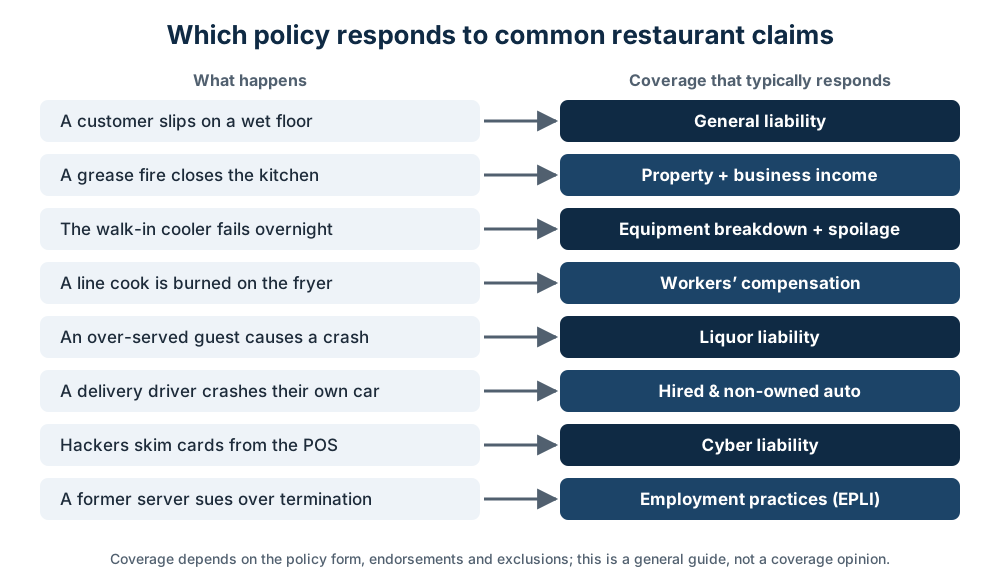
- A river flood fills a riverside kitchen with mud, and the owner discovers the property policy does not cover flood.
- Road closures after a storm keep tourists away for weeks even though the restaurant itself is undamaged.
- A food truck parked at a brewery is blamed when a customer gets sick, and both businesses are named.
- A seasonal employee hired for leaf season is injured, and the owner learns headcount crossed the comp threshold months earlier.
Coverage checklist for Asheville restaurants
- Flood insurance — separate from commercial property and essential in river valleys.
- Commercial property — equipment, stock and improvements, with attention to water damage terms.
- Business income with extended period of indemnity — supports a seasonal business through slow recoveries.
- Liquor liability — for restaurants and taprooms serving beer, wine or cocktails.
- General liability with products coverage — for foodborne illness and off-site sales.
- Workers’ compensation — mandatory at three regular employees, seasonal staff included.
- Commercial auto — for food trucks, catering vans and supply runs on mountain roads.
Rating factors for mountain restaurants
Underwriters weigh flood zone and elevation, distance to rivers and streams, building construction and heating, seasonal payroll, alcohol share of sales, vehicle use on hilly roads and loss history. Elevating equipment, keeping a written storm and evacuation plan, backing up records off-site, documenting RASP training and tracking headcount through the season all strengthen your application.
How Provident Financial Group quotes Asheville businesses
As an independent agency, we take one application and compare multiple carriers side by side, including flood options. We issue live certificates of insurance for landlords, breweries that host your truck and event organizers. Call (866) 964-6660. Coverage is subject to underwriting and policy terms.
Frequently asked questions
Is flood covered by my Asheville restaurant’s property policy?
Typically not. Flood usually requires a separate policy, and waiting periods can apply, so buy it well before storm season.
Do seasonal workers count toward North Carolina’s three-employee threshold?
Regularly employed workers count, and seasonal hiring can push you over the threshold. Review headcount before each busy season.
My food truck parks at a brewery. Whose insurance applies?
Usually both businesses need their own liability coverage, and many breweries ask trucks for a certificate naming them as additional insured.
Can business income help if tourists stay away after a storm?
Standard business income generally needs direct physical damage, but some policies add limited civil authority or access coverage. We compare how each carrier handles it.
Protect your Asheville restaurant before the next storm. Get Multiple Quotes within minutes.
Official North Carolina sources
- N.C. General Statutes Chapter 18B, Article 1A (Dram Shop Act)
- N.C. General Statutes § 97-2 (workers' comp definitions; employee threshold)
- NC DHHS Environmental Health: certified food protection manager requirement
- NC DHHS Environmental Health: mobile food unit commissary guidance
- N.C. General Statutes § 58-45-5 (NC Insurance Underwriting Association coverage areas)
State facts on this page are drawn from the statutes and agency pages above. Laws and agency rules change, so confirm current requirements with the agency before relying on them. This page is general information, not legal advice or a coverage opinion.