
Restaurants in Savannah, GA typically need general liability, property coverage that accounts for older buildings and coastal storms, a separate flood policy, workers’ compensation at three or more regular employees, and liquor liability. Georgia’s dram shop law makes a server liable when it knowingly serves a minor or a noticeably intoxicated guest who will soon be driving.
Savannah is a tourism and port city with a walkable historic core, riverfront dining, busy wedding and event calendars, and many restaurants operating inside buildings far older than modern codes. If that describes your operation, the details below matter more than a generic restaurant package.
Old buildings, coastal weather and your property policy
Two property issues come up again and again in Savannah. First, historic structures. If a covered fire damages an older building, local codes may require upgrades during the rebuild, such as wiring, sprinklers or accessibility, and a basic policy may not pay for them. Ordinance or law coverage addresses that cost, and tenants should read the lease to see who is responsible for what.
Second, water and wind. Savannah’s low-lying coastal setting brings tropical storm and flood risk. Standard commercial property policies generally exclude flood, so a separate flood policy is needed for rising water. Wind coverage is usually included on the property policy here, but it may carry a separate named-storm or wind deductible, often calculated as a percentage of insured value. Know that number before storm season, not after.
Georgia’s liquor and licensing rules in a tourist town
Georgia law treats consumption, not the sale, as the proximate cause of an alcohol-related injury (O.C.G.A. 51-1-40). A server is exposed only when it knowingly serves someone under 21 or someone noticeably intoxicated, knowing the person will soon be driving. Visitors on foot are common downtown, but guests staying outside the district often drive, and that is the scenario a plaintiff will focus on. The statute has no damage cap. See our Georgia liquor liability guide.
Alcohol sales require a local license first and then a state license from the Georgia Department of Revenue. Server permits or training rules are set locally. Food service permits come through the county health department under Department of Public Health rules, with a certified food safety manager required on staff.
Staffing, events and workers’ comp
Georgia requires workers’ comp once you regularly employ three or more people, and regular part-timers count. That includes the extra servers you bring on for event season. If you cater off-site weddings or tours, your employees are covered when working away from the restaurant too. Our Georgia restaurant workers’ comp page explains officer waivers and class codes.
Savannah claim scenarios
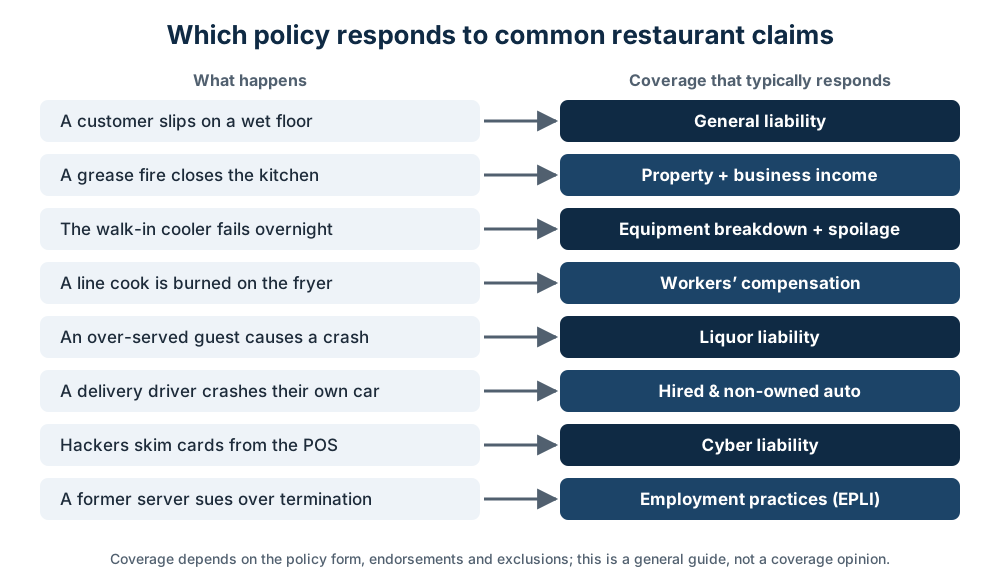
- A visitor catches a heel on an uneven historic stair and breaks a wrist.
- A tropical storm floods the ground floor of a riverfront restaurant, and the owner learns the property policy excludes flood.
- A 150-guest rehearsal dinner runs late, and an attendee who drove in is served past noticeable intoxication.
- A kitchen fire in a century-old building triggers code upgrades that double the repair bill.
- A catering van rear-ends a trolley on a crowded downtown street.
Coverage checklist for Savannah restaurants
- General liability — steady foot traffic, older stairs and narrow entries.
- Liquor liability — especially for bars and event-heavy restaurants.
- Commercial property with ordinance or law — for historic buildings and code-driven rebuild costs.
- Flood insurance — the only coverage that responds to rising water.
- Business income — lost revenue during a covered shutdown, including storm damage.
- Workers’ compensation — required at three regular employees.
- Commercial or hired and non-owned auto — catering vans and staff errands.
- Special event and off-premises coverage — for weddings and private events at outside venues.
Price factors
Carriers weigh building age and updates, construction type, flood zone, distance to water, alcohol share of sales, closing time, event and catering revenue, payroll and loss history. Updated wiring and plumbing, sprinklers, storm shutters and documented server policies all help. Clean loss runs and complete building information speed up underwriting.
How we quote
Provident Financial Group is an independent agency. One application lets us compare multiple carriers quoted through our agency side by side, including flood options, and we issue certificates for landlords and event venues when you bind. Call (866) 964-6660.
Frequently asked questions
Does my Savannah restaurant need ordinance or law coverage?
If you own or lease space in an older building, it is worth pricing. Without it, required code upgrades after a covered loss may come out of pocket.
Is flood covered under my business owner’s policy?
Generally no. Flood requires a separate policy, and there is often a waiting period before new coverage takes effect.
We cater weddings at outside venues. Are we covered there?
Your general and liquor liability should extend to off-premises catering, but confirm it, and expect venues to ask for a certificate naming them as additional insured.
Do seasonal event staff count toward Georgia’s comp threshold?
Regularly employed part-timers count. If three or more people work for you regularly, you need coverage.
Get your Savannah restaurant covered properly. Get Multiple Quotes within minutes.
Official Georgia sources
- Official Code of Georgia § 51-1-40 (alcohol furnisher liability)
- Georgia State Board of Workers' Compensation: employer information
- Georgia Department of Public Health: food service program
- Ga. Comp. R. & Regs. 511-6-1-.03 (food service rules)
State facts on this page are drawn from the statutes and agency pages above. Laws and agency rules change, so confirm current requirements with the agency before relying on them. This page is general information, not legal advice or a coverage opinion.