
Bakeries in Connecticut typically need product liability as part of general liability (allergen and contamination claims follow every loaf and cake you sell), property coverage with equipment breakdown for deck ovens, mixers and dough retarders, hired and non-owned auto for cake and wholesale deliveries, and workers’ compensation, which the state requires of every employer no matter how small the staff.
We wrote this for retail bakeries, pastry shops, cake studios and small wholesale bakers supplying cafes and markets in towns from Fairfield to Enfield. A bakery’s risk profile is different from a restaurant’s: fewer customers in the building, but more product leaving it, early-morning shifts, and heavy equipment that runs for hours. Our national bakery insurance page covers the fundamentals.
What Connecticut expects of a bakery owner
Workers’ compensation is mandatory. Conn. Gen. Stat. § 31-284(b) requires every employer to insure its full liability with an authorized insurer or qualify as a self-insurer, and there is no minimum employee count. You buy it in the private market; there is no state fund, and NCCI administers the residual market for employers carriers decline. Operating without it exposes owners to civil penalties and, for knowing and willful failure, a class D felony charge (details on our Connecticut restaurant workers’ compensation page).
Your local health director issues your food establishment permit and inspects under the Connecticut Food Code, which adopted the FDA Food Code and has been fully effective statewide since February 17, 2023. Class 2, 3 and 4 establishments must employ a certified food protection manager and name an alternate person in charge. If you sell wholesale to other businesses or ship out of state, ask your health director whether additional licensing applies, since that was not confirmed here.
Bakery hazards, from the 4 a.m. shift to the wedding reception
Heat and machinery drive most bakery injuries. A baker reaching into a spiral mixer to scrape dough before it stops turning, a rack oven door that swings back onto a forearm, a sheet pan pulled out bare-handed during a rush: these are workers’ comp claims, and they tend to be costly because hand and burn injuries mean long recovery. Flour dust is also combustible, and grease on hood filters in shops that fry doughnuts adds fire load.
On the liability side, product is the exposure. A cafe you supply sells a muffin labeled nut-free that was mixed on shared equipment, and a customer ends up in the emergency room; both the cafe and your bakery are named. A tiered wedding cake collapses in the back of an employee’s SUV on the way to a venue in Old Saybrook, and the couple wants the cost of the replacement dessert and more. A bent wire from a whisk ends up in a batch of cookies.
Weather matters here too. Nor’easters and ice storms knock out power, and a bakery with a walk-in full of butter, cream and finished cakes can lose days of work. Freeze-ups in older mill-town buildings can burst pipes over a weekend, and heavy snow loads can close a shop even when nothing is damaged.
Coverages to put on a Connecticut bakery’s policy
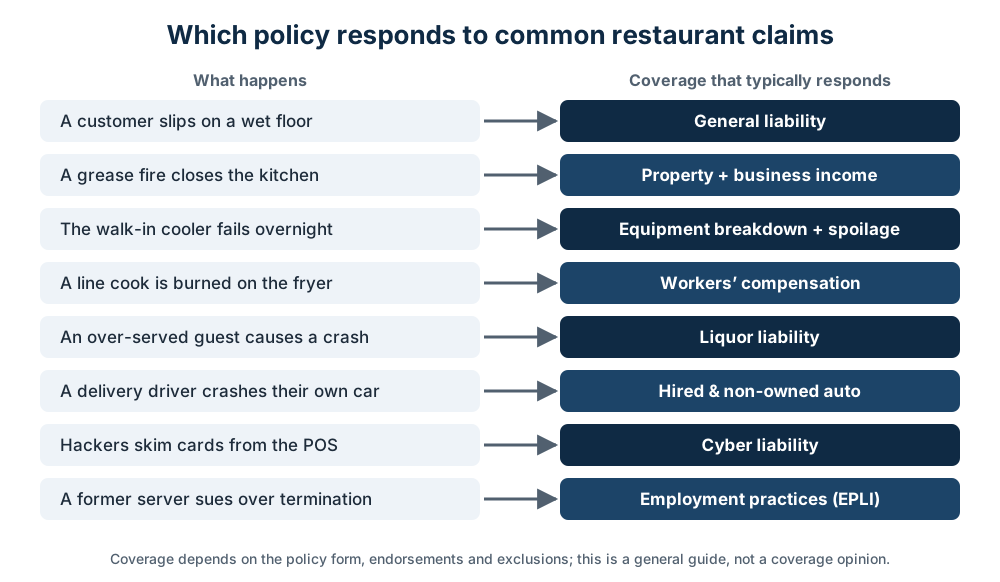
- General liability with products-completed operations — responds to allergen reactions, foreign objects and illness tied to baked goods sold retail or wholesale.
- Commercial property — covers ovens, mixers, display cases, build-out and inventory against fire, theft and wind.
- Equipment breakdown — pays for sudden mechanical or electrical failure of deck ovens, dough retarders, sheeters and refrigeration.
- Spoilage — replaces butter, cream, fillings and finished product lost to a cooler failure or power outage.
- Business income and extra expense — keeps payroll going and helps you rent kitchen time elsewhere after a covered loss.
- Hired and non-owned auto — protects the business when staff deliver cakes or wholesale orders in their own cars.
- Workers’ compensation — required for all Connecticut employers; burns, lacerations and repetitive-motion injuries are common in bakeries.
- Umbrella liability — adds limits that wholesale buyers and grocery accounts often request.
How underwriters size up a bakery
Rating starts with sales, and carriers usually split retail from wholesale because product that leaves your building carries more liability. They also look at payroll by class, the type of ovens and whether you fry, building age and fire protection, delivery radius and who drives, and your loss history. A shop in a converted mill building with older wiring will be viewed differently from a new unit with sprinklers.
To help your pricing, keep written allergen controls and labeling procedures, clean hood filters on a schedule, guard mixers and train staff on lockout before cleaning, keep maintenance records on ovens and refrigeration, and get written specs and hold-harmless language from wholesale accounts. Good records also speed up claims.
Shopping bakery coverage through one independent agent
Provident Financial Group is an independent agency, which means one application gets your bakery in front of multiple carriers, compared side by side. Once bound, we issue certificates of insurance for your landlord, farmers markets and wholesale buyers, often the same day. Call (866) 964-6660 with questions. All coverage is subject to underwriting and policy terms. More state context is on our Connecticut restaurant insurance page.
Frequently asked questions
Do wholesale bakeries need more liability coverage than retail shops?
Usually. Grocery stores and cafe chains often require higher liability limits and additional insured status before they will carry your products, so wholesale bakers commonly add an umbrella.
Is a cake damaged during delivery covered?
Damage to your own product in transit is usually a property or inland marine question, while injury to others from a delivery accident falls under auto coverage. We review both so the gap is closed before the next wedding season.
Does equipment breakdown cover an old deck oven?
Equipment breakdown generally covers sudden mechanical or electrical failure, not gradual wear. Keeping maintenance logs helps show the failure was sudden.
I bake alone with one part-time helper. Do I need workers’ comp?
Yes. Connecticut sets no employee minimum, so one part-time helper makes you an employer who must carry coverage.
Tell us about your ovens, your menu and where your product goes, and we will do the comparison shopping. Get Multiple Quotes within minutes.