
Breweries and taprooms in South Carolina generally need product liability for the beer they package, liquor liability for pints poured on site, property and equipment breakdown for the brewhouse, and workers’ comp once four or more people are on payroll. A taproom licensed for on-premises consumption that sells after 5 p.m. must also meet the state’s liquor liability minimum and list SCDOR on the certificate.
This page covers production breweries with a tasting room, brewpubs and small nano operations across South Carolina. Brewing is a manufacturing risk and a hospitality risk at the same time, so the insurance has to follow the beer from the fermenter to the customer’s car. For the national overview, see brewery and taproom insurance.
Taproom licensing, Act 42 and the insurance minimum
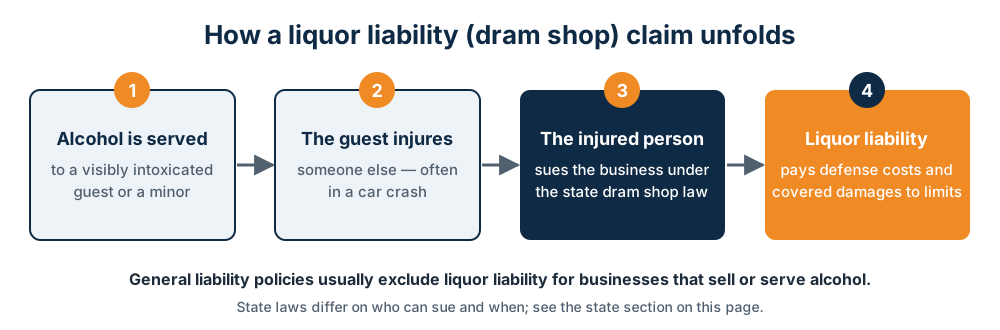
Alcohol licenses in South Carolina run through the Department of Revenue’s Alcohol Beverage Licensing section, and SLED investigates violations. If your taproom is licensed for on-premises consumption and pours after 5 p.m., S.C. Code 61-2-145 requires liquor liability (or GL with a liquor liability endorsement) with an annual aggregate of at least $1,000,000, a per-occurrence limit of at least 50% of that total, and SCDOR named as certificate holder. A lapse is grounds for suspension or revocation.
Act 42 of 2025 (H.3430), effective January 1, 2026, created a risk mitigation program that can bring the requirement down to a $300,000 floor. Some qualifying steps fit a taproom naturally, such as closing by midnight and training every server, while keeping alcohol under 40% of sales rarely works when beer is the product. The same law makes a licensee jointly and severally liable for 50% of actual damages when a DUI defendant is also found liable (61-2-147), a strong argument for limits above the floor. Our South Carolina liquor liability guide explains the filing.
Beertenders count under the new mandatory server training rule. Employees who serve alcohol for on-premises consumption at least 10 hours a week, and their managers and supervisors, must complete an SCDOR-approved course (S.C. Code 61-3-110 to 61-3-140). New hires have 30 days, and certificates stay on premises.
Brewhouse and taproom risks that turn into claims
A glycol line fails over a long weekend and three fermenters of lager warm past saving. A keg coupler releases under pressure and strikes a cellar worker in the face. A seasonal sour ships to a distributor with a secondary fermentation problem, and cans start bursting on grocery shelves, triggering a recall and a property damage claim from the retailer. A guest who asked for the gluten-reduced option is poured a different beer from a mislabeled tap handle and has a reaction.
Taproom-only risks look more like a bar’s: food trucks on your lot, trivia and run-club nights, dogs on the patio, and patrons driving home after a flight of high-gravity beers. Inside the brewhouse, grain dust, CO2 in enclosed cold rooms, hot caustic cleaning solutions and wet floors drive most employee injuries.
Policies a South Carolina brewery should line up
- Product liability — injury or illness claims tied to beer you package and distribute, including cans and crowlers sold to go.
- Liquor liability — pints poured in the taproom, with limits and certificate wording that satisfy 61-2-145.
- General liability — patio, parking lot and brewery-tour injuries.
- Commercial property — brewhouse, fermenters, canning line and finished inventory, valued at replacement cost where possible.
- Equipment breakdown and spoilage — glycol chillers, boilers and cold rooms, plus the beer lost when they fail.
- Product recall — the cost of pulling a bad batch back from distributors and store shelves.
- Business interruption — lost income while a damaged brewhouse is repaired.
- Workers’ compensation — required at four or more employees in South Carolina; details on our SC restaurant workers’ comp page.
- Commercial auto or hired and non-owned auto — self-distribution runs and festival deliveries; the state minimum is 25/50/25 (in thousands of dollars) plus matching uninsured motorist coverage.
Rating factors carriers weigh for breweries
Underwriters look at annual barrel output, the split between taproom and distribution revenue, where your beer is sold, in-house canning versus contract packaging, and the age and maintenance record of pressure vessels. Shipping into other states widens the product liability exposure. For a brewery in Charleston or Horry County, wind coverage may need to be placed separately; the South Carolina Wind and Hail Underwriting Association is the statutory residual market for commercial property in the coastal area.
Batch records that support a targeted recall, pressure-relief valve testing, CO2 monitors, written cleaning procedures and server training records all help your submission. So does a clear food arrangement: if food trucks serve on your lot, require them to carry their own liability and name the brewery as additional insured.
How we shop a brewery account
Provident Financial Group sends one brewery application to multiple carriers that understand craft beverage risks, then lays the quotes out side by side so you can compare product liability limits, spoilage sublimits and recall options rather than just the total. We issue live certificates of insurance with SCDOR as certificate holder for liquor coverage, and for distributors, landlords and festival organizers. Call (866) 964-6660 to talk it through. All coverage is subject to underwriting and policy terms.
Frequently asked questions
Are cans I sell to go covered by liquor liability or product liability?
Usually product liability. Liquor liability responds to claims arising from serving alcohol to someone who then causes harm, while contamination or defective-container claims generally fall under products coverage, so most breweries carry both.
Do my beertenders need South Carolina server training?
Yes, if they serve for on-premises consumption at least 10 hours a week. Their managers and supervisors must also complete an SCDOR-approved program, and new hires have 30 days.
Is beer lost to a chiller failure covered by property insurance?
Not always. Standard property forms often exclude mechanical breakdown, so ask for equipment breakdown with a spoilage limit sized to the value of the beer in your tanks.
Can the state’s risk mitigation program lower my taproom’s required limit?
It may. Closing by midnight and training all servers are among the qualifying steps, but the requirement cannot drop below the $300,000 floor, and many breweries keep higher limits anyway.
Ready to see how carriers price your brewery and taproom? Get Multiple Quotes within minutes.