
Restaurant delivery insurance is the combination of policies that responds once food leaves your building: hired and non-owned auto when staff drive their own cars, commercial auto for vehicles the restaurant owns, general liability for food that makes a customer sick, and workers’ compensation for injured drivers. Third-party apps insure their own platform and couriers, not your restaurant’s liability.
This page is for pizzerias, fast-casual concepts, delivery-only kitchens, caterers and full-service restaurants that deliver in any form, whether a server runs lunch orders in her own car, the shop owns two branded hatchbacks, or every order goes out through an app. US Restaurant Insure is the restaurant site of Provident Financial Group, an independent agency, and delivery is one of the areas where carrier appetite varies most, so how you deliver shapes which carriers will quote you.
Which delivery model are you running, and what does it need?
Start by matching how you actually deliver to the policies that respond. Many restaurants run two or three of these at once, for example app orders on weeknights and employee drivers for large office lunches.
| Delivery model | Primary coverage needs | Common gap |
|---|---|---|
| Employees in their own cars | Hired and non-owned auto (HNOA), workers’ comp, general liability | Employee’s personal auto may exclude delivery use |
| Restaurant-owned cars, vans or scooters | Commercial auto (liability, physical damage, uninsured motorist), workers’ comp | Undisclosed drivers or personal use after hours |
| Owner delivering in a personally titled car | Commercial auto or a business-use arrangement the insurer approves | Assuming the personal policy covers paid delivery |
| Third-party apps only | General liability with products-completed operations; certificate for the platform | Believing the app’s insurance protects the restaurant |
| Drivers hired as independent contractors | Contractor’s own commercial auto plus your HNOA; review workers’ comp exposure | Misclassification and uninsured contractor claims |
| Catering van delivery and setup | Commercial auto, general liability, workers’ comp | Injuries and property damage at the client’s venue |
Employees driving their own cars: why hired and non-owned auto matters
A line cook takes a large lunch order to an office park in his own sedan and rear-ends a pickup at a light. Many personal auto policies exclude or restrict use of the car to deliver goods for a fee, so his insurer may contest the claim. The injured driver’s attorney then names your restaurant, because the cook was working for you when it happened. Hired and non-owned auto (HNOA) exists for exactly this: it covers the restaurant’s liability for accidents in vehicles it does not own, generally excess over the employee’s own policy.
HNOA does not repair the employee’s car and does not pay the employee’s own injuries; those fall to his personal policy and to workers’ comp. Carriers writing HNOA for delivery will usually ask how many employees drive, how often, how far, and whether you check motor vehicle records and proof of personal insurance. Our comparison of hired and non-owned auto vs. commercial auto explains when HNOA stops being enough.
Owned delivery vehicles need commercial auto
Once the restaurant owns or leases a delivery car, van or food-carrying scooter, you need a commercial auto policy that lists the vehicles and the drivers. Coverage typically includes liability, physical damage (collision and comprehensive), uninsured and underinsured motorist, and medical payments or personal injury protection where your state requires it. Every state sets its own minimum liability limits, and leases, catering contracts and franchise agreements usually require more; an umbrella is the usual way to get there.
Underwriters will want every regular driver listed with a clean enough driving record, and they will ask whether vehicles go home with employees at night. Electric bikes and scooters raise their own questions, since not every auto or liability policy is written to cover them, so tell your agent exactly what your fleet looks like. See whether restaurants need commercial auto insurance for the fuller picture.
What third-party delivery apps cover, and what they leave with you
Delivery platforms generally arrange auto liability coverage that applies while a courier is on an active delivery, often excess over the courier’s own auto policy, and some offer accident coverage for couriers. That insurance is designed to protect the platform and its couriers, and the terms are set by the platform and can change. It does not make the restaurant an insured for its own exposures.
What stays with you: the food itself, including undercooking, contamination and allergen mix-ups; injuries at your pickup counter, such as a courier slipping on a freshly mopped floor, which is a premises claim against your general liability; and any indemnity you agreed to in the platform’s merchant terms. Many platforms also ask for proof of your insurance to stay listed. Our guide to what delivery apps require from restaurants covers those certificate requests.
Food contamination and product liability in transit
Delivery adds time and distance between the kitchen and the customer, and that is where food claims start. A container of seafood soup sits in a courier’s bag for fifty minutes on a hot afternoon; two customers report food poisoning the next day. Or a gluten-free substitution is lost when an order is repackaged and a customer with a serious allergy reacts. These are bodily injury claims under the products-completed operations part of your general liability, which applies after the food leaves your control. See whether general liability covers food poisoning.
A separate first-party coverage, food contamination, can pay for spoiled inventory, cleanup, and lost income if the health department closes you after a suspected outbreak; our explainer on food contamination coverage walks through it. Practical controls matter to carriers too: tamper-evident seals, insulated bags, clear allergen labeling on every container, and a maximum hold time for delivery orders.
Driver injuries and workers’ compensation
When an employee driver is hurt, whether in a collision, carrying a stack of catering trays up icy apartment steps, or during a robbery at a doorstep, it is generally a workers’ compensation claim, regardless of who caused the accident. Workers’ comp pays medical bills and lost wages; if another driver was at fault, the comp carrier may pursue that driver’s insurer. Your policy premium is based on payroll by classification, so report delivery driver payroll accurately; the annual audit will look at who drives and how they are paid. For deeper workers’ comp questions, our sister site USA Workers Comp covers state rules and classifications.
Independent contractor drivers and misclassification risk
Some restaurants pay drivers as independent contractors to keep them off payroll. The label does not settle the question. If you set their schedules, require your uniform, assign routes and pay them by the hour, a state agency or court may decide they are employees under that state’s test. The consequences show up in insurance: a workers’ comp audit can add their pay to your payroll and bill premium after the fact, an injured contractor may file a comp claim anyway, and some HNOA forms treat contractor vehicles differently from employee vehicles. If you do use true contractors, require their own commercial auto and a certificate naming your restaurant, and ask your state labor department or an employment attorney how your state classifies drivers.
Delivery radius, hours and alcohol-to-go rules
Underwriters look closely at how far and how late you deliver. A three-mile radius at lunch is a different risk from a late-night delivery zone that crosses highways. Number of drivers, deliveries per shift and whether drivers are paid per delivery, which can encourage speeding, all factor in.
Alcohol delivery is its own question. Rules on beer, wine and cocktails to go vary widely: some states allow them with food orders in sealed containers, others restrict or prohibit them, and delivery by third parties may carry separate requirements. Check with your state’s alcohol regulator before adding drinks to delivery orders, and see our overview of liquor liability laws by state. Also confirm with your carrier that your liquor liability policy covers off-premises sales and delivery, since some forms limit coverage to on-premises service. Drivers should check ID at the door and refuse delivery to anyone who appears intoxicated.
Delivery coverage checklist
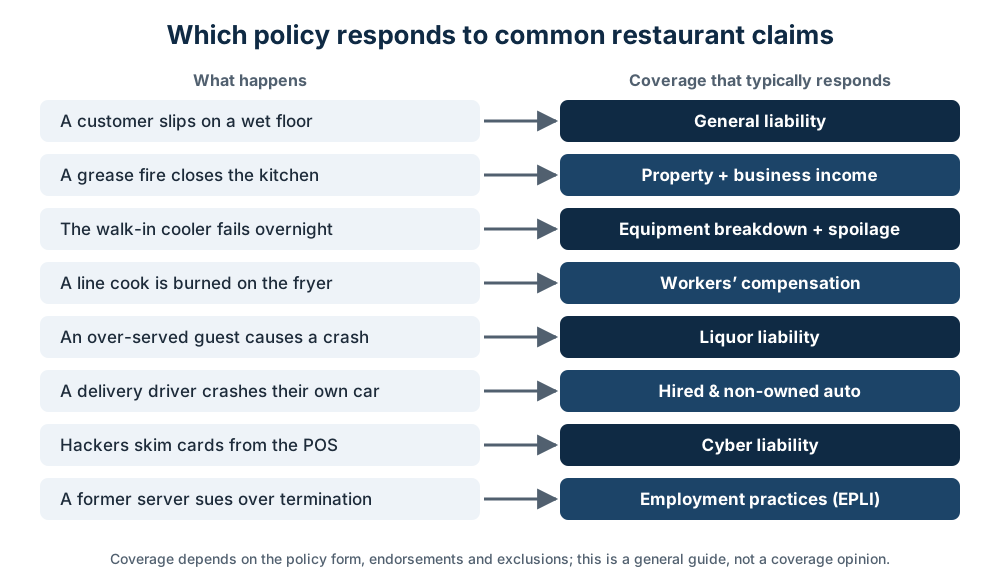
- Hired and non-owned auto — protects the restaurant when employees deliver in their own cars.
- Commercial auto — required for vehicles the restaurant owns or leases, with every driver listed.
- General liability with products-completed operations — responds to food illness and allergen claims after the order leaves.
- Food contamination coverage — pays for cleanup, spoiled stock and lost income after a suspected outbreak.
- Workers’ compensation — covers employee drivers hurt on the road or at a customer’s door.
- Liquor liability endorsed for off-premises sales — needed before any alcohol goes out with delivery orders.
- Umbrella liability — auto claims are among the largest a restaurant faces; see umbrella vs. excess liability.
- Business owners policy — the property and liability base that delivery coverages attach to; see the restaurant BOP.
What delivery does to your premium
Delivery touches several policies at once, so it moves price in several places. Auto pricing reflects the number of drivers, their records and ages, vehicle types, radius, hours and delivery volume. General liability reflects sales, including delivery sales. Workers’ comp reflects driver payroll and classification. Some carriers decline delivery-heavy operations entirely, which narrows your options if you only ask one. You can improve terms with written driver standards and annual record checks, a phone-free driving rule, a capped radius, no per-delivery pay incentives that reward speed, and packaging controls for food safety. Delivery-first concepts like a pizzeria or ghost kitchen should expect underwriters to ask about all of these.
How quoting delivery coverage works with an independent agency
With Provident Financial Group you complete one application describing how you deliver. We take it to multiple carriers, since appetite for restaurant delivery varies widely, and compare the options side by side so you can see what you qualify for. Once bound, you get live certificates of insurance to share with delivery platforms, landlords and catering clients. Call (866) 964-6660 to walk through your delivery setup. All coverage is subject to underwriting and policy terms.
Frequently asked questions
Does an employee’s personal auto insurance cover restaurant deliveries?
Often not fully. Many personal auto policies exclude or restrict delivery for a fee, which is why the restaurant needs hired and non-owned auto to protect itself.
Does hired and non-owned auto pay to fix my employee’s car?
No. HNOA covers the restaurant’s liability to others; damage to the employee’s own car falls to the employee’s personal policy, and the employee’s injuries fall to workers’ comp.
If every order goes through a delivery app, do I still need auto coverage?
If no employee ever drives for the business, you may not need auto coverage for delivery, but you still need general liability for the food and premises. Most restaurants add HNOA anyway, because staff run errands, bank deposits and supply pickups.
Can I pay my delivery drivers as independent contractors?
Only if they meet your state’s test for contractor status. If they are really employees, a workers’ comp audit can add their pay to your premium and an injured driver may still file a comp claim.
Can we deliver cocktails or wine with takeout orders?
It depends on your state, so check with your state’s alcohol regulator first. Then confirm your liquor liability policy covers off-premises delivery before the first order goes out.
Delivering already, or about to start? Get Multiple Quotes within minutes.