
Maryland bars and restaurants still need liquor liability insurance even though Maryland does not recognize dram shop liability. In Warr v. JMGM Group (2013), the state’s highest court declined to let injured third parties sue a tavern for off-premises harm caused by an intoxicated patron, absent a special relationship. Fights inside the venue, lease requirements and defense costs keep the coverage essential.
This guide is for Maryland license holders, from rowhouse taverns in Baltimore to waterfront dining rooms in Annapolis and seasonal beach bars on the shore. Maryland is unusual: retail alcohol licenses are issued and enforced by 24 local liquor boards (the 23 counties plus Baltimore City), with the Alcohol, Tobacco, and Cannabis Commission (ATCC) handling state-level oversight and coordination. That local patchwork shapes several answers below.
What Warr v. JMGM Group means for a Maryland licensee
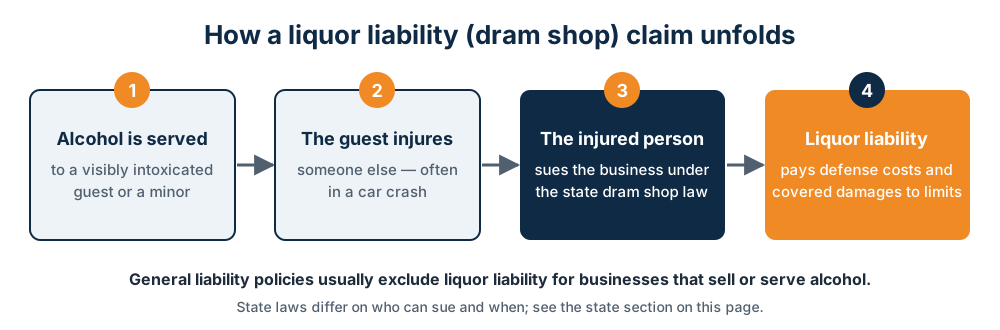
In Warr, a patron was served at a bar, drove away and caused a fatal crash. The Court of Appeals held that Maryland does not recognize a cause of action against a tavern for harm an intoxicated patron causes off premises, unless a special relationship exists, and it left any change to the General Assembly. So the classic dram shop suit, where a stranger hit by a drunk driver sues the bar that served him, generally fails in Maryland today.
Two cautions. First, the legislature can change this, so a coverage plan built on today’s case law should not assume it is permanent. Second, no dram shop liability is not the same as no liquor claims. Plaintiffs still file, and your carrier still has to defend.
If Maryland has no dram shop law, where do alcohol claims come from?
- Incidents inside your walls — a guest who has been drinking falls on a stairway, or is hurt in a fight your staff saw coming, and the claim is pleaded as a premises-safety case
- Special-relationship arguments — plaintiffs’ lawyers try to fit the facts into the exception Warr left open
- Ejections and security — injuries caused by doormen or by guests after staff remove someone
- Service to minors — a local liquor board can discipline your license even where no civil claim succeeds
- Contracts — leases, catering agreements and venue contracts often make you indemnify the other party for alcohol-related claims, regardless of state tort law
- Defense costs — getting a meritless suit dismissed still takes lawyers, and liquor liability pays for them
| Situation | Typical dram shop state | Maryland |
|---|---|---|
| Over-served patron crashes after leaving | Statutory or common-law claim against the seller | No cause of action absent a special relationship (Warr) |
| Fight on the dance floor | Liquor or GL claim, depending on exclusions | Still pleaded as a premises-safety claim |
| Sale to a minor | Civil claim plus license discipline | Local board discipline; civil exposure argued case by case |
| Lease requires liquor coverage | Contract requirement | Same contract requirement |
Social host liability after Kiriakos v. Phillips
Maryland’s social host rule is narrow. In Kiriakos v. Phillips (2016), the court recognized civil negligence liability for adults who knowingly and willfully allow people under 21 to possess or consume alcohol at a residence they own or lease, in violation of Criminal Law § 10-117(b), which is also a misdemeanor carrying fines. The ruling is limited to residential settings and does not reach commercial vendors, but caterers working private homes should know the homeowner has this exposure and may look to you if your staff served minors.
Is liquor liability insurance required in Maryland?
We found no statewide statute requiring it, but that point is unverified, and local liquor boards set many licensing conditions of their own, so ask your board. In practice the requirement is contractual: landlords, lenders, event venues and franchisors routinely demand it, often with additional insured status and specific assault and battery terms.
Mandatory alcohol awareness training under Alc. Bev. § 4-505
Unlike many states, Maryland makes training mandatory. Under Alcoholic Beverages § 4-505, the holder of a retail license, or an employee the holder designates, must complete an approved alcohol awareness program and retrain every four years. Temporary licenses and Class E, F and G licenses are excluded, and local boards may add rules about a certified person being present. Whether training creates any statewide safe harbor is unverified, but carriers read current certificates as a sign of a well-run account.
BYOB rules change at the county line
BYOB at unlicensed restaurants is governed locally, and the rules vary by county and jurisdiction. Confirm with your local board before allowing it, and read do BYOB restaurants need liquor liability?
Assault and battery is Maryland’s real exposure
With off-premises crash claims largely shut down, the claims that reach Maryland liquor policies tend to start inside: a scuffle at closing time, a bouncer’s takedown, a guest shoved down a deck stair on a crowded summer night. Many liquor and GL forms exclude assault and battery or cap it with a small sublimit, so this term deserves more attention here than the headline limit. See does liquor liability cover assault claims? A doorman hurt in the same fight is a workers’ comp claim, which Maryland requires from the first employee; see restaurant workers’ comp in Maryland.
Choosing per-occurrence and aggregate limits
The per-occurrence limit is the most the carrier pays for one incident; the aggregate caps the whole policy year. A single brawl with several injured guests is usually one occurrence. Match your limits to the lease first, then ask whether defense costs erode the limit and whether your umbrella sits over liquor liability.
Maryland coverage checklist
- Liquor liability — defends suits even when Warr should defeat them
- Assault and battery at full limits — fights are the main Maryland exposure
- Coverage for security staff actions — ejections are where injuries happen
- Additional insured endorsements — landlords and venues ask for them
- Contractual liability — covers indemnity promises in leases and catering contracts
- Umbrella that follows form over liquor — protects against a future change in the law
- Workers’ compensation — required from the first employee
What moves the price of Maryland liquor coverage
Carriers rate primarily on alcohol receipts and on the share of sales that alcohol represents, then adjust for closing hours, entertainment, dance floors, occupancy, security, prior claims and board violations. The absence of dram shop liability helps, but it does not erase the premises and assault exposure underwriters price for. Current § 4-505 certificates, ID scanning and incident logs strengthen the submission.
Which Maryland businesses face which issues
Bars face the most assault and ejection exposure. Breweries juggle taproom crowds and product liability. Caterers carry contract indemnity risk and the private-home issue above. Fine dining rooms usually have lower alcohol ratios but still need the coverage their leases require.
How quoting works with Provident Financial Group
You fill out one application, and Provident Financial Group compares liquor liability from multiple carriers side by side, with the assault and battery wording laid out for each. After you bind, we issue certificates for landlords and venues. Call (866) 964-6660. For the full package, see restaurant insurance in Maryland.
Frequently asked questions
Can a Maryland bar be sued after a customer drives drunk?
Under Warr v. JMGM Group, Maryland does not recognize that claim absent a special relationship. Suits can still be filed, and your policy pays to defend them.
Is alcohol awareness training mandatory in Maryland?
Yes for most retail licenses under Alcoholic Beverages § 4-505: the license holder or a designated employee must complete an approved program and retrain every four years.
Does Maryland’s social host rule apply to my restaurant?
Kiriakos v. Phillips is limited to adults allowing under-21 drinking at a residence they own or lease. It does not reach commercial vendors.
Why does my landlord require liquor coverage if there is no dram shop law?
Because fights, falls and defense costs still happen, the law can change, and the landlord does not want to be the one sued. Leases usually set limits and additional insured terms.
See what Maryland carriers will offer your venue. Get Multiple Quotes within minutes.
Official Maryland sources
- Maryland Alcohol, Tobacco, and Cannabis Commission: local alcohol jurisdictions
- Maryland Code, Alcoholic Beverages § 4-505 (alcohol awareness training)
State facts on this page are drawn from the statutes and agency pages above. Laws and agency rules change, so confirm current requirements with the agency before relying on them. This page is general information, not legal advice or a coverage opinion.
Related pages
- Restaurant insurance in Maryland
- Bar insurance in Maryland
- Brewery insurance in Maryland
- Catering insurance in Maryland
- Fine dining insurance in Maryland
- Liquor liability laws by state
- Per-occurrence vs. aggregate limits