
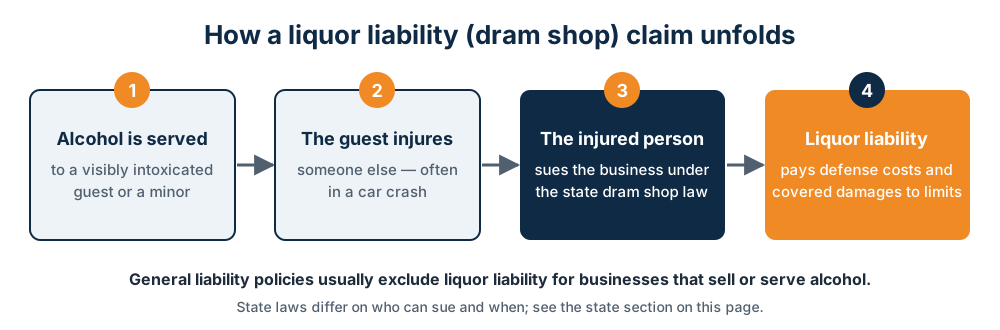
Texas bars, restaurants and breweries that serve alcohol face civil liability under Texas Alcoholic Beverage Code §2.02 when they serve someone so obviously intoxicated that he presents a clear danger to himself and others, and that intoxication causes the harm. State law does not appear to require liquor liability insurance, but landlords, lenders and event organizers usually do, and general liability excludes these claims.
This page is for TABC permit holders, from an Austin live-music bar to a Houston icehouse, a Hill Country brewery or a San Antonio caterer working weddings and quinceañeras. It covers the Dram Shop Act, how the TABC safe harbor works, and how to build coverage around Texas claims. For the statewide view, see restaurant insurance in Texas.
The Texas Dram Shop Act: §2.02 and §2.03
Under §2.02, a provider is liable only if, at the time of service, it was apparent that the person was obviously intoxicated to the extent that he presented a clear danger to himself and others, and the intoxication proximately caused the damages. §2.03 makes Chapter 2 the exclusive cause of action for providing alcohol to someone 18 or older, so a plaintiff can’t sidestep that standard with a general negligence theory. No statutory damage cap was identified. The Texas Alcoholic Beverage Commission (TABC) issues and enforces permits.
The standard is demanding, but these suits are still filed and must still be defended. For most bars, defense costs alone justify the policy.
Social host exposure: the under-18 rule
§2.02(c) makes an adult 21 or older liable for damages proximately caused by the intoxication of a minor under 18 if the adult knowingly served or provided the alcohol, or knowingly allowed it to be served on premises the adult owns or leases. Parents, guardians, spouses and court-appointed custodians are excepted. Outside that rule, no general social-host provision was found. For a business, private events in your space, such as a graduation party in the back room, are the moment to enforce ID checks. See liquor liability vs. host liquor liability.
Does Texas require liquor liability insurance?
We found no statewide statutory requirement in the TABC materials reviewed, and we treat that as unverified rather than settled. The requirement usually comes from landlords, lenders and local event rules: a festival, a city-permitted street event or a venue contract will typically want a certificate naming them as additional insured.
TABC seller-server certification and the §106.14 safe harbor
Server training is voluntary under state law. TABC says there is no requirement to be certified under state law, but many employers require it, and certificates are valid for two years. Under Alcoholic Beverage Code §106.14, an employee’s illegal sale is not attributed to the employer if the employer requires TABC-approved seller-server training, the employee actually attended it, and the employer did not directly or indirectly encourage the violation. That protects the permit from TABC action, and it can also be used as a defense in a civil dram shop suit. TABC also lists conditions such as certifying all alcohol-service staff within 30 days of hire and keeping written policies.
Be precise about what that protects. The Texas Supreme Court has held that the safe harbor is also a defense in civil dram shop suits (20801, Inc. v. Parker, 2008). The business must prove the training requirement and the server’s attendance, and the injured party can still defeat the defense by showing the business directly or indirectly encouraged over-service, which can include evidence of the business’s own negligence. Treat it as a strong defense, not a guarantee. Keep certification current for both the license and a possible defense, and carry liquor liability for the lawsuit itself.
| Question | TABC administrative action | Civil dram shop suit |
|---|---|---|
| Who brings it | TABC | An injured third party |
| What triggers it | An employee’s illegal sale | Injury caused by a guest served while obviously intoxicated |
| Does §106.14 help? | Yes, if the training, attendance and no-encouragement conditions are met | Yes, as a defense the business must prove; the injured party can defeat it by showing the business encouraged over-service |
| What responds | Compliance records, not insurance | Liquor liability policy, subject to its terms |
BYOB in Texas: wet areas, legal hours and fees
TABC allows customers to bring alcohol to businesses without a TABC permit when the location is wet for that type of beverage. Legal consumption hours still apply, and the business may charge a fee. Check your location’s wet or dry status before you advertise BYOB, and remember that a BYOB restaurant can still be pulled into a lawsuit after a guest leaves drunk; see do BYOB restaurants need liquor liability.
Claim scenarios Texas venues run into
- A Houston icehouse keeps serving a stumbling, loud patron who then causes a multi-car wreck on the freeway. The plaintiff builds the clear-danger case from bar tabs and security video.
- A Dallas club’s door staff shove a guest down the entry stairs during an ejection, an assault and battery claim that may sit outside the liquor policy.
- A caterer’s bartender serves a 17-year-old at a wedding reception, creating TABC exposure and possible §2.02(c) claims against the adults involved.
- A Fort Worth sports bar employee sells to a minor during a compliance check. Training records can protect the permit under §106.14 and support a safe-harbor defense in a dram shop suit, but they do not cover other liability.
Where liquor and general liability exclusions leave Texas bars exposed
General liability excludes alcohol-related injury for businesses in the business of selling or serving alcohol, so without a liquor policy a Chapter 2 claim may have no one paying for the defense. Many bar policies also exclude or sublimit assault and battery, and some put defense costs inside the limit. Read the A&B wording line by line; see does liquor liability cover assault claims. A solid Texas program includes:
- Liquor liability — defends and pays Chapter 2 claims.
- Assault and battery — door staff and patio fights.
- General liability — premises and food claims.
- Host liquor — company parties and private buyouts.
- Umbrella — limits above liquor and GL (umbrella vs. excess).
- Workers’ comp — optional for most private employers, but non-subscribers must file notice with DWC and lose key defenses under Labor Code §406.033 (Texas restaurant workers’ comp).
- Property with windstorm — coastal locations may need the Texas Windstorm Insurance Association.
Picking per-occurrence and aggregate limits
The per-occurrence limit caps what the carrier pays for one incident; the aggregate caps the whole policy year. With no statutory damage cap identified, a single freeway crash can test the per-occurrence limit, while a busy club with frequent incidents should watch the aggregate. Venue and landlord contracts often dictate both. See per-occurrence vs. aggregate limits.
Why liquor receipts set your Texas premium
Liquor liability is rated mostly on annual alcohol sales. A Tex-Mex restaurant selling margaritas alongside a full dinner menu rates very differently from a late-night club where drinks are nearly all of revenue. Hours, live music, occupancy, security, TABC violations and prior claims also matter. Requiring TABC certification for every server, scanning IDs and cutting off service before close are the practical levers.
Bars, breweries, caterers and fine dining in Texas
- Bars and nightclubs — the clear-danger standard, crowds and A&B claims.
- Breweries — taproom events and family visitors with minors.
- Caterers — event certificates and mixed-age receptions.
- Fine dining — wine service, private dining rooms and corkage.
One application, multiple carriers
Provident Financial Group is an independent agency, so one application reaches multiple carriers writing liquor liability in Texas, and you compare limits, A&B terms and exclusions side by side. Once bound, you get live certificates of insurance to share with landlords and event organizers. Call (866) 964-6660.
Frequently asked questions
Does TABC certification stop a dram shop lawsuit?
It can help. The §106.14 safe harbor protects the permit from TABC action and, under 20801, Inc. v. Parker (Tex. 2008), can also be a defense in a civil dram shop suit if the business proves it required TABC training, the server attended, and it did not encourage over-service. It is not a guarantee, and defense costs still need liquor liability insurance.
Can a bar be sued for serving someone who wasn’t obviously drunk?
Under §2.02 the plaintiff must show it was apparent the person was obviously intoxicated to the point of being a clear danger, and §2.03 makes Chapter 2 the exclusive remedy for patrons 18 and older.
Is liquor liability insurance required for a TABC permit?
We found no statewide statutory requirement in the TABC materials reviewed; landlords, lenders and event organizers are what usually require it.
Can my restaurant allow BYOB without a TABC permit?
Yes, if the location is wet for that type of beverage. Legal consumption hours still apply, and you may charge a fee.
Do I need workers’ comp for Texas bar staff?
Not by state law for most private employers, but non-subscribers must file notice with the Division of Workers’ Compensation and lose common-law defenses in employee injury suits.
See what you qualify for. Get Multiple Quotes within minutes.
Official Texas sources
- Texas Alcoholic Beverage Code, Chapter 2 (dram shop liability)
- Texas Alcoholic Beverage Code, Chapter 106 (incl. § 106.14 seller-server safe harbor)
- Texas Alcoholic Beverage Commission: seller-server certification FAQ
- Texas Alcoholic Beverage Commission: FAQ
- TABC: mixed beverage permit (MB) for on-premise retailers
State facts on this page are drawn from the statutes and agency pages above. Laws and agency rules change, so confirm current requirements with the agency before relying on them. This page is general information, not legal advice or a coverage opinion.
Related pages
- Bar insurance in Texas
- Brewery insurance in Texas
- Catering insurance in Texas
- Fine dining insurance in Texas
- Texas restaurant insurance
- Restaurant insurance in Houston
- Restaurant insurance in Austin